

5 Rock Songs From The '50s That Were Ahead Of Their Time
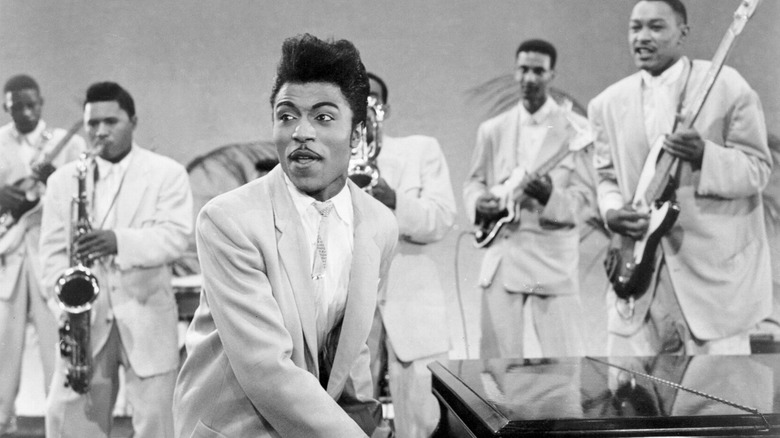
Often, rock 'n' roll is considered a daring genre that produces genuinely groundbreaking work. But when rock was really getting its start back in the 1950s, who were the true innovators? When we say that a song is ahead of its time, it must contain something that people hadn't quite seen before. It may be a guitar riff that had other musicians wishing they'd thought of it first, or a lyrical twist or artistic focus that made a performer stand out like none before. Take Little Richard; while he got plenty of inspiration and mentorship from established performers like Sister Rosetta Tharpe, that arresting onomatopoeia at the beginning of "Tutti Frutti" was all his own. And don't make the mistake of thinking that Ozzy Osbourne somehow invented shock rock in the '70s, as Screamin' Jay Hawkins would have something to say — or is that scream? — about basically doing just that two decades earlier.
It's worth noting that quite a few of the truly groundbreaking artists from the 1950s were often sidelined in favor of big-name acts like Elvis. While we intend no disrespect to the King, who could certainly shock more conservative folks with his hip-wiggling dances back in the day, he wasn't strictly on the rock 'n' roll edge. That frontier is perhaps more fully embodied by artists from oftentimes marginalized groups, including women and musicians of color. Often, it's them we have to thank for rock songs that were truly ahead of their time.
Tutti Frutti — Little Richard
Take a legend of rock 'n' roll, and chances are pretty darn good that they got at least one of their cues from Little Richard. Born Richard Penniman in Macon, Georgia, when he released "Tutti Frutti" in late 1955, it soon became a hit. It was soon recorded by other, more mainstream artists like Elvis and Pat Boone, with milder versions meant to appeal to white kids and their families. But make no mistake: Little Richard absolutely originated this tune, which easily became his most famous song.
Besides the sheer energy of the song, its influences from Little Richard's time performing on the Black "Chitlin' Circuit," and his powerful voice, "Tutti Frutti" has quite the daring edge. At least, it does in its original form, written when Little Richard was a frustrated dishwasher in a Greyhound bus station. Back then, the lyrics intimated some rather close encounters, and perhaps not between a man and a woman, at that — certainly ahead of its time.
Little Richard consented to reworked lyrics that made "Tutti Frutti" ready for a wider audience. And while Boone and Elvis' whitewashed versions may have technically sold better, Little Richard himself said he didn't mind the extra attention and opportunities it brought him. Then again, other accounts say that his follow-up, "Long Tall Sally," was intentionally made fast-paced in an attempt to outwit Boone ... who covered it anyway. Still, there's simply no comparing those covers to the verve, joy, and daring displayed by the utterly unforgettable Little Richard.
Johnny B. Goode — Chuck Berry
There's no way around it: you just can't have rock 'n' roll without the guitar. And you can't sit down to talk about the importance of this instrument without also discussing the rock maestro who not only put the sound of an electric guitar front and center, but wrote and performed a foundational hit all about the glory of playing one really, really well. Oh, and also the track was shot into interstellar space aboard the 1977 Voyager missions, not once but twice. We're talking, of course, about Chuck Berry's 1958 hit, "Johnny B. Goode."
The lyrics to the song might seem unbearably braggadocious if it weren't for Berry's masterful playing. Were people playing the guitar before Berry? Of course. But was anyone playing quite like him? No, not really, at least not to the level of recognition Berry achieved when "Johnny B. Goode" earned the 8th spot on Billboard's Hot 100. And Berry's energetic and joyous guitar playing was something to behold in an era before such riffs were quite so common, along with the fact that he wrote his own lyrics. Even superstar Elvis, who only ever technically earned co-songwriter credits, was jealous. He later confessed that "I just wish I could express my feeling the way Chuck Berry does" (via John Collis' "Chuck Berry: The Biography").
Hound Dog — Big Mama Thornton
You might think that Elvis really made a splash with his 1956 recording of "Hound Dog," but the song has rock roots that go far deeper. Firsthand accounts say that, while performing in Las Vegas, Elvis saw a comedic version performed by Freddy Bell and the Bellboys and was inspired from there. But the real originator was Big Mama Thornton, who first recorded the original "Hound Dog" song in 1952. In fact, the song was written specifically for her by Jerry Lieber and Mike Stoller, at the request of bandleader Johnny Otis. Lieber and Stoller would go on to write other hits, including "Jailhouse Rock" and "Stand By Me," but this time the focus was all on Thornton.
That's for good reason: Thornton's voice and stage presence are indelible, even when heard on a track recorded over 70 years ago. Besides her bold voice, Thornton stands out for proudly singing about her independence and relationships as a Black woman, at a time when these things weren't necessarily celebrated.
As Lieber and Stoller first wrote "Hound Dog," Thornton references a no-good partner who's getting removed from her life. Elvis' version ... is about a literal dog. Hence, the titular hound dog goes from "snoopin' 'round my door" in Thornton's version to "cryin' all the time" in the Elvis track. While his version was obviously popular, you can't help but feel that it lost a lot of sophistication and groundbreaking nature in translation.
I Put a Spell on You — Screamin' Jay Hawkins
Lest you think Ozzy Osbourne or Alice Cooper invented shock rock, take a trip back to 1956, when Screamin' Jay Hawkins cut his hit, "I Put a Spell on You." Hawkins originally wanted to put out a smooth, more conventional track, but he and his fellow musicians partied a little too heartily one evening. A very loosened-up Hawkins recorded the vocals heard on the song today — guttural, unnerving, and striking.
Decades before Ozzy shockingly offed a bat on a Des Moines stage in 1982 (he thought it was a rubber toy, to be fair), Hawkins was freaking people out with his stage presence — and no creatures were harmed in the process. He was initially reluctant to go all-in on the schtick, telling promoter Alan Freed that his idea for Hawkins to emerge from a coffin on stage was nuts. "No black dude gets in a coffin alive — they don't expect to get out!" he said (via Leila Taylor's "Darkly: Black History and America's Gothic Soul").
But Freed's offer of extra cash clearly changed his mind and Hawkins, often decked out in ostentatious clothes and dipping into "witch doctor" stereotypes, soon got typecast. Hawkins wasn't always comfortable with it. "Why can't people take me as a regular singer without making a bogeyman out of me?" he asked (via "Darkly").
Drugstore Rock 'n' Roll — Janis Martin
When you think back on 1950s rock, there is no denying the presence of Elvis. Even when he wasn't literally in the room, his reputation often seemed to loom over other singers. For Janis Martin, it's not that she was among the teeming masses of screaming fans — she wanted to make her own mark. And she did, to the point that publications like Billboard referred to her unofficial designation as the "female Elvis" by 1956. However, Martin achieved far more than just mimicking Presley. Her voice and guitar playing are catchy as heck, as is the fact that she wrote some of her own songs, including another well-performing single, "Drugstore Rock 'n' Roll."
As some have noted, even Elvis didn't write his own stuff, but Martin sure did. Eventually, however, Martin fell victim to an industry that liked to sideline performers who became inconvenient. After marrying her first husband when she was only 15 years old, Martin's record company, RCA, first tried to keep it all hushed up, then simply dropped her when she became pregnant. Martin's second husband demanded that she leave music altogether, which she did for a time before experiencing something of a career resurgence during the rockabilly revival of the 1970s and 1980s.