

The Eagles Dominated The '70s With Ease — These 5 No. 1 Hits Are Proof
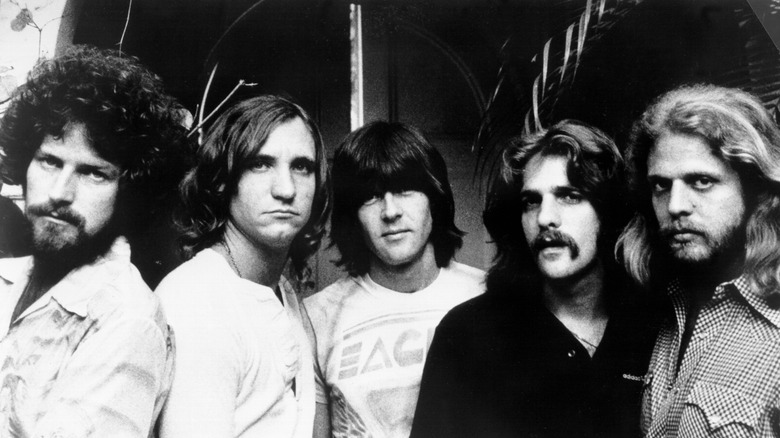
When the Eagles broke up in 1980, the band closed the door on a decade that had seen them transform from brash young upstarts to one of the biggest rock acts on the planet. Blending country and rock with soulful harmonies, the group racked up an enviable string of five No. 1 hits, spanning from 1975 to 1979.
In the decades since then, the band's popularity has continued to endure. It speaks volumes that the Eagles' "Their Greatest Hits 1971-1975" collection, released in 1976, holds the crown as the top-selling album in U.S. music history, the first LP to ever exceed sales of 40 million units.
Of course, the saga of the Eagles didn't end in 1980; the band got back together in 1994 for their "Hell Freezes Over" album and massively lucrative tour. And even after the tragic death of Glenn Frey in 2016, the group remained active, back on the road in 2026 for one last tour before packing it in. Yet it's undeniable that their finest work came decades earlier, when the Eagles dominated the '70s with ease — and these five No. 1 hits are proof.
The Best of My Love
The Eagles experienced meteoric success when the second single from their 1972 self-titled debut, "Witchy Woman," cracked the top 10 (the first, "Take It Easy," came close by peaking at No. 12 on the country charts). It would be a few more years before the Eagles entered the top 10 again — but when they did, they did it with aplomb: "The Best of My Love," from the band's third album, "On the Border," rocketed to No. 1 in 1975, ultimately spending 19 weeks on Billboard's Hot 100.
Representing a shift from the country-tinged sound of their earlier albums, "On the Border" benefited from the recent addition of guitarist Don Felder, who brought a heavier rock feel than OG guitarist Bernie Leadon's country-influenced playing. However, it's also true that "The Best of My Love" was hardly representative of the band's increasingly rock-oriented direction; it was, at its heart, a sweet, slow-paced ballad that never veered out of the adult contemporary/soft rock lane.
For the band, the success of the Don Henley-sung single came as an out-of-the-blue surprise. "We had more or less given up hope for the success of the 'On the Border' album, and we'd begun work on the next album," Henley recalled in a 2016 interview with Rolling Stone. "So, when 'The Best of My Love' took off, it was like a resurrection, a miracle. Totally unexpected."
One of These Nights
Just a few months after landing their first No. 1, the title track from the Eagles' fourth album, "One of These Nights," took the band to the top of the charts a second time. Kicking off with Randy Meisner's loping bass line, the song is a mid-tempo rocker with a solid groove — a far cry from "The Best of My Love." The song was also something of a showcase for Meisner's high vocal range when singing harmony with lead vocalist Don Henley.
According to Henley, releasing the song as a single was a direct response to the unanticipated success of their earlier No. 1 hit. "We wanted to get away from the ballad syndrome with 'One of These Nights.' With Don Felder in the band now, we can really rock. He's made us nastier and done a great guitar solo on the single," Henley told Rolling Stone in a 1975 interview. Glenn Frey concurred, adding that they "wanted 'One of These Nights' to have a lot of teeth, a lot of bite — a nasty track with pretty vocals."
There's a slight disco feel — perhaps because the Eagles had been influenced when recording in the same studio as the Bee Gees — but the track also represented a calculated quest for further hits. "Glenn and I now wanted to take advantage of the momentum we had going; we wanted to write more songs that would be played on the radio," Henley recalled for Rolling Stone in 2016.
New Kid in Town
"New Kid in Town" was the first single to be released from "Hotel California," the band's fifth album — and the first to feature Joe Walsh. Released in late 1976, the song hit No. 1 the following February. Co-written by Glenn Frey, Don Henley and frequent songwriting collaborator J.D. Souther, "New Kid in Town" showcases Frey — marking the first time an Eagles track with Frey's lead vocals hit the top spot in the charts.
As Don Henley recalled in the liner notes of the Eagles' greatest hits package "The Very Best Of," there was more to the song than met the ear. "It's about the fleeting, fickle nature of love and romance," he said, while also pointing to a deeper meaning. "It's also about the fleeting nature of fame, especially in the music business. We were basically saying, 'Look, we know we're red hot right now but we also know that somebody's going to come along and replace us — both in music and in love."
While there were rumors at the time that the titular new kid was Bruce Springsteen, Souther insisted the song's inspiration wasn't so specific. Using the analogy of an Old West gunfighter, Souther said the lyrics referred to the fresh crop of up-and-coming rockers vying to usurp the Eagles' throne. "We were approaching 30 and could see that the rear-view mirror was full of newcomers as hungry as we had been," Souther told Rolling Stone.
Hotel California
If there's one song that defines the Eagles, it's undeniably "Hotel California." Not only did the album prove to be the band's magnum opus, the title track — the second single from the album — hit No. 1.
The song originated from the unmistakable Don Felder guitar pattern that opens the song. Recognizing the potential upon hearing Felder's demo, Don Henley took it from there, writing the bulk of the cryptic lyrics. As Henley told Rolling Stone in 2016, "Hotel California" is the one song of which he's most proud. "Those lyrics employ what Glenn [Frey] used to call 'the perfect ambiguity,' and are open to a wide array of interpretations — and we've seen some doozies," he said of the varied theories on the hidden meaning of the Eagles' "Hotel California." "But the song has somehow resonated all around the globe ..."
Clocking in at six-and-a-half minutes, "Hotel California" is on the long side for a No. 1 single. It also boasts what is arguably one of rock's most iconic guitar solos, two stunning minutes of virtuoso interplay between Felder and Joe Walsh that has become one of five killer guitar solos imprinted on true classic rock fans for life. The solo wasn't something the two guitarists tossed off in one take, but the end result of meticulous perfectionism. "I have to give them props," Henley told Rolling Stone. "They wrote those solos, worked over those harmony parts for days, then played them over and over again."
Heartache Tonight
The Eagles closed out the 1970s with the final No. 1 hit of their career, the 1979 single "Heartache Tonight." The album from which it came, "The Long Run," had been aptly titled. "'The Long Run' was not as good as 'Hotel California,' and it was an excruciatingly painful album to make," Don Henley observed for Classic Rock magazine. "That record took three years and cost $800,000, and we burned out." Yet despite the challenges, "Heartache Tonight" — the first single released — earned the Eagles their fifth and final chart-topper.
With its shuffling rhythm and percussive handclaps, the country-rock feel of "Heartache Tonight" was something of a callback to the Eagles' early material. The song was written by Henley, Glenn Frey, and J.D. Souther, with the assistance of an unexpected ally: rocker Bob Seger, who'd been on his own run of chart success at that time.
As Souther told Rolling Stone, he and Frey had come up with the song's basic structure, but struggled with the chorus until Frey sought advice from Seger, who'd been a musical mentor when they were coming up in the Detroit rock scene. "Glenn played it for Seger, and he wrote the chorus," Souther recalled. Once Seger's contribution was in place, the band just chiseled away at the song until it sounded like a hit. "The only thing predictable was that we would stay at it until it was right," Souther observed.