

Every Music Lover Had One In The '60s — And It Deserves A Comeback
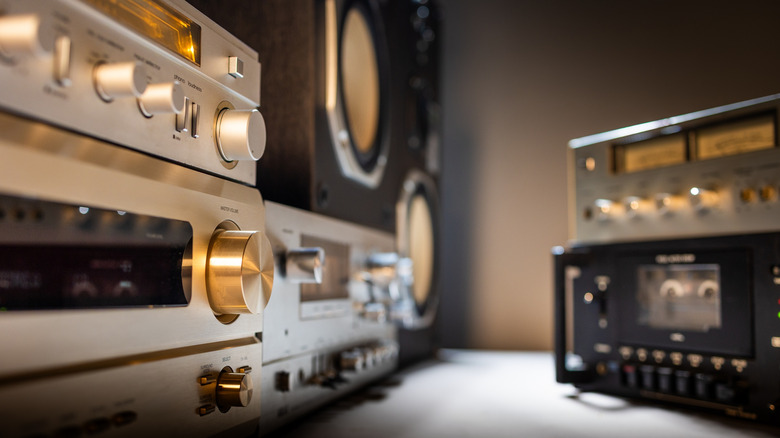
In the 1960s, the hi-fi home stereo sat at the center of home life. It encouraged people to listen more closely to music, which in turn encouraged technology that better captured recording quality. And while it's incredibly easy nowadays to pull out your phone and absent-mindedly listen to music with whatever crummy earphones you've got, we think the older method deserves a comeback.
The home hi-fi revolution — and the marketing term "hi-fi" (high fidelity) — began in 1954 with the Yamaha Hi-Fi player, just a few years after 7-inch records first became popular. No matter the sound quality, this was still a mono system, however. It took until 1958 for the first stereo system to hit the market, with a more spatially immersive sound coming from multiple speakers. At that point, hi-fi systems and all of their various technological components were largely the province of well-heeled enthusiasts. It wasn't long, though, before non-audiophiles started scooping up hi-fi stereo systems because they loved music, not because they cared about gadgets. This is what kicked off the golden age of the home stereo, the '60s through '70s, when the home hi-fi system became an essential, but still luxury-leaning, home good.
Most importantly, the home hi-fi stereo encouraged folks to actually sit and listen to vinyls, not just click on a random playlist and let it buzz in the background. This is the true benefit of a home hi-fi system: It encourages a love of music, which we think can't help but make life better.
Bringing back an appreciation for music
Boomers who lived through the '60s can be instantly brought to their childhoods and the family stereo with a single listen to a song from that period. A stereo system was often the prominent set piece of the house, and listening parties, when friends were invited over to hang out and listen to a new album, were a huge deal. Indeed, hi-fi systems epitomized the music-listening experience of the era, but like many popular things from the 1960s that have since been left behind, times have changed, and in this case, not necessarily for the better.
Listening to music is an extremely different experience in the 21st century. As of mid-2026, almost three-quarters of the world listens to music through streaming services (Spotify accounting for almost a third, as reported by SQ Magazine), while a mere 9% still listen through physical media. Plenty of folks still use speakers and home entertainment systems, but the hi-fi market remains relatively small and has reverted to audiophiles. This is all incredibly ironic for a time more than half a century after the '60s hi-fi boom, when we've sacrificed quality for quantity and communally minded listening for scattered, solo experiences. Sometimes, it seems like everyone is living in their own bubbled musical worlds with their earphones stuck in their ears.
Of course, modern hi-fi stereo systems can get pretty pricey, and it's just too tempting (and affordable) to go with some cheap, throwaway Amazon-recommended product. But for those who really want to dig into their music and recapture a bit of the past — whether they lived through it or not — a nice, hi-fi home system might be the way to go, with bonus points for vinyl players.