

5 Rock Musicians Who Experimented With '70s Country — And Nailed It
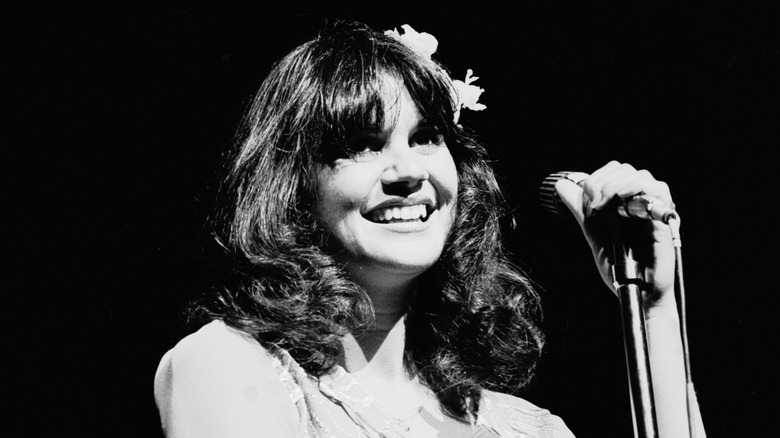
On the heels of the explosion of psychedelic, folk, and roots rock in the late '60s, the 1970s saw country influences trickle into rock music and take over. Like Bob Dylan, who hired Nashville pros to play on albums like "Nashville Skyline" in the late '60s, rock musicians in the '70s mined country sounds and songwriting and found gold.
The twang, harmonies, storytelling, and drawl these musicians took up yielded groundbreaking albums and iconic sounds. Not only did going country help Jerry Garcia and the Grateful Dead gain wider audiences, it also pushed the legendary band to produce perhaps its finest studio work. And on the rock, pop, and country charts, the 1970s also saw the emergence of Linda Ronstadt, whose rock and country balancing act made her a megastar. This blending of genres gave us not just country rock, but everything after, from soft rock, alt-country, heartland rock, and Americana to megastars like Taylor Swift.
Here, we've rounded up five rock musicians whose experiments with the Nashville influences opened new sonic byways, indelibly impacting American music. Of course, rock and country are close cousins, and rockabilly from the likes of Johnny Cash had already blended country and early rock 'n' roll in the '50s. Therefore, we kept our choices to those who either broke out with their country-rock blend in the '70s, such as Glenn Frey, or like Neil Young and Garcia, nailed the switch in that decade. However it transpired, something extra special happened when '70s rockers took the country route.
Neil Young
You can't talk about country's influence on rock without bringing up Neil Young's 1972 album "Harvest." Sure, there's a little twang in his work with Buffalo Springfield, Crosby, Stills, Nash & Young, and on early solo albums, but the early '70s saw the Canadian singer-songwriter truly lean into the genre. Featuring Linda Ronstadt on backing vocals, the album's hit single "Heart of Gold" soared to No. 1 on the Billboard Hot 100 in 1972, bringing country rock to the masses. On it and the rest of the album, you can hear how Nashville influences pushed his sound and songwriting.
"Harvest" features (mostly) acoustic guitar because recovery from back surgery made playing electric impossible for Young, but what gave the album its country pedigree was the Stray Gators, the backing band assembled for the sessions in Nashville. It featured musicians who'd cut their teeth in town, including drummer Kenny Buttrey (who played in Bob Dylan's "Nashville Skyline"), Ben Keith on pedal steel guitar, and bassist Tim Drummond. Their contributions make songs like "Are You Ready for the Country?" especially bleak, with mournful slide guitar underscoring lines about death and salvation.
Young had a love-hate relationship with the album, telling the Los Angeles Times in 2022, "I made 'Harvest' ... Then we moved on. Gotta get away from that. That's not where I want to be." But there's no denying that the synergy between country influences and his songwriting led to some of his finest and most impactful work.
Linda Ronstadt
Linda Ronstadt is known as the "Queen of Country-Rock" for a reason. Or at least 10, by which we mean the number of her Top 10 Billboard 200 albums, including her seminal 1974 album "Heart Like a Wheel." Raised on country, early rock 'n' roll, and both Mexican and American folk music in Tucson, Arizona, Ronstadt got her start playing folk rock with the Stone Poneys. However, after splitting with the group in 1968, she took a decidedly more country direction. With her 1969 debut solo album "Hand Sown...Home Grown" — recorded with a backing band that would become the Eagles — she set the template for country rock, and the 1970s saw her become well-loved in pop, rock, and country circles.
Few have been as successful at bridging these musical styles as Ronstadt. Her solo work is country enough to be considered country (among her accolades is a Grammy for best female country rock vocal performance), rock enough to be considered rock, and pop enough to play everywhere. That unique mixture paid dividends on "Heart Like a Wheel," her commercial breakthrough and the first of three No. 1 albums she'd release in the '70s. The title track, penned by folk singer Anna McGarrigle, takes a stripped-down piano and fiddle arrangement and spins it into gold. Hearing the song for the first time, Ronstadt recalled in "Simple Dreams," her 2014 autobiography (via the Library of Congress), "It felt like a bomb had exploded in my head ... It rearranged my entire musical landscape." By proving how well country twang could ride with rock 'n' roll, she charted new territory.
Jerry Garcia
The Grateful Dead's early '70s country sound was part of its ever-evolving trip. As the late '60s countercultural wave it had soundtracked descended from the idealism of 1967's wild Summer of Love to the violence of the festival at Altamont Speedway in 1969, lead guitarist Jerry Garcia and the band were at a crossroads. Setting aside its heavy psychedelic rock experimentation, the Grateful Dead entered the new decade with 1970's "Workingman's Dead" and follow-up "American Beauty." These albums incorporate sweet vocal harmonies, slide guitar, banjos, mandolins, strings, and a down-home register. The Grateful Dead had gone country, and Garcia and lyricist Robert Hunter's songwriting flourished.
Studio work always played second fiddle to the band's live shows, and the shift to a more accessible, country sound must've blown some Dead Heads' minds. But since early experimental albums like "Aoxomoxoa" were expensive and time-consuming to make, the plan was to get back to basics. "So I thought, what I'm gonna do is write some songs that are so f***in' simple, man, and so easy for everybody to understand that we'll do 'em in the studio in about a minute," Garcia remarked to Warner Bros. studio executive Joe Smith in 1988 (via Far Out).
From this approach came some Grateful Dead classics, including "Friend of the Devil" from "American Beauty." With lyrics like "Set out runnin' but I take my time / A friend of the devil is a friend of mine," it's an outlaw narrative straight out of Johnny Cash's playbook. Country music became part of Garcia and the band's legendary trip; indeed, it kept them truckin'.
Glenn Frey
Even though he hailed from Detroit, the Eagles' Glenn Frey deserves as much credit as anyone for bringing country twang to rock 'n' roll. After all, that blend of genres was instrumental to the sound that let the Eagles soar. In the early '70s, Frey and eventual bandmate drummer Don Henley formed the core of Linda Ronstadt's backing band on "Hand Sown...Home Grown." The original Eagles line-up also included other veterans of her band over the years, including ex-Flying Burrito Brothers guitarist Bernie Leadon and bassist Randy Meisner.
"Take It Easy," the Eagles' breakthrough hit off their 1972 self-titled debut, pairs lush Beach Boys-like harmonies with country twang, slide guitar, and some serious banjo pickin'. That song, which Frey co-wrote with friend and neighbor Jackson Browne, put the Eagles on the map, reaching No. 12 on the Billboard Hot 100. That blend of country and rock blossomed, and by the time it broke up at the end of the decade, the band had five No. 1 singles under their belts.
But the country influences that pervaded the band's early '70s albums dominated 1973's follow-up, "Desperado." The lead single "Tequila Sunrise" is a heartsick ballad that goes full country and western, becoming a pitch-perfect distillation of the country-inflected rock coming out of LA at the time. Glenn Frey will forever be associated with the Southern California sound, but country music is part of his and the Eagles' musical DNA.
Gram Parsons
Gram Parsons never sold as many records as Linda Ronstadt or the Eagles, and his tragedy-filled life was cut short at just 26, but his influence on country rock is undeniable. Raised in Georgia, Parsons arrived in Laurel Canyon, California, in 1967 and was picked to take over for David Crosby in the Byrds soon after. He pushed the psychedelic stalwarts into country territory, even getting them to record in Nashville instead of LA. The 1968 album they produced, "Sweetheart of the Rodeo," released before Bob Dylan's "Nashville Skyline," basically set the country rock thing in motion.
But wild behavior and frequent intoxication led to Parsons being fired both from the Byrds and the band he co-founded afterward, the Flying Burrito Brothers. In the early '70s, Parsons teamed up with singer Emmylou Harris to record his solo debut record, "GP," and the 1974 follow-up "Grievous Angel." The latter's lush harmonies, melancholy lyrics, and luscious arrangements are everything you'd want in a country rock record. "In My Hour of Darkness," the final track, finds Parsons seeking salvation: "But he was just a country boy / His simple songs confess / And the music he had in him / So very few possess." Released after his death, the album continues to haunt us as a country rock gem.