

5 Simon & Garfunkel Hits That Prove They Were The Ultimate Duo Of The '60s
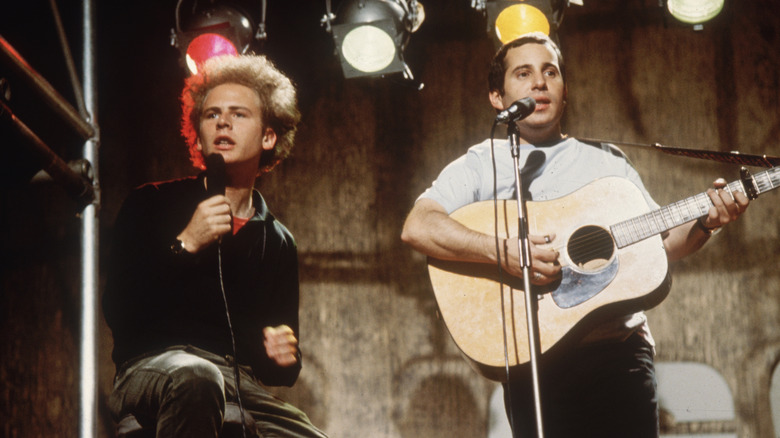
Paul Simon and Art Garfunkel brought supreme successes to folk and folk rock music during their prime as a duo. Their stacked catalogue of unforgettable tracks proves they just about lapped every other pair in their heyday since Simon & Garfunkel got their start in the '50s. The pair's 1970 album and likely magnum opus, "Bridge Over Troubled Water," included "The Only Living Boy in New York" and the LP's titular song, which topped the charts for six weeks in 1970. Then, there's the duo's breakout mid-'60s hit and first No. 1, "The Sound of Silence." Yet even looking past those, there are still enough hits that fully make clear the dominance of Simon & Garfunkel throughout the 1960s.
In this list, we'll look back to some of Simon & Garfunkel's best hits. These songs didn't totally define each musician's career by themselves, but they were all essential pieces in establishing them as the household names they are today. Whether you're looking for songs from their early years and their 1966 breakout, the hits leading up to their 1970 takeover, or anywhere in between, these are five of Simon & Garfunkel's best tracks — a lineup that sets them far apart from any other duo of the '60s.
The Boxer
"I am just a poor boy, though my story's seldom told." This iconic opening kicks off "The Boxer," arguably Simon & Garfunkel's best track and a folk masterpiece. Telling a haunting but hopeful story of a boy who becomes a boxer, the song is nearly magical in its serene melodies and ambient feel. Released in March '69, "The Boxer" was another definite success for the duo, peaking at seventh and remaining on the charts for 10 weeks. It was eventually included on "Bridge Over Troubled Water" in 1970.
The song itself represents much of the very best of what the duo was capable of. In songwriting alone, it's one of Paul Simon's best, and time has agreed, with the track being covered by dozens of artists, from Bob Dylan and Emmylou Harris to Mumford & Sons. It paints a uniquely human portrait of its subject, rife with emotion and an inherent nostalgia. The sound, though, didn't come easy — the track took over 100 hours to record. Still, the final result was well worth it, as its pretty acoustics and vocals, and even the ridiculous bass harmonica, all slot perfectly together for an iconic recording. It may not be the duo's biggest hit, but "The Boxer" is arguably the highest creative peak of their partnership.
Mrs. Robinson
"Mrs. Robinson" is Simon & Garfunkel's only other No. 1 hit aside from "Bridge Over Troubled Water" and "The Sound of Silence." The song held the top spot on the Billboard Hot 100 for three weeks in 1968, and it's among the most essential of Simon & Garfunkel's tracks even today. With over 780 million streams on Spotify alone, it's the highest-streamed track of their discography. Released in spring of '68, the song was originally included in the film "The Graduate" before being included on the album "Bookends."
"Mrs. Robinson" finds the pair at their most folk rock, with a catchy, almost campfire tune revolving around falsetto vocals, groovy acoustic guitars, and a singalong chorus: "And here's to you, Mrs. Robinson / Jesus loves you more than you will know / Woah, woah, woah." The song has also been remembered for its reference to a legendary ballplayer: "Where have you gone, Joe DiMaggio? / A nation turns its lonely eyes to you ... Joltin' Joe has left and gone away." As reported by The New York Times, Simon later likened the athlete to the truest of American heroes, which he said then "were in short supply." Though "Mrs. Robinson" is foremost an enjoyable No. 1 hit, it's also a unique reflection of its era's culture — a songwriting practice Simon was one of the best at.
Homeward Bound
"Homeward Bound," the follow-up single to the smash hit "The Sound of Silence," is one of six top-five hits for Simon & Garfunkel and spent 12 weeks on the charts in the U.S. during 1966. The track was also part of their '66 album "Parsley, Sage, Rosemary and Thyme," the fourth standout record featured on this list, proving that the duo generated hits consistently and without fail during the '60s.
The simultaneously melancholy and uplifting nature of "Homeward Bound" features an excellent back and forth between the two singers, whose voices twirl around each other throughout the tune's short runtime. The chorus especially is where this shines: "Home, where my thought's escaping / Home, where my music's playing / Home, where my love lies waiting / Silently for me." The effortlessness with which their melodies pair is proof alone that no other duo could do it like them, and the standout quality of the rest of the song only furthers the separation. Written about the universal feeling of homesickness, Simon & Garfunkel balance a perfect blend of personal storytelling with this overall theme, and the listener feels right there with Simon on the lonely trains and tour stops, longing for home.
Scarborough Fair / Canticle
The only song on this list not written by Paul Simon and Art Garfunkel, "Scarborough Fair / Canticle" was still a success, proving the duo's versatility despite the composition type. It charted all the way up to 11th in 1968 and joined "Homeward Bound" on "Parsley, Sage, Rosemary and Thyme." Some lyrics may be familiar — "Remember me to one who lives there / She once was a true love of mine" — because they're notably shared with Bob Dylan's slightly earlier "Girl from the North Country." The reason being that "Scarborough Fair" is a classic folk ballad dating back hundreds of years.
These classic lyrics were paired with some lyrics of Simon's own, though, which weave in a beautiful harmonic back and forth between the duo, recontextualizing the classic tune. It's an ethereal listen, with Garfunkel's uniquely beautiful voice and classic folk instrumentation making the song feel as old and timeless as its original inspiration. Even old folk ballads could chart for the iconic duo, further proof nearly everything they touched turned to gold. It didn't matter if they were fresh sounds or classic ones — the power of Simon & Garfunkel couldn't help but shine through for critics and fans alike.
I Am a Rock
Released in 1966 on the album "Sounds of Silence," "I Am a Rock" is another folk-rock masterpiece from the duo. It starts slow with some pensive vocals from Simon and immediately builds into a more upbeat pop song that mixes the best of folk rock with chart-friendly catchiness, a style the duo helped bring into the spotlight. The song's most recognizable piece is its short but sweet refrain: "I am a rock / I am an island." The section most prominently features Simon's vocals, with Garfunkel's in a background melody, and it's here where the music swells to its most satisfying.
"I Am a Rock" soared all the way to third on the Hot 100 in June 1966 and spent 11 weeks in total on the charts, no doubt thanks to its catchy hook. Still, the song may be at its best in its verses, which flesh out the repeated proclamation with detail, eventually building to a melancholy outro: "And a rock feels no pain / And an island never cries." These lines twist the rest of the song's mantra back in irony and melancholy. It's a song that balances complex and circular songwriting with an undeniable tune, the balance of which is essential to the success of Simon & Garfunkel — and proof there just wasn't another duo who could reach any similar heights, both in quality and commercial success.