

5 David Allan Coe Outlaw Country Lyrics That Shred As Hard As Classic Rock
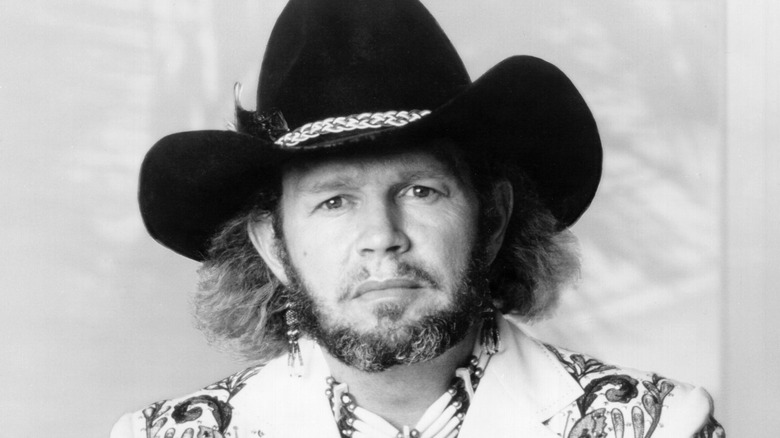
In the song "Willie, Waylon, and Me," David Allan Coe declares that, like the legends named in the title, he lived and breathed the outlaw country sound. And what always made the singer truly stand out — even among these giants — were his often cutting and sharp but always colorful lyrics. Give' em a listen, and you hear that they shred every bit as hard as anything devised by classic rockers. The bad boys of outlaw country live up to both the tough-as-nails image Coe promoted and the hardscrabble man behind it; Ozzy Osbourne, Keith Richards, and Axl Rose must have taken notes.
You don't have to believe everything Coe sings — in the aforementioned tune, the Akron, Ohio-native declares he's from Dallas — but his stamp on that brand of music is undeniable. When he passed away on April 29, 2026, country music lost one of its most brilliant, if controversial, figures. Though Coe scored a few mainstream hits as a songwriter, such as "Take This Job and Shove It" (sung by Johnny Paycheck), he never got the notoriety of his outlaw peers. Still, he carved out a space for his fierce, unapologetic brand of outlaw country, even though he went too far for many sometimes with racist, misogynistic, and homophobic lyrics.
Still, Coe's dark and colorful lyrics in songs like "Longhaired Redneck," "Laid Back and Wasted," and "Time Off for Bad Behavior" establish him as one of the genre's darkest and baddest. These tales of drinking, hard living, and run-ins with the law could be backed by stacks of buzzing amps and distorted guitars. Instead, they're country gold. Not bad for a cowboy from Ohio.
Longhaired Redneck
Long, flowy hair is in the DNA of both outlaw country and classic rock, signaling its lifeblood: rebellion and countercultural cache. Classic post-hippie anthem "Almost Cut My Hair" by Crosby, Stills, Nash, and Young hinges on that image: losing the locks stands in for selling out to mainstream culture and society. The 1970s long hair movement in country music spearheaded by folks like Willie Nelson is central to David Allan Coe's fiery classic "Longhaired Redneck," which depicts the wild, colorful life of a travelling country musician. Lifting details from his own life, including his time incarcerated in Ohio for petty theft and other charges, it's about as outlaw as a country anthem can get.
What makes this song especially hard is the swagger of the narrator, who seems ready to throw fists at the drop of a hat. "The loud mouth in the corner's getting to me / Talking 'bout my earrings and my hair," goes the second verse, "I guess he ain't read the signs that say that I been to prison." It's narrated from the corner seat of a honky tonk dive bar, "Where bikers stare at cowboys, who are laughing at the hippies / Who are praying they'll get out here alive." The title track of Coe's 1976 "Longhaired Redneck" album is a whiskey-soaked country jukebox staple. But if they're singing along to it where you're at, you might want to watch your back.
Piece of Wood and Steel
From David Allan Coe's seminal 1975 album "Once Upon a Rhyme," "Piece of Wood and Steel" is an ode to the core of blues, rock, and country: the guitar. The cause of and solution to all the narrator's problems, the instrument has had about as tough a road as its owner. "Its face is scarred and beaten / Like the ragged clothes I wear," Coe sings, "Like the body that God gave me / I might give it better care." All the hard-living outlaw narrator needs, "In a world that's full of trouble / A world that's full of pain" with "Many more are bending low / or broken at the wheel," is his trusty six-string.
"Piece of Wood and Steel" plays with the image of the crossroads: the core mythology behind the blues (and by extension rock, country, folk, and countless other American styles of music). The legend is that Robert Johnson sold his soul to the devil at the crossroads (said to be an intersection of country roads in Mississippi) to become the world's greatest guitarist. But in Coe's telling, "... I often met the devil / But I never made a deal." This isn't the only time that Satan appears in his songs. But there's something extra badass about Coe turning the devil down; there's nothing he could learn from the fallen angel. We suspect that Jimmy Page would've signed his name.
Suicide
With a title like "Suicide," you just know this David Allan Coe number is going to plum some depths. The last track off his 1978 album "Human Emotions," the song tells the story of a man who has just murdered his wife and her lover, who was a trusted friend. In the vein of classic rock staples like "Hey Joe" (made legendary by Jimi Hendrix) or Neil Young's "Down by the River," the song is a murder ballad: a tale of romantic betrayal leading to bloody consequences and (often) a run from the law. Of course, country music has produced many, from Lefty Frizzell's chilling and mournful "Long Black Veil" to Carrie Underwood's "Two Black Cadillacs."
In Coe's addition to the genre, the story starts with the gun loaded, pointed, and firing as the narrator finds his love cheating in their bed. "She called out my name just before she died / She swore she loved me and I almost cried," the narrator laments. Of course, with "Blood splattered all over the wall" and "The gun still smoking as I watch it fall," he's now on the run from heartbreak, anguished emotions, the law, and even their infant child. What makes "Suicide" go so hard is that, like other murder ballads, it creates an antihero; you end up sympathizing with the murderer and rooting for his escape. That's pretty heavy.
Laid Back and Wasted
"Laid Back and Wasted" has a waltz-like groove, and David Allan Coe's singing is warm and tender. But the moment you take in the lyrics — well, and the title — you realize what's really happening. The song, off the classic 1977 album "Rides Again," depicts and celebrates the hard-drinking, hard-living lifestyle of the drifting rebel. It's a biker anthem, and it tracks that Coe was a member of the Outlaws Motorcycle Club. As on the "Rides Again" album cover, he was known to ride his hog onto the stage.
It's the gritty imagery in "Laid Back and Wasted" that makes the tune stand up to the hardest of rock anthems. "Ten thousand miles / Of road dust can't cover / The scars that I put on my arm" kicks off the third verse, making the wear and tear of the biker lifestyle clear. But perhaps the hardest lines in the tune come in the next verse, which lay everything bare: "Dying looks easy / Drifting gets harder / I don't know which one I'd choose." The song's got booze, broken hearts, blues, and a soul that ends up sold in New Mexico. Coe was known to exaggerate — spinning yarns and crafting a hard persona in songs and interviews — but you can tell he's singing from an authentic space. It's as rock 'n' roll as anything, but it's 100% his brand of country.
Need A Little Time Off For Bad Behavior
"Need a Little Time Off for Bad Behavior" has everything you'd need from a fiery outlaw country staple. You got your bottles of Jim Beam, good old boys that want to go fishing, and a "pretty little strawberry blonde with a Southern drawl" all tempting the narrator, who's bored both at work and home. In the vein of "Take This Job and Shove It," David Allan Coe's lyrics make it plain that the straight world with its rules is no place for a self-respecting country singer and motorcycle riding rebel. Every bit as urgent as classic rock songs like Twisted Sister's "We're Not Gonna Take It" or Bachman Turner Overdrive's "Takin' Care of Business," it's a clocking-out-of-work-and-going-out anthem that revels in freedom.
Another cut off his "A Matter of Life and Death" album, "Need a Little Time Off for Bad Behavior," Coe's gift for clever turns of phrase is on full display. In his telling, work and even marriage become a kind of prison, with the heaviest chains being the need to please the boss or partner. "I've been sayin' 'Yes sir' all day at work / I've been sayin' 'Yes, ma'am' at home," Coe sings, before upping the ante, "I've been storin' up the cuss words, keepin' 'em under my tongue." During a live performance in 2002, Coe told the audience at Billy Bob's Texas, "I think this is one of the coolest lines I ever wrote in my life" (via YouTube). If we've learned anything about Coe, it's that he never bit his tongue.