

We Bet You've Never Heard These Underrated INXS Songs
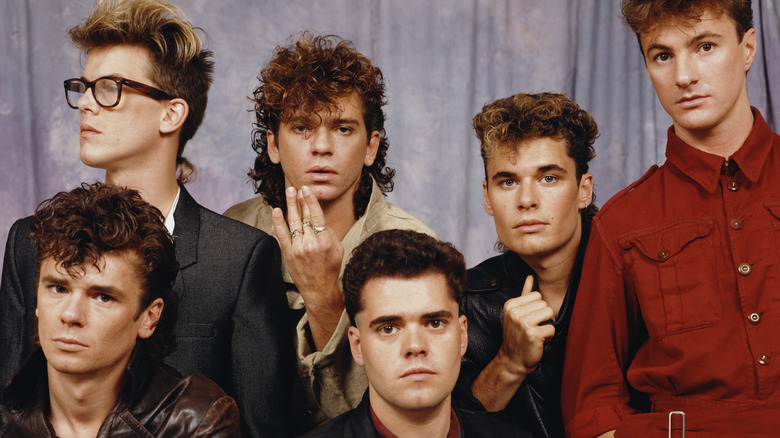
INXS began as an Australian bar band in the late 1970s and rose to become a huge international rock act less than a decade later with its smash hit album "Kick" from 1987. You're probably familiar with songs from that album like "Never Tear Us Apart," "Need You Tonight," and "Devil Inside" — which sounds even cooler today — since they were all top 10 hits in the U.S. But we're betting you may not have heard some of INXS' deep cuts that were never released as A-side singles.
Brothers Andrew, Jon, and Tim Farriss (keyboards, drums, and guitar, respectively), bassist Garry Gary Beers, Kirk Pengilly on sax, and singer Michael Hutchence started the band in Sydney, Australia, in 1977. INXS released a string of hits in the '80s and '90s before the tragic death of Hutchence in 1997 that eventually led to the break-up of the band in 2012.
Even if you're familiar with the band's earlier albums, such as "The Swing" and "Shabooh Shoobah," there may be some underrated INXS songs you don't know. We've included deep cuts like "In Vain" off the band's first self-titled album from 1980 and oddities such as "Phantim of the Opera," which only appeared as a B-side in 1982, among our list of INXS songs that deserve another listen.
Johnson's Aeroplane
"Johnson's Aeroplane" from INXS' 1984 album "The Swing" may be one of the most unusual of the band's songs, both lyrically and musically. The track begins with strings before a bouncing groove enters and Michael Hutchence begins his tale of an airplane pilot cloud-seeding in the hopes of bringing relief to drought-stricken farmers. Besides the use of strings, there's Kirk Pengilly's gorgeous sax solo, brief moments of grinding guitar, and the haunting refrain "Heart-shaped hedges, Japanese gardens" that puts the listener in the pilot's seat looking at the land below.
What differentiates the song lyrically from much of INXS' other songs is a cohesive narrative that is far removed from the band's typical subject matter. "Johnson's Aeroplane" digs into the plight of farmers struggling to survive — "The animals are thin and the pastures dry" — who have pinned their hopes on Johnson and his plane. Musically, the song has an eerie, otherworldly feel that's multi-layered, including the vocals. The band members sing "ah, ah, ah, ah" in unison in the background at various points in the song and then join Hutchence in close harmony on the bridge. "Johnson's Aeroplane" is a gorgeous song and one of INXS' most underrated.
In Vain
"In Vain," from INXS' 1980 debut album, has a rawer sound than the band's output from the late '80s and early '90s. It combines pub rock with elements of new wave for a layered sound that jumps out of the speakers to stop you in your tracks. "In Vain" begins with a slow synth opening before piano and gritty, Rolling Stones-style eclectic guitar enter to change the tenor of this tune. Michael Hutchence's fast and bouncy singing style is yet one more element that elevates this song, about the frustration of finding real love, to another level.
One of the most distinctive parts of "In Vain" is its bridge, with the music dropping down to a murmur to allow Hutchence to give a slower, nearly a cappella, delivery as he sings about looking inward to the "heaven" within oneself for happiness rather than the outside world. He ends the bridge with a raucous bellow on the lyric "confusion" that brings chills. The song beautifully illustrates the band's ability to combine unusual elements to produce something striking that sounds brand new even more than 40 years on.
Golden Playpen
From drummer Jon Farriss' drumstick count-off to Kirk Pengilly's soaring saxophone that ends "Golden Playpen," from the band's 1982 album "Shabooh Shoobah," this song perfectly captures the ins and outs of nightlife. Its jangly electric guitar plays off Michael Hutchence's sneering delivery that begins with "I'm drunk can't see my glass / Not worried — chair dancing man." The lyrics describe a drunken night of bar-hopping, looking for love (possibly after a bad breakup), and, in the end, being "Tossed out of the golden playpen / Beating the drum of pain and pleasure."
"Golden Playpen" is another incredibly tight song in which all six members of INXS are in complete sync, each adding to the whole while remaining distinctive in their performances. The song's pace is set by Garry Gary Beers' driving bass that helps propel the song ever forward toward dawn, an empty wallet, and the eventual hangover. Pengilly (who co-wrote the song with Hutchence) takes center stage, with his saxophone as a melodic counterpoint to the song's frenetic energy.
Barbarian
"Barbarian," from INXS' second studio album, 1981's "Underneath the Colours," has the band tapping into post-punk for a heavy tune with a fat bass line, snaking electric guitar, and a repeating synth line that sounds like a European police siren during the choruses. Musically, it's one of the band's darker and more aggressive songs — a tonal departure that sets it apart not only from the rest of the album, but from much of INXS' other work. Drummer Jon Farriss is a standout on this track and adds some unusual flourishes to this fast-paced tune.
Lyrically, the song seems to be about the artist as shaman ("He makes drawings / Turns them into real things / Simple paintings / On caves long ago") who is separated from the rest of society ("Barbarian, he's lonely / He's the only one"). This is then contrasted with modern society, which has killed off art's magical capabilities ("A lot of people / Bent on the future / Set up the countries / Closing all the doors"). The song is one of INXS' more unusual offerings and deserves a place among the band's better-known work.
Phantim of the Opera
"Phantim of the Opera" may be one of the strangest tunes INXS ever released. Written by guitarist Tim Farriss — the spelling of phantom with an "i" is a nod to Tim — this goth-rock instrumental track predates Andrew Lloyd Webber's smash musical by several years and includes dialogue from the 1962 Hammer film version of "Phantom of the Opera." With eerie touches such as operatic singing, it makes for a spine-tingling listen. It's strange and beautiful and mysterious. The song only appeared in the U.S. as a B-side to "The One Thing" from the 1982 album "Shabooh Shoobah."
Long before the tragic death of Michael Hutchence and, later, the unfortunate reality show that brought J.D. Fortune into the group, the original members of INXS incorporated a unique blend of styles to produce unforgettable music that has stood the test of time. And while INXS' biggest hits merit the acclaim they've received, the rest of the band's rich catalog deserves attention as well — not just the five songs we've highlighted, but many more.