

The 5 Best Cat Stevens Songs That Aren't Wild World
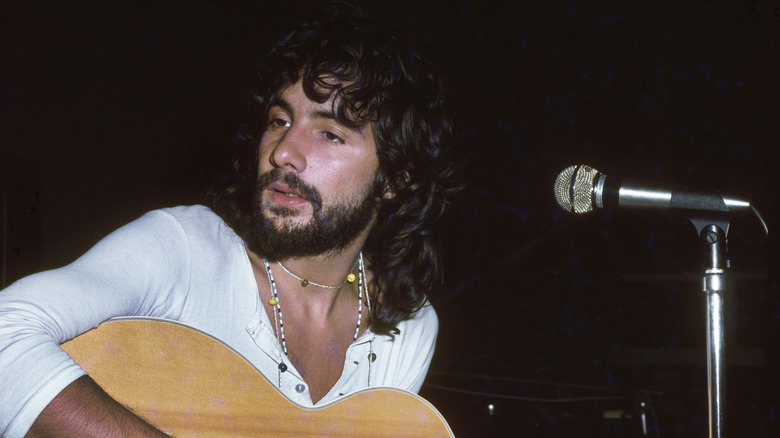
While "Wild World" may be Cat Stevens best-known song, by no means is it the only classic. However, that song, like the other songs on this list, came from an authentic place in Stevens' life. There have been various interpretations of what the 1971 single from his acclaimed "Tea for the Tillerman" album is actually about, but its composer offered his own explanation about "Wild World" when appearing on "The Chris Isaak Hour" in 2009. "I was always, you know trying to relate to my life," he said, recalling how he wrote the song in the face of impending stardom. "I was at the point where it was beginning to happen and I kind of saw myself going into the world ... I was sort of, I think, within myself, warning myself to be careful."
Stevens – now known as Yusuf, the result of joining the ranks of musicians who converted to new religions when he embraced Islam in the mid-1970s — wrote many songs that held meaning for him, and in which others found meaning too. Clearly, selecting songs considered to be his best can be wildly subjective — one person's opinion of their favorites will likely differ markedly from that of another. So when selecting the top five, we looked at an array of criteria, which includes songs that have steadfastly endured, made an impact in the larger culture beyond music, and continue to be discovered by new generations of music fans. With that in mind, here are the five best Yusuf/Cat Stevens songs that aren't "Wild World."
Peace Train
While it's true that Cat Stevens has experienced his share of tragedy in his life, he's also enjoyed massive success. For example, a single from Cat Stevens' 1971 "Teaser and the Firecat" album, "Peace Train," has long been one of his most recognizable hits. Marking the first time Yusuf/Stevens cracked Billboard's top 10, the song invites listeners to climb aboard the titular train, its lyrics asking, "Why must we go on hating, why can't we live in bliss?"
On the 50th anniversary of the song's release, the legacy of "Peace Train" lived on. That was when Yusuf/Stevens celebrated 2021's International Day of Peace by assembling an impressive group of musicians to record a new version of "Peace Train."
According to the singer, the song's underlying message was as necessary then as it had been 50 years earlier. "We are privileged to be able to create a glimpse of unity through music," Yusuf/Stevens declared in a statement to Rolling Stone. "However, if you want to make the Peace Train real, then you need two tracks: one track has to be Justice, and the other must be Well-being. Everybody should have access to these two things, then the Peace Train can really get going."
Father and Son
Taken from Cat Stevens' 1970 "Tea for the Tillerman" album, "Father and Son" remains a musical touchstone for many. The song tells the highly relatable story of a father and son who don't see eye to eye in a changing world. More than a half-century later, the song's poignant lyrics can still elicit tears in both father and sons.
Confirming the assumptions of many fans, the song is somewhat representative of the relationship between Stevens and his own father at that time. "It probably was," he observed when appearing on "The Chris Isaak Hour," "because he was running a restaurant and I was a pop star, you know? I wasn't following the path." However, the song was actually written for a since-abandoned musical about the Russian Revolution. "Change is basically the theme of the song," Yusuf/Stevens told GQ in 2020, admitting that one reason it's stood the test of time is that it's so open to interpretation. "It's a powerful song, whatever way you approach it," he observed.
Discussing the track with Entertainment Weekly, he described "Father and Son" as "a very, very important, profound song." As he explained, the song continues to resonate because of the generational divide that will always exist between fathers and sons. "Traditions have a big impact on our lives," he added, "and sometimes you've got to walk away."
Moonshadow
A single from "Teaser and the Firecat," Cat Stevens' "Moonshadow" finds the singer-songwriter at his most optimistic, living in the moment and joyfully loving every second of it. The genesis of the song, he explained (via Facebook), came during a brightly moonlit night while vacationing in Spain. "Suddenly, I looked down and discovered there he was ... that was my moonshadow!" he recalled.
The song has retained its popularity over the years. That was evident by its use in the hit TV series "This Is Us," in a pivotal scene featuring Mandy Moore's character performing the song in a bar, marking the first time that her future husband (Milo Ventimiglia) glimpses her.
The importance of this particular tune in his canon was underlined when Yusuf/Stevens used the track as the title for his stage musical, "Moonshadow," which premiered in Melbourne, Australia in 2011. At the time, he discussed the hopefulness at the heart of both the musical and the song that inspired it. "Although 'Moonshadow' deals with dark matters, its theme is to do with light," he said, via his website. "So it's a very bright and hopeful musical. The song, 'Moonshadow,' is the eternal optimist's anthem."
The Wind
There's a memorable scene in Wes Anderson's 1998 film "Rushmore," when quirky protagonist Max Fischer (Jason Schwartzman) is flying a kite, and the unmistakable guitar flourish that opens Cat Stevens' 1971 hit "The Wind" begins playing on the soundtrack. The lyrics in the "Teaser and the Firecat" track are demonstrative of the singer's spiritual yearning at that time: "I listen to the wind / To the wind of my soul / Where I'll end up well I think / Only God really knows."
"The Wind" remains one of his most haunting, delicate, and introspective songs. For Yusuf/Stevens himself, the song has become sort of a musical time capsule, capturing a moment in time when he was a spiritual seeker on a journey that would ultimately lead him to Islam. "My song, 'The Wind,' makes reference to that mysterious form of inner journey, which takes place beneath the surface of our conscious thoughts," he said, via his website.
In a 2022 interview with Rolling Stone, he looked back on the place he was at when he wrote "The Wind," pointing specifically to the lyric, "I've sat upon the setting sun," telling the magazine, "That means that you're not really part of the physical world anymore. That was my goal: to be able to detach myself from my physical surroundings and material things. I was very earnestly searching."
All Nights, All Days
Like many musicians of his generation, Cat Stevens has continued to write and record new music — which, like the new offerings of many veteran artists, are often ignored by fans who prefer his earlier work. However, they're missing out on some truly vital songs, certainly the case with Yusuf/Stevens' brilliant 2023 single "All Nights, All Days." Taken from his album "King of a Land," the song is a straight-ahead rocker — or at least as rocking as it gets for the composer of "Morning Has Broken."
Boasting a catchy melody, slinky guitar, and propulsive beat, the lyrics of "All Nights, All Days" find him bemoaning a broken world, where greedy, dishonest politicians tax the poor and enrich themselves. "If it don't break it'll burst / If it's not bad it's worse / If it don't bleed, it really hurts!" he sings. However, it's not all doom and gloom, and his optimism bursts through when he proclaims that change is within our grasp. "If people stopped behaving strange," he continues. "Smile at strangers, neighbors too / Lock those leaders in London's zoo!"
"There is a hint of George Harrison's guitar here — it has a lot of that kind of joyous musical, uplifting feel," he told Consequence of Sound, discussing the song's inspiration and its potent message. "How can one affect change?" he added. "Can we only dream about it, or is there something we can do? So it talks about destiny, which is a mystery that we have to work out."