

5 Hits That Prove 1967 Was The Decade's Best Year For Psychedelic Rock
In the years immediately before heavy metal began its long and oftentimes controversial history as a much-louder-than-usual sub-genre of rock, psychedelic rock was arguably the loudest form of music you could hear on the radio. With lyrics oftentimes analogous to (if not directly related to) substance use and a much heavier reliance on guitar effects to create dreamier or grittier sounds from the instrument (or both in the same song), psychedelic rock took the genre to hitherto uncharted territory in the mid-to-late '60s. But nowhere was it more impactful than it was in 1967, and that was both in terms of impact on rock music history and on that traditional yardstick of musical success — the pop charts.
When it came to choosing songs for this list, we prioritized songs that reached the U.S. top 20 at some point in 1967, sticking to one song per artist. However, we also widened the definition of "hit" to take the U.K. pop charts into account for special cases of songs that remain recognizable to most listeners in modern times. That means if a song didn't perform too well on the U.S. Billboard charts, it could still be classified as a hit if it cracked the top 10 or thereabouts across the pond. So with that out of the way, let's take a trip back to 1967 and explore five hit singles that helped make it the best year ever for psychedelic rock.
Purple Haze — The Jimi Hendrix Experience
This is exactly the type of song we were thinking of when we made an exception for U.K. chart positions. "Purple Haze" peaked at an unremarkable No. 65 in Jimi Hendrix's home country of the U.S., but over in the U.K., where Hendrix and his Experience bandmates were based, the song was much more successful, reaching No. 3 in May 1967. It also happens to be one of Hendrix's signature songs, remaining very recognizable for modern listeners several decades after its release.
Not only is "Purple Haze" one of the most iconic tunes ever in the psychedelic genre; it's also one of those songs that helped define '60s classic rock, period. Before Hendrix broke out in 1967, the closest thing one could have heard in terms of psychedelic heaviness would have likely been Jeff Beck's lead guitar work for the Yardbirds. Hendrix went above and beyond that, however, cranking the volume up even louder in a way that enhanced his own distinct playing style. Then you've got the lyrics, which fit perfectly into the tripped-out psychedelic template despite Hendrix's claim that they were inspired by a strange underwater dream.
"Purple Haze" may have been too adventurous for most American radio programmers in 1967, but that's also why it's one of the first songs many people born after that year think of when the words "psychedelic rock" are mentioned.
I Had Too Much to Dream (Last Night) — The Electric Prunes
It's become a rock urban legend of sorts — romantic balladeer Jerry Vale was supposedly the unlikely singer who recorded an early demo for the Electric Prunes' fuzzed-out stomper "I Had Too Much to Dream (Last Night)." That would have been a fun bit of irony if only it were true; the song's co-writer Annette Tucker has since clarified that it was another musician named Jerry (Fuller) who actually cut the demo. With that myth debunked, let's talk about why "I Had Too Much to Dream (Last Night)" is such a standout among 1967 psychedelic rockers.
For one, the tune's psychedelic qualities are apparent from the very start. Guitarist Ken Williams kicks things off and sets the mood with a tremolo-heavy backward guitar lick, allowing frontman James Lowe to begin the song's story, sounding quite appropriately like someone who'd just woken up from a vivid dream about reconnecting with an ex-lover. And it doesn't let up from there, with the rest of the song picking up the pace and the guitar effects leveling up; there might not be another hit from the same era with such copious usage of the fuzz pedal.
Much like "Purple Haze," this was pretty out there for rock radio in 1967, but unlike the far more recognizable Jimi Hendrix classic, "I Had Too Much to Dream (Last Night)" actually did quite well on the Billboard Hot 100, reaching a peak position of No. 11 in February of that year.
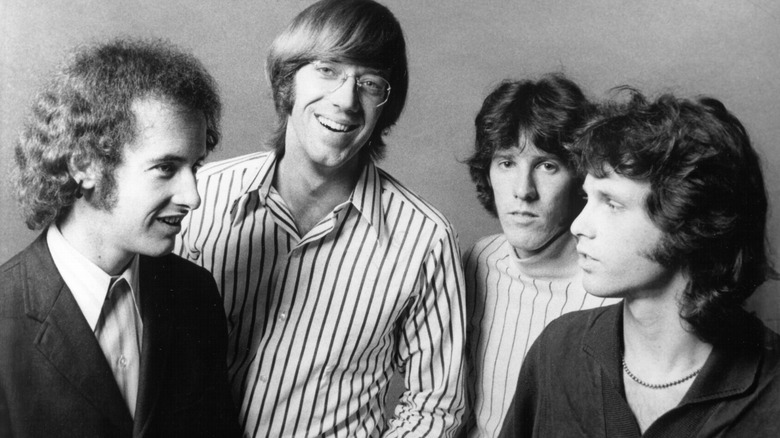
Light My Fire — The Doors
Speaking of psychedelic rock tunes that might have seemed like a handful for radio programmers but did surprisingly well on the charts, how about this seven-minute-long epic with extended keyboard and guitar solos? Of course, the Doors topped the Billboard Hot 100 in the summer of 1967 with a much more concise, three-minute single version, but if you want to really maximize your enjoyment of this song, you'll want to sit through the full-length track or any of the even longer live versions. There's also the version that got the Doors banned from "The Ed Sullivan Show," though if you watched their biopic, be forewarned — Jim Morrison did not troll Sullivan by over-emphasizing the word "higher," as the late Val Kilmer did in the movie.
Unlike other acts on this list, the Doors didn't achieve psychedelic perfection on "Light My Fire" through unusually heavy, trippy, or fuzzy guitars, nor did they do so with lyrics that came straight out of the dream world. Morrison's mesmerizing onstage charisma was the secret sauce, and while it's probably been repeated ad nauseam since the Doors' heyday, it was his shaman-like stage presence that drew the fans in. You also can't ignore Ray Manzarek's keyboard work, which is at its finest on songs like "Light My Fire" that are long enough to fully maximize his creativity. Finally, Robby Krieger's simple, tasteful guitar solos work perfectly as-is on this tune — adding the usual psychedelic effects would have felt like too many cooks spoiling the broth on a song that didn't need them.
When I Was Young — Eric Burdon and the Animals
By the time the original Animals disbanded in late 1966, the band was already dipping its toes into psychedelia, with the fuzz guitar-heavy "Don't Bring Me Down" being their last major hit with the original lineup. But when frontman Eric Burdon revived the Animals in 1967 and attached his name to that of the band, they were light-years removed from the group whose version of "House of the Rising Sun" might have inspired Bob Dylan to go electric. This was very apparent in their hit single "When I Was Young," which peaked at No. 15 on the Billboard Hot 100 in May 1967.
Many great psychedelic songs have out-there lyrics that can border on nonsense for the untrained listener, but "When I Was Young" takes the opposite route. While it's not clear how much the song was inspired by Burdon's growing-up years, the lyrics are sung in the point of view of a young man looking back on his rough childhood and the lessons he learned in those early years. Toward the end, the protagonist looks back on his past idealism, then contrasts this with his disillusionment with present society, muttering the words "I was so much older then" in an interesting echo of those very same words in Dylan's "My Back Pages." (Which was coincidentally a hit for the Byrds when they covered it in 1967.)
Summing it all up, "When I Was Young" has some of the best rock songwriting of 1967, and when combined with the Indian-inspired guitar and violin riffs that underpin the song, it's a certified psych-rock classic that holds up to this day.
I Can See for Miles — The Who
The Who's "I Can See for Miles" is not the only song from the era sung in the point of view of a jealous man upset about his partner potentially (or actually) fooling around — the Beatles' "Run for Your Life" immediately comes to mind. This song, however, comes about as a more nuanced, much less misogynistic portrayal of jealousy and cheating, and one whose lyrical touches make it more trippy than foreboding, though the latter vibe certainly remains. It must be the brag of being able to see the Eiffel Tower and the Taj Mahal on clearer days (which, of course, is not possible unless you're some sort of superhero), as well as the mention of being able to see through the haze.
As for the tune's arrangement, "I Can See for Miles" is arguably the heaviest from The Who's discography to that point, driven by Keith Moon's hard-hitting, manic drumming and Pete Townshend's urgent guitar riffs and leads, which make it feel as if the song's protagonist isn't entirely alright up there. It's got all the necessary ingredients for a great psychedelic rocker, and in what may come as a surprise to casual fans, it's The Who's only single to peak in the top 10 of the Billboard Hot 100, having hit No. 9 in November 1967.