

5 Folk Rock Songs That Snapped The Boomer Generation Awake
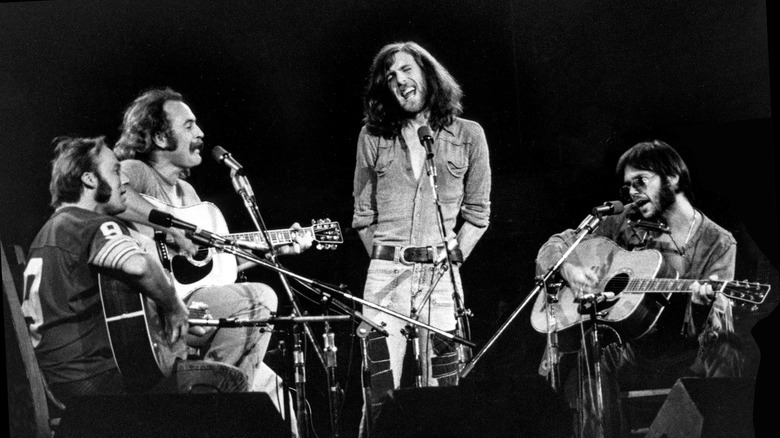
Folk rock became one of the defining veins of rock 'n' roll when baby boomers were coming of age, and some tunes of the '60s and early '70s made their mark on young listeners as they discussed complex, serious topics — like the Vietnam War — through the means of song. These, often called protest songs, were both the mark of a hopeful generation for change and a generation overwhelmed by the goings on of their time.
In this list, we'll run through some of the most iconic of these moving songs, songs that found an essential message within whatever specific subject matter they were inspired by, from shootings to riots to environmental concerns. Though the larger social issues, universal in nature, were a common throughline, each individual track offers its own take on the tumultuous '60s, intersecting cynical and understandably angry sentiments with forward-thinking, optimistic ones. When it comes to music with a message, it's hard to beat these five '60s and early '70s folk rock tracks, songs every boomer of the time is sure to remember from this era of change.
For What It's Worth — Buffalo Springfield
Among the most important of '60s folk rock anthems, Buffalo Springfield's "For What It's Worth" — more than any other song — snapped the boomer generation awake, blending a vital message with an irresistibly catchy hook that stuck in the minds of listeners for generations. Released in the winter of 1966, it reached the top 10 in the U.S. in January of '67 as one of the most iconic anti-violence anthems of its time. Though the band originally wrote "For What It's Worth" about the government's response to riots in Los Angeles in 1966, it grew a more universal message and reception as it found success.
A central interpretation was to do with the Vietnam War, with certain lyrics later drawing a clear parallel: "There's battle lines being drawn / And nobody's right if everybody's wrong / Young people speaking their minds / Are gettin' so much resistance from behind." This message was rousing for fans of the time, and this anti-Vietnam sentiment specifically found its way into a great number of tunes, but few charted as highly and brought together as many listeners as "For What It's Worth."
The Times They Are A'Changin' — Bob Dylan
Bob Dylan was once known for his prophetic voice in protest songs, and this timeless anthem is perhaps the most definitive, though tracks like "Masters of War" and "Blowin' in the Wind" certainly capture a similar energy. "The Times They Are A'Changin," released in 1964, makes its separation with its soft but rousing folk rock sound, and its unforgettable titular refrain, a phrase that united the boomer generation which it first represented.
It feels as if Dylan is calling an entire generation around a campfire to hear his message, a message of unity and change — "Come gather 'round, people, wherever you roam" — that builds into a grand, hopeful conclusion: "The order is rapidly fadin' / And the first one now will later be last / For the times, they are a-changin'." It's bright and hopeful, a bit of a different take from many protest songs of the era, which were often written in reaction to an event or atrocity, and were naturally much more cynical. Though the times changing can be interpreted for better or for worse, Dylan's anthemic song brings that essential mid-'60s hope together into one outlet, a cry out for good in a rapidly evolving world.
Big Yellow Taxi — Joni Mitchell
Joni Mitchell's unique style of folk rock took on a number of feelings and concerns over her impressive career, including her relationship with fellow-listed musician David Crosby, but this early '70s hit relayed a message bigger than herself. "Big Yellow Taxi" is a unique protest compared to many others in this list, tackling environmental concerns from observations on a trip to Hawaii, where "They paved paradise and put up a parking lot / With a pink hotel, a boutique, and a swingin' hot spot."
While issues involving direct conflict may have been more immediate in listeners' minds, rather than the destruction of wildlife and the environment, this song resonated well, reaching the top 25 on the charts, though peaking on the Billboard chart a few years after its 1970 release. "Big Yellow Taxi" blends this message with a bright, upbeat sound, a sound that reflects the beauty and sunshine of the place it was written about. Though it's tackling a specific concern, and is evidence that protest songs can span a wide range of issues, this sunny song contains a universal message, a kernel of truth that raises it to the status of an essential protest song from the boomer generation: "Don't it always seem to go / That you don't know what you've got 'til it's gone?"
Ohio — Crosby, Stills, Nash & Young
The supergroup of David Crosby, Stephen Stills, Graham Nash, and Neil Young — multiple of which coming from our previous entry Buffalo Springfield — may have been at their best on softer folk rock songs, but they took a more straightforward rock approach on this gritty protest ballad, a song that packs quite the punch. Released in 1970 in the wake of the Kent State shootings, "Ohio" memorializes the moment and the movement, which the violence was the product of. The song certainly brought together the masses of coming-of-age boomers, peaking in the top 15 on the U.S. charts in late summer.
Though it is an enjoyable tune from its music alone, headlined by a groovy guitar lead and harmonic early '70s folk rock vocals, "Ohio" does not beat around the bush at all in its content. "Tin soldiers and Nixon's comin' / We're finally on our own / This summer I hear the drummin' / Four dead in Ohio" opens the song, and that final line of the chorus repeats 10 times at its conclusion. Crosby, Stills, Nash & Young brought an angst and a heart to this tragic moment, and their immortalization of this time in "Ohio" is one of the most striking and compelling folk rock songs of this era.
Deportee (Plane Wreck at Los Gatos) — The Byrds
Originally written by Woody Guthrie, the early 20th century singer-songwriter who fathered much of the folk and protest movements to follow, this 1969 rendition by the Byrds best captures the energy of the folk rock zeitgeist this composition represents. Though the original song was based on a 1948 tragedy and was written a month later, its sentiment is parallel to the unrest of the '60s when baby boomers were bringing folk rock to the mainstream.
"Deportee (Plane Wreck at Los Gatos)," in its twangy, country folk style, full of mourning lyrics and meditative guitars, tells the story of migrant workers who were killed in a California plane crash. This song, though remaining a relevant story even to this day, was especially relevant to the Civil Rights movements in the late '60s, as young people everywhere were becoming aware of the injustices marginalized groups faced, many through the rise of folk rock music specifically. This reclaiming of classic folk songs in itself was fundamental to the movements of the '60s, where folk became the genre of the growing generation of baby boomers. The Byrds were a key part of bringing folk rock to the mainstream, and this modernized rendition of a folk classic is a can't-miss part of the protest song revival.