

Rockers Who Went Electronic Before It Was Cool — And Changed The Game
The great push forward for technology in the modern era has been digitalization, and a few of the most forward-thinking rockers knew it as far back as the '60s. By definition, musicians have always been creative, but that tends to translate into novel lyrics, playing techniques, and arrangements — innovations within the medium's existing framework. Yet some tech-savvy (or just playfully experimental) artists started redefining that framework altogether by replacing analog sounds for digital, paving a new road for electronic rock and its many offshoots.
Much of the access to digital techniques came with the invention of the first synthesizers, and in particular the almighty Moog. Combined with the rapidly popularized use of audio sampling (dubbed musique concrète by its principal pioneer, Pierre Schaeffer), the synthesizer brought a literal whole world of sounds to artists that had previously never been possible. Though the techniques are commonplace nowadays, it took a few daring sonic explorers to get the digital ball rolling, and here we examine five of the earliest and most influential.
Silver Apples
Silver Apples, a New York-based duo whose heyday was the late 1960s, were one of the earliest adopters of electronic music, and were one of the bands that adopted it most fervently for that time. Originally a more traditional five-piece band, member Simeon (just Simeon) winnowed the band down to just him and drummer Danny Taylor by introducing an instrument of his own design, which he indulgently but fairly dubbed the Simeon. The instrument, an electronic oscillator/synth combo, produced robotic blips, tones, and whirs practically unheard of at the time, and was so counter to the other band members' sensibilities that they quit, one by one, aside from Taylor.
What emerged was a Simeon/drummer duo known as Silver Apples, and during their brief four year run, they produced some of the most unprecedented music in modern history. The first track off their '68, self-titled debut, "Oscillations" is their thesis statement, and the opening verse almost reads like a technical manual for the Simeon. "Oscillations, oscillations," sings Simeon, over a kaleidoscope of robotic Simeon (the instrument) sounds, "Electronic evocations of sound's reality / Spinning, magnetic fluctuations / Waves of wave configurations."
Silver Apples' music was hypnotic, otherworldly, and seemed more at home in a David Lynch film than on rock radio, and that ultimately kept the band from any real commercial success. Nonetheless, they released two trailblazing albums, built almost entirely from drums, vocals, and electronic sounds, which influenced a slew of electronic music's eventual flagbearers.
The Beatles
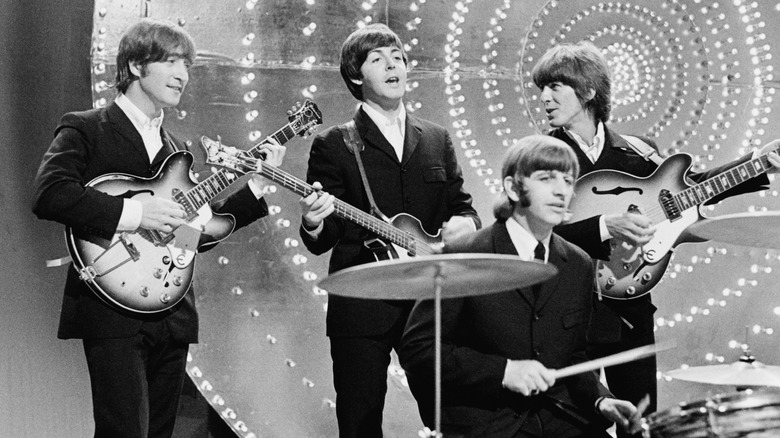
Though the Beatles may have been as mainstream as it gets, essentially defining the pop sound of their time, they also famously never rested on their laurels. Their sound was always evolving, with the boyish, swinging pop of "Please Please Me" giving way to the unfettered psychedelia of "Sgt. Pepper's Lonely Hearts Club Band" before settling on the mature distillation of it all that was "Abbey Road." But when it comes to electronic music, it's "Revolver" that stakes the band's claim in the genre's formation and popularization, and in particular, the album's closer, "Tomorrow Never Knows."
Conceived by John Lennon in an attempt to recreate his experience on LSD, "Tomorrow Never Knows" certainly sounds as though it accomplishes its task. Ringo Starr's drums and Paul McCartney's bass are a constant pulse throughout, but it's the many sampled audio tracks and studio effects that give the song its visionary (in both senses of the word) identity. George Harrison supplies sitar and what would otherwise be typical lead guitar, except that they're presented backward, an almost entirely unprecedented effect in '66. The reverse effect was accomplished using tape loops, which also created the sped-up effect heard on the "seagull" sound, strings, and more, which again was all but unknown to everyone but musicologists and audiologists at the time. Further experimentations with rotating Leslie speakers, tape echo, and more help establish the track as a spearhead of electronic innovation within pop and rock music.
Gary Numan
A decade behind the earliest electronic pioneers of the '60s, Gary Numan was hardly the first to utilize its constituent techniques. But given how thoroughly he embraced them — completely retooling his punk band into synth-pop upon discovering his first Minimoog synthesizer — and how popular he made them, electronic music as a whole owes him a tremendous debt. Both as the frontman of Tubeway Army and then solo, Numan has made a career out of demonstrating that electronic instrumentation can be just as personal and affecting as its analog counterpart.
Speaking to The Enfield Independent about the moment he discovered his first synth, Numan recalled that, "[the Minimoog] just had an amazing sound, which made the whole room shake ... Just one key did something ten times more powerful than anything I'd ever heard." His record label was less than thrilled about the new punk band they signed, Numan's Tubeway Army, abandoning the entire genre for one which had barely gained any mainstream appeal, but that didn't stop Numan. As he told the Independent, "There was a lot of resistance to synths, people said you couldn't replicate that warm, human feel. My argument was that electronic music could be very emotive ... it's in the sound itself, not the melody or lyrics." Numan proved his point with two No. 1 hits, "Are 'Friends' Electric?" (with Tubeway Army) and "Cars," two of the first to establish synth-pop as both a valid and valuable addition to the popular music canon.
The United States of America
For a select few bands that possess the right blend of talent and ingenuity, a single album is all it takes to secure a spot in music history, and The United States of America are one of the best examples, up there among icons like the Sex Pistols and Jeff Buckley. The band released a single self-titled album in '68 which sold poorly, barely touched the charts, and received mixed reviews at the time. As many reviewers have noted in the intervening years, the album was the epitome of "ahead of its time." Though its commercial failure and challenging artistry quickly led to the band's breakup, it has stood the test of time as a truly revolutionary incorporation of electronica into rock.
There are a number of fun melodies and catchy rhythmic jams throughout "The United States of America" (we defy you not to bop your head along with "The Garden of Earthly Delights"), but it's the near-constant synthesizers, oscillators, and disparate audio samples that set the album so far apart from its peers. There's barely a gap to be found without some form of electronic trilling or liberally-used studio effect, and it turns what would otherwise be fairly par-for-the-course psychedelia into a kaleidoscopic odyssey. This ever-present dedication to burgeoning electronic production, as opposed to the occasional usage by bands like the Beatles and the Beach Boys, gave The United States of America a true identity as revolutionaries — both the band's death knell and its claim to music history.
Kraftwerk
No discussion of electronic music pioneers would be complete without Kraftwerk, one of the most (if not the most) undisputed paragons of the genre, as well as one of its earliest and most impactful popularizers. When Gary Numan made a career out of using synthesizer music to examine humanity's technological future, he was walking a road (or "Autobahn") that Kraftwerk had been driving for years.
As early as the first track, "Ruckzuck," from their 1970 debut, Kraftwerk were eschewing traditional instrumentation and structure, instead turning to free structure and relying on the electronic organ as their musical backbone. By the time they released their 1975 single "Autobahn," which astonishingly climbed to No. 25 on the Billboard Hot 100, the band was in full electro mode, almost exclusively using synthesizers and other electronic instruments, and without a doubt changing the course of music.
As the de facto heads of the krautrock scene, and certainly the most successful after making the leap to full synth-pop, Kraftwerk developed a sound that spawned genre after genre, from new wave to techno to industrial rock. Even hip-hop, with its extensive use of audio sampling and synthesizers, owes Kraftwerk a major thanks. It's no surprise, then, how many artists, across decades and genres, have cited the band as an influence. Following that, it's also no surprise how often Kraftwerk has been hailed as one of the most influential musical acts in history.