

Don't Throw Out Concert Ticket Stubs From The '60s And '70s — They Could Be Worth Hundreds Or More
We may receive a commission on purchases made from links.
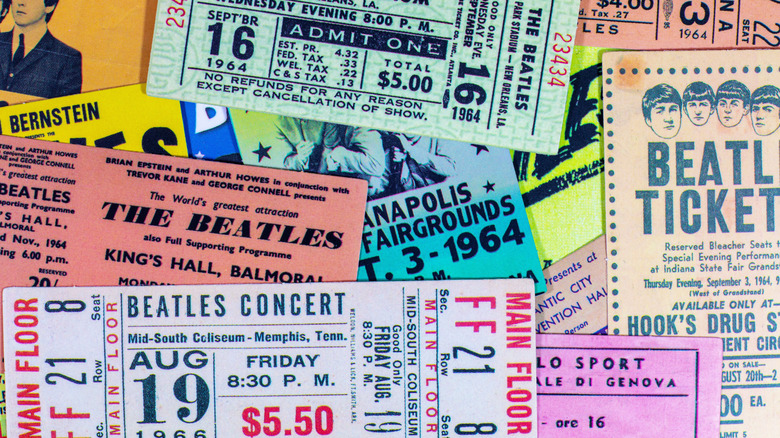
Does anyone remember physical concert tickets? As absurd as physical tickets might sound to younger people, the lack of them might seem equally absurd to older people. But no matter that tickets make decent souvenirs or curios to tuck away in a box somewhere, they can also be your ticket to one month's mortgage discount. Don't throw away stubs from the '60s and '70s just yet, because they could be worth hundreds.
But first: Yes, it seems like a long shot that a tiny slip of deteriorated, graying or yellowing paper with faded ink could survive longer than some people. It also seems like a long shot that someone would pay money for such a keepsake rather than go, "Oh neat," and continue on their merry way. But here's a general rule, whether it be for concert posters found at thrift stores or estate sales, vintage '80s rock band t-shirts that go for hundreds, or anything else: If you sell it, they will buy. There's always a superfan somewhere who wants your swag.
If you're keen on cleaning out your closet and want to divest yourself of tchotchkes, head to eBay for a public auction, StubHaul or Dave Buys Ticket Stubs for a private evaluation and purchase, Autographia for (often, but not always) signed goods, or many other websites, and get to work peddling your memories. Some places actually pay cash. No matter such pawn-shop practices, old ticket stubs constitute a real market — one that can make hundreds, if not more.
Calculating the value of an old stub
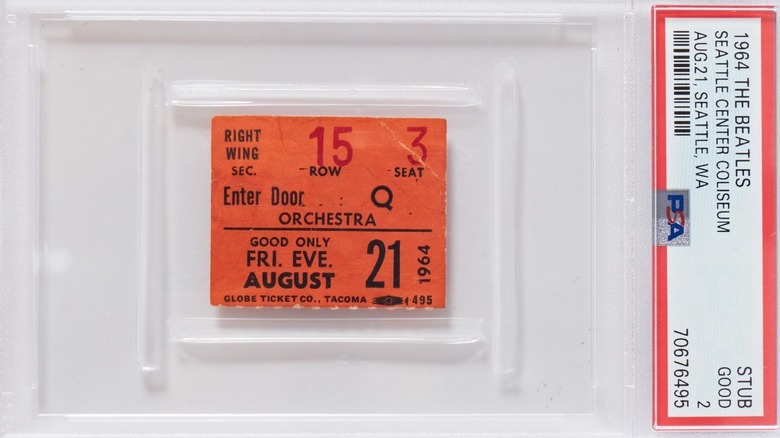
So how does someone know if a crumpled Genesis ticket (Peter Gabriel-era, of course) fished out of the back pocket of an ancient pair of jeans is worth something or is just a piece of barely-legible trash? As StubHaul explains, there's loads of factors: how damaged the ticket is, whether it belongs to some notable, historic event, changes in market value over time, etc. There's no way to know without doing a proper valuation, which can happen through a third-party business like the Professional Sports Authenticator (PSA), which at this point appraises everything from coins to video games.
To give the reader an idea of the price range: Beatles pre-fame Cavern Club tickets in Liverpool have sold for up to $8,000. A ticket from a 12-song Beatles set at the Seattle Center Coliseum from their first, 1964 U.S. tour goes for $834.98, creases and damage included, on Autographia. Contrarily, someone is selling a colossal, framed collage of 117 tickets on Etsy for $999.99. This collage contains basically every big name from the '70s imaginable (and some from the '80s): Lynyrd Skynyrd, Fleetwood Mac, the Rolling Stones, Neil Young, etc. But, it only breaks down to a little more than a dollar per ticket. There's also an unredeemed Led Zeppelin-Jethro Tull ticket on Etsy from 1969 for about $550, and two stubs from The Who circa "Quadrophenia" (early '70s) on eBay for $124.99.
These are only a few examples out of many, but they illustrate both the potential value of a ticket and how much that value can vary. Bottom line: Keep your ticket stubs, because you never know. And hopefully, you never washed those jeans from 1968.