

How Long Do Acoustic Guitars Usually Last?
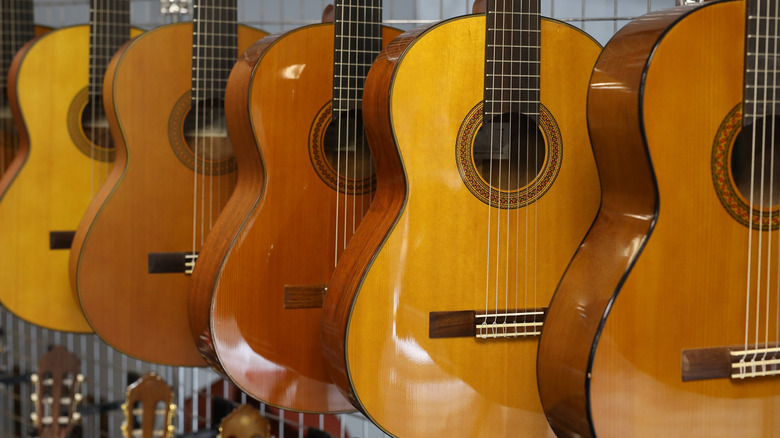
We all know that you've got to take care of things to make them last, right? Time deteriorates everything, but especially minutely-crafted panels of wood shaped into a hollow cavity and kept under about 180 pounds of incessant string tension. Add skin oil and perspiration, humidity, temperature and air pressure differences, exposure to light, etc., and you've got a battle of preservation ahead of you. But is there a limit? How long do acoustic guitars usually last?
The real answer will satisfy nobody: It depends. First off, acoustic guitars are more sensitive and prone to damage over time than solid-body electrics. They can also be made from solid wood or laminate, the former of which uses pieces of solid wood while the latter uses a bunch of pieces of wood or other materials stuck together in layers. Predictably, solid wood guitars last much longer and are that much more expensive. In either case, frets get worn down over time, necks bend under the pressure of strings, tuning pegs might loosen, the headstock might crack, the body gets scuffed and warped, etc. But most importantly, more use equals more wear and tear.
Like a true death by 1,000 cuts, or a bad eating habit that catches up to you after 20 years, an acoustic guitar need not be bashed to splinters on stage to get ruined. Lower-quality guitars can die in as little as five years or less, while well-constructed, well-cared-for guitars can live for hundreds. But take heart, because even beater guitars, like Elvis' first $6.95 guitar, can change music forever.
Helping your guitar last as long as possible
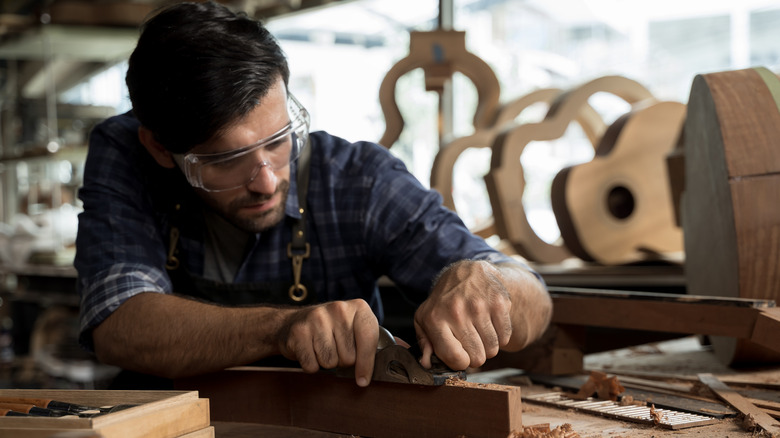
The Museum of Fine Arts in Boston shows us precisely how long guitars can last with proper construction and care. Guitars in its collection stretch back to a stunning 1628 instrument from Italian luthier Jacopo Checchucci. We don't know how it stacks up against the world's most valuable guitar money-wise, but it's certainly one of the world's most beautiful. It also looks in better condition than some new guitars that have been hanging around on stands in the dusty air for a few years. But that's just it: After quality of build, it's all on the owner to prolong a guitar's life.
Right out of the gate, do not leave your guitar out, exposed to humidity, dust, light, etc., all of which eat away at the wood. A comfortable temperature of low-to-mid-70s Fahrenheit is best, as is mid-level humidity — not too dry, not too wet. And for the love of God, do not do as some people proudly do and try to keep the strings in tune. Let the strings grow slack, or else detune them after playing to release pressure on the neck, especially if you're not going to play for a while. Then, wipe the guitar down after playing it, especially the strings and body, using guitar-specific cleaning products, not whatever Windex you've got in the kitchen cabinet. It's very simple: Treat a guitar like disposable garbage and that's what you'll get, same as a car, phone, or paperback book.
Best-case scenario: If you take care of a well-made, modern guitar, it might last 20 to 30 years on average, or even more. Even a cheap guitar can last 10 years if you treat it with respect.