

The No. 1 Song On June 10, 1966 Sounds So Much Cooler Today
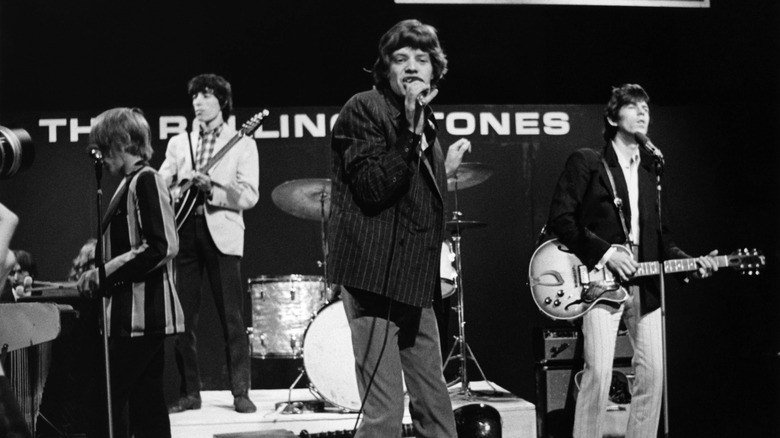
Welcome to the first edition of The No. 1 Song on This Day, a biweekly column where we discuss the No. 1 songs from decades ago that are way cooler today.
It can be hard to hear a song like "Paint It, Black" with fresh ears. It's a 60-year-old song from one of rock's biggest names, the Rolling Stones, and you've probably heard it about a quadrillion times unless you're very young. It not only hit No. 1 on The Billboard Hot 100 on the week of June 10, 1966 and stayed there for two weeks — it went on to snowball in popularity over time to become the Stones' most listened-to song on Spotify, at about 1.7 billion listens. But trust us when we say: It wasn't only one of 1966's coolest songs, it still sounds vastly weirder, cutting-edge, and cooler today.
At its heart, "Paint It, Black" is a weird song. Give it a listen. Does it really sound like "rock?" Does it sound like any other chart-topper? To us, it really sounds like a galloping desert chase between an obsessed, Wild West lawman and outlaw, one of whom is a yogi and both of whom wield black magic. It sounds like madness and smothering oppression and exactly what the lyrics describe: "I wanna see it painted, painted black / Black as night, black as coal / I wanna see the sun, blotted out from the sky / I wanna see it painted, painted, painted/ Painted black, yeah." Is this the memoir of a serial killer?
It's a testament to the enduring, legitimately brilliant songcraft of "Paint It, Black" that the song got to where it is. Fear not, we're going to get to the heart of what makes "Paint It, Black" so undeniably cool.
The lyrics of Paint It, Black
Even though "Paint It, Black" is a whole package of a song, where each part links perfectly to the other — mood, intent, lyricism, tempo, rhythm, etc. — we're going to first highlight why the song's lyrics go far in making it so cool. Plainly put, "Paint It, Black's" lyrics paint a disturbing story that can be downright uncomfortable when read outside of its melody. Take lines like, "I see the girls walk by dressed in their summer clothes / I have to turn my head until my darkness goes." Say what, again?
We're sure plenty of people know these lyrics by heart, but have you ever realized what they're saying? Mick Jagger basically lists a whole bunch of things cloaked in darkness: doors, cars, hearts, the "whole world." It's the repetition that makes it work, lockstep with repeating musical phrases. The song's stand-out verse sounds like gothic musings of an eloquent goblin creeping through shadow: "No more will my green sea go turn a deeper blue / I could not foresee this thing happening to you / If I look hard enough into the setting sun / My love will laugh with me before the morning comes." Good luck finding many songs, rock or otherwise, classic or modern, with lyrics like this. It's something of a miracle that words so impenetrable, heavy, and even graceful snuck into an up-tempo, mainstream rock song that's become all-but-immortalized over time.
As for what "Paint It, Black" is actually about, well, it's pretty simple: grief. True to the song's classical-sounding allusions, it's about a lover who just can't go on after his love has died — hence the desire for everything to turn to black.
The music of Paint It, Black
Intriguingly, "Paint It, Black" has no chorus. It's a song that hit No. 1 on the Billboard Hot 100, is the Rolling Stones' No. 1 listened-to song on Spotify — the biggest song from one of rock's biggest bands, ever — and it has no chorus. It's just a bunch of end-on-end verses with different lyrics that build and build, and drive on and on, relentless and all-consuming. The final 90 seconds is mostly instrumental, with some "hmm, hmm, hmm, hmms" and final outro lyrics. It's written in an exotic-sounding Phrygian musical mode, not a bog-standard major or minor mode — unheard of for a popular song. It was also the first song featuring a sitar to hit No. 1, thanks to Brian Jones' deft riffs. How did this all happen? How does it possibly work?
The honest answer is that good music is good music. But really, "Paint It, Black" boils down its ultra-cool main riff, the one that repeats again and again, matching Jagger's vocal melody note for note: "I see a red door and I want it painted black." Without getting too far into the music theory weeds, this main riff is written in a musical mode not typically associated with rock or Western musical scales: Phrygian, reminiscent of Arabic music, Indian music, Spanish flamenco, plenty of metal, and more. The mode sounds mysterious, even sinister, like a terrible secret, and fits the tenor and lyrical themes of "Paint It, Black" to a T.
Extra hats off to Brian Jones' sitar playing in "Paint It, Black," without which the song loses much of its musical color. He tragically died very young in 1969, which only adds to the song's darkness.