

In 1970, Crosby, Stills, Nash & Young Took This Quiet Joni Mitchell Song And Spun It Into A Rock Hit
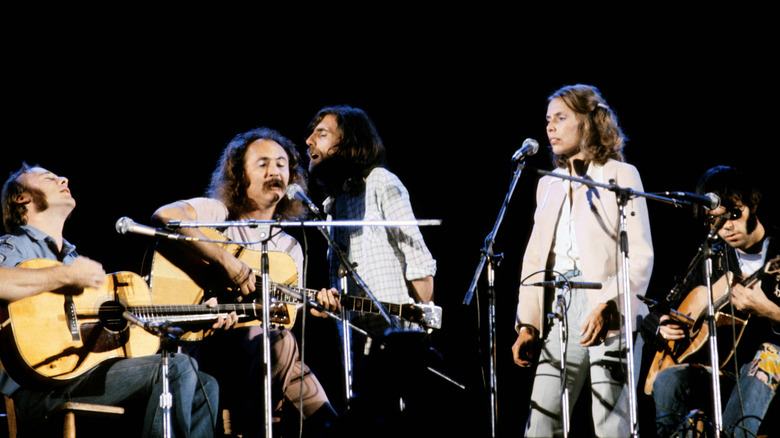
If there's one album that perfectly sums up the turbulent but hopeful spirit of the late '60s, it's Crosby, Stills, Nash & Young's album "Déjà Vu." Released a few months before the Kent State shootings in May of 1970, stripped the peace movement of its innocence, and less than three years after the Summer of Love, it's an album that, as the title suggests, looks back. Helping it to reach No. 1 on the Billboard Hot 200 album charts was a cover of Joni Mitchell's "Woodstock," which became a top 40 hit for the band. CSNY dressed her ode to the ideals of the festival at the zenith of the hippie cultural movement in tight harmonies, hard-edged guitar lines, and groovy rock 'n' roll.
In doing that, they turned Mitchell's song into a generational touchstone. Rock journalist Langdon Winner panned the album in Rolling Stone (unfairly in our opinion), but he struck on something when he quipped that CSNY "will probably remain the band that asks the question, 'What can we do that would be really heavy?' And then answers, "How about something by Joni Mitchell?'" He's not wrong that "Woodstock" goes extra hard. Mitchell's composition and performance are luminous and ethereal — it's one among many gems from the prolific Canadian singer-songwriter — but in the hands of a band made up of close peers, friends, and ex-lovers, it's a heavy, beautiful anthem. A song that sounds even cooler today than when it came out, it's both a rich document of its time and timeless.
We are stardust
The song "Woodstock" comes from a massive case of FOMO. Joni Mitchell was slated to play the festival, but, on the urging of her manager David Geffen, cancelled to fit in a TV appearance on the Dick Cavett show the next day. The traffic out of Bethel, New York, would be murder. But it must've stung to see festival performers like David Crosby and Stephen Stills stroll onto the studio set during the broadcast to talk about their experiences. That's a bummer, but maybe Joni's not being at Woodstock is what makes her song about it so good. Watching the TV coverage and hearing about the festival gave Mitchell a wide perspective.
From afar, she could see it for the groundswell it was. "I was a little 'God mad' at the time," she said in a 1995 interview, adding "... Woodstock, for some reason, impressed me as being a modern miracle, like a modern-day fishes-and-loaves story" (via Pop History Dig). Certainly, the lyrics take on a Biblical dimension, as in the chorus: "We are stardust / (Billion-year-old carbon) / We are golden / (Caught in the devil's bargain) / And we've got to get ourselves / Back to the garden." Mitchell's version — on the "Ladies of the Canyon" album released about a month after "Déjà Vu" — is stripped down and luminous. Despite its message of peace and cooperation, it sounds more like she's longing and hoping for that utopia, rather than reveling in it.
Crosby, Stills, Nash, & Young bring us back to the garden
The connections between Joni Mitchell and Crosby, Stills, Nash, & Young run deep. Not only did David Crosby once date Mitchell and produce her first album, but he and Stephen Stills first sang together with her then-partner Graham Nash at a party at her home in Laurel Canyon, outside of LA. Fellow Canadian Neil Young — who was Stills' bandmate in Buffalo Springfield — got in the fold in 1969, with their 3:30 a.m. Monday morning Woodstock set (the festival running predictably long), the second performance with the full line-up. It's his and Stills' aggressive guitarwork, in many ways, that give "Woodstock" its edge. Actually being there, no doubt, lent gravity to their version.
By the time CSNY recorded the tune, there were plenty of reasons to long for more innocent days. Nash and Mitchell had split, Crosby was reeling from the death of his girlfriend Christine Hinton, and there were always creative tensions in the band. But that darkness may have been the secret ingredient, lending extra weight to lines like, "And I dreamed I saw the bomber jet planes / Riding shotgun in the sky / Turning into butterflies / Above our nation." What if music and collective love — 400,000 turned-on kids in a muddy field — could overcome hate and the war machine? What if they could change the world? Or what if it was all just a dream?