

5 U2 Songs That Prove 1992 Was The Best Year Of Their Career
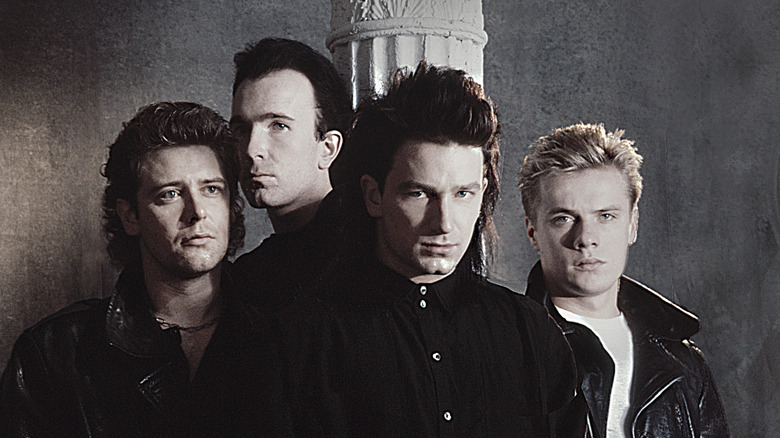
In 1992, U2 reinvented themselves as techno-rock juggernauts, playing fast and loose with new textures and moods to create their experimental joy fest "Achtung Baby." In the four years prior, they'd released the ponderous and self-serious (though still incredible) American roots rock explorations of "The Joshua Tree" (which gave the band its aching No. 1 love song, "With or Without You") and its companion piece "Rattle and Hum" from the late '80s. With "Achtung Baby," joyous industrial crunch became a key component in their musical mixture. It served to bring the band a wider audience and capitalize on the mainstream success they'd courted with those earlier works, an expansion that showed U2 had a variety of tricks up their collective sleeve.
The move made 1992 the band's biggest year for extended exposure, too. By spacing out their singles, U2 managed to keep songs from "Achtung Baby" on the charts for more than a year. No song spent fewer than 10 weeks on the Billboard Hot 100, and "Mysterious Ways" and "One" managed to break into the Top 10. "Even Better Than the Real Thing" and "Who's Gonna Ride Your Wild Horses?" showed up in the Top 40, proving that songs with wordy titles could become contenders. And while "The Fly" didn't rise past the middle of the Hot 100, it set the tone for a milestone year in the U2 catalog, one that proved to be their biggest yet.
The Fly
U2 dropped its first new single in two years at the tail end of 1991 and walloped fans with an unexpectedly disco-charged crackler called "The Fly." It's full of delicious feedback and has a completely different sensibility than any other song the band had ever unleashed on the world at the time. Bono's voice barely rises above a hoarse whisper as he warns: "Every artist is a cannibal, every poet is a thief/ All kill their inspiration and sing about their grief." The darkly impressionistic lyricism from "The Unforgettable Fire" returned, this time wrapped in barbed wire and delivered with a dancefloor-friendly soul that feels distinctly un-U2-like but in a highly intriguing way.
"The Fly" flew fast and furious, hitting the Billboard Hot 100 on November 9 and peaking at No. 61 a mere two weeks later. Fans and music business folk may have been a bit unsure about how to receive this new iteration of U2 — a song so unlike their other works may have been lucky to chart at all. But instead of being a firecracker of a hit, this one turned out to be a fuse lighter instead — a spark that ignited a new chapter for the band and signaled their willingness to flex with the times to keep their sound fresh and relevant. Regardless of chart movement, it was refreshing to hear U2 tinkering with house beats and taking their sound into groovy new territory.
Mysterious Ways
"Mysterious Ways" was the follow-up single to "The Fly" and was received much more warmly by audiences. This time, U2 introduced a trip-hop element, with layered percussion lightening up their usually thunderous drum work and making the most of a hypnotically snaky bassline that plays peek-a-boo among the other arrangements. Edge is at his funkiest too, slamming out a feedback-fried thread that eschews all traces of his trademark chime-and-echo patterning. The sizzling guitarwork juxtaposed against a modern backbeat stretched the U2 blueprint into a fascinating new shape that made sense for an evolving band.
There's deeper meaning in the lyrics in this one too, a suggestion of "let go and let God" as Bono intones: "Johnny, take a walk with your sister the moon / Let her pale light in to fill up your room / You've been living underground, eating from a can / You've been running away from what you don't understand, love." The chorus eventually drives it home, with the enigmatic "She moves in mysterious ways" turning into the more direct "Spirit moves in mysterious ways" at the end of the song. The power of love is the only way through, it appears, and the crunchy, bouncy backing tracks will lead the way.
U2 hit a high note with "Mysterious Ways," capping out at No. 9 in late January 1992 and taking up space on the Hot 100 for an astounding 20 weeks. Fans were picking up what the band was laying down.
One
Maybe only second to "With or Without You" among U2 singles with gut-wrenching emotional heft, "One" gave the world another whisper-to-a-scream ballad that swirled together the topic of spoiled romantic love and greater spiritual striving for all-encompassing redemption. The lyrics leap from an intimate image like "Well, it's too late tonight / To drag the past out into the light / We're one, but we're not the same" to a vast spiritual overview like "One love, one blood / One life you got to do what you should / One life with each other / Sisters, brothers." The deep meaning behind the lyrics of "One" pierces through the production. It's a messy mix that perfectly encapsulates the need for understanding and acceptance on all levels, served with the Edge's scratchy riffs and the growing tension that resolves with Bono's ecstatic falsetto vocals.
"One" turned out to have a huge impact on listeners, inspiring covers and samples from other artists in over 60 different works. That far-reaching influence is no surprise for a song that reached No. 10 on the Billboard Hot 100 and spent 20 weeks on the charts overall. More than just a popular mid-tempo tune that stirred music fans into a frenzy, it served as a bridge back to the more serious tone of early U2 songs, reminding listeners that the band hadn't lost its ability to raise goosebumps amidst the shift to their new sound. It's also a timeless piece, a classic '90s song that doesn't sound 30 years old.
Even Better Than the Real Thing
With "Even Better Than the Real Thing," U2 dialed down the groove and got back to basics, with a psychedelic twist that kept the cheeky new joyfulness in place. It's nothing more than a tribute to someone special, a semi-'60s love letter that exalts its subject in the most superlative terms. "You're honey, child, to a swarm of bees," Bono asserts, before confirming his more sensual intentions, "Gonna blow right through ya like a breeze." Whether it's forever love or for-now love is for listeners to work out for themselves.
This one was a reminder of how uplifting a happy U2 song could be. It had no greater message than expressing affection for someone special, a celebration of the simple thrill of love. There's no hidden message or political stance being taken here. Elation turned out to be inspiration enough, creating a vibe that earned the single the No. 32 spot in September 1992 and proved that the band's core audience would welcome a lighter spirit from a band that made its mark with far more solemn works.
Who's Gonna Ride Your Wild Horses?
If any single from "Achtung Baby" asserted U2's ability to deliver a booming rock tune about nothing more than intense love, "Who's Gonna Ride Your Wild Horses?" was going to do the deed. The lyrics describe the dangerous edges of someone just out of reach — Bono pleads to be the one to round down the jagged bits without draining the dark magic entirely. The song is unbridled audio power with that electrifying desperation the band had become known for in earlier works but with a soul as bright as sunshine that feels jubilant.
The quartet's wall of sound has seldom been as sturdy as in this churning major-key carnival. Bono's simple yet evocative listing of metaphors for how dangerous his lover is — "You're an accident waiting to happen / You're a piece of glass left there on a beach" — are a twisted love poem that reveals deeper truths without sugarcoating the imagery. And the "Hey hey, sha la la" bits between verses are infectious and proved a highly singable and not-so-subtle callback to Van Morrison's "Brown Eyed Girl" chorus.
The band closed out the year with another Billboard Top 40 banger, reaching No. 35 on the Hot 100 just before Christmas 1992 and hanging around the chart for 16 weeks total. The final single from "Achtung Baby" affirmed that this new U2 format had been a welcome change and hinted at even more experimentation to come.