

Classic Rock Songs You Probably Didn't Know Were Inspired By Real Events
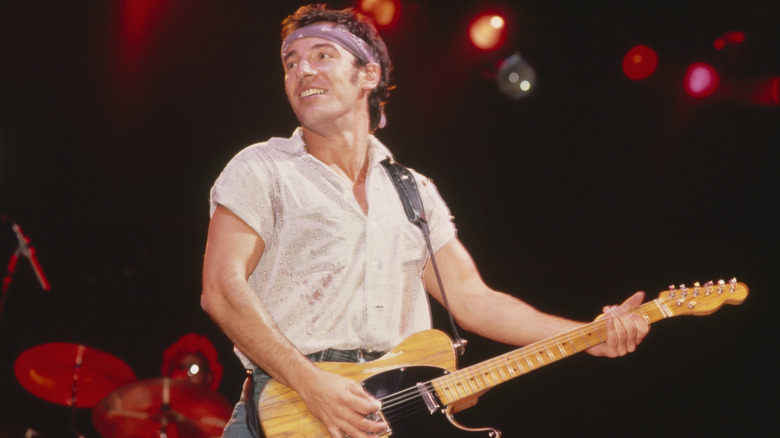
Many of us may have once assumed that musicians must somehow pluck their inspiration from nothingness into reality. But, of course, it doesn't work that way. Any artist can tell you that they're nearly always inspired by the world around them, and even the most famous classic rock musicians are no different. As it turns out, some of your favorite songs from this era were inspired by real-life events, ranging from one dreamily silly Beatles song to a hauntingly bleak track that has become one of Bruce Springsteen's very best achievements.
Of course, it's not like the best rockers of the era simply slapped together a bare-bones report of an event and set it to music. What fan would want to listen to a news article, after all, even if it's got a John Bonham drumbeat beneath it? In other words, you'll often have to go digging — just ask anyone who's tried to tease out the meaning of Don McLean's famously symbolic "American Pie," though there is real truth behind those lyrics, too. That's all for the best, though, as these artists took real events and turned them into songs that are arresting enough to have stood the test of time.
Smoke on the Water — Deep Purple
Deep Purple's 1972 much-covered classic, "Smoke on the Water," is about — get this — smoke drifting over water. But there's more to the story, which began at Switzerland's Montreux Jazz Festival. Despite the name, rock acts also joined in, and, by 1971, Deep Purple was there to record their sixth album. That year, while Frank Zappa and the Mothers of Invention performed at the Montreux Casino, someone in the audience set off fireworks — or a flare gun or lit matches, depending on whose account you read.
Whatever the ignition source, a careless attendee lodged it in the venue's low ceiling, where it caught fire. As the song's lyrics tell it, "Frank Zappa and the Mothers / Were at the best place around / But some stupid with a flare gun / Burned the place to the ground." Meanwhile, Claude Nobs, the festival founder, gets called out as the heroic, child-saving "funky Claude." But disaster was still close; some in the audience thought they were trapped, but firefighters arrived in time to break open windows and help attendees escape.
Though no one was seriously injured or killed, the casino burned down. In another lucky turn, the wind shifted, sending flames and smoke away from Montreux and over Lake Geneva instead. Deep Purple witnessed all this, spontaneously wrote "Smoke on the Water," then set up a last-minute studio at a closed-for-the-season hotel. When the album came up a bit short, they tacked on "Smoke on the Water."
American Pie — Don McLean
Sure, we all know that "American Pie" is about tragic real-life events. It's right there in the lyrics, with Don McLean singing about the tumult of the '50s and '60s, but which events, exactly? The references get pretty confusing amidst McLean's dense metaphorical imagery, though many listeners have picked out what they believe are references to the John F. Kennedy assassination, the Beatles, and the space race, among many others. McLean himself told Forbes that the song is linked to some of the era's high-profile deaths. "My dream ended with a lot of sixties' assassinations. It didn't have to end," he said.
McLean typically stops there, but some events almost surely link to the song, like "the day the music died." That could be a metaphor for multiple things, but it's hard to ignore the same-name link with the February 1959 airplane crash in which Buddy Holly, Ritchie Valens, and J.P. Richardson (aka The Big Bopper) died. The musicians hoped to escape a grueling cross-country tour leg in an unheated bus, but poor weather and pilot error led to the crash shortly after takeoff.
When it comes to "American Pie," there's also a personal element for McLean. He's directly said that the lines "For 10 years we've been on our own / Moss grows fat on a rolling stone" reference his father's death in 1960, leaving McLean and his mother by themselves. Still, don't get carried away. McLean told Forbes that some of the song's lyrics "have no meaning that people have tried to make into something, and some are just funny nonsense."
Nebraska — Bruce Springsteen
Released in 1982, the album "Nebraska" represented a major departure for Bruce Springsteen. Gone were the boisterous songs that had brought him fame, and in their place was a spare, haunting album that looked at the dark side of American life and offered no easy answers. The album demos were recorded in a rented farmhouse, with just Springsteen, a few instruments, and a four-track recorder.
But the project didn't really come together until he saw an airing of Terrence Malick's "Badlands," which fictionalized the 1957-1958 murder spree of Charles Starkweather, who took 14-year-old Caril Ann Fugate with him. Drawn in, Springsteen used Starkweather as direct inspiration for the title song. In Springsteen's lyrics, Starkweather is bleakly unapologetic about the 11 lives he took for no discernible reason, musing, "They wanted to know why I did what I did / Well, sir, I guess there's just a meanness in this world."
Fugate said that she'd tried to break up with Starkweather, who then abducted her and said that her compliance would keep her family alive — when he'd already murdered them. Starkweather initially agreed with Fugate's account, then dramatically changed course, saying she'd actually masterminded the spree. Testifying at her trial, Starkweather said, "If I fry in the electric chair, she should be sitting in my lap" (via KQED), a line that Springsteen directly references in "Nebraska." Starkweather and Fugate were both convicted of murder, but only Starkweather received the death penalty, while Fugate was paroled in 1976.
When The Levee Breaks — Led Zeppelin
"When the Levee Breaks" is indeed about a major flood. But this Led Zeppelin song — actually a cover of an older blues tune — has a far weightier history than you might think, given that it was inspired by the real tragedy of the Great 1927 Mississippi River Flood. Beginning in summer 1926, a series of torrential rainstorms ruined crops, destroyed communities, and took lives. At its worst, floodwaters stretched to a 75-mile span in places. Hundreds of thousands were displaced, while the death toll ranged from nearly 250 to over 1,000 lives lost.
The original "When The Levee Breaks" was recorded in 1929 by Memphis Minnie (real name Lizzie Douglas) and Kansas Joe McCoy. McCoy was the singer, while Minnie expertly played guitar on the track. Minnie continued her career and retired in the '50s, after which her work faded, though only for a time.
It came back to life in 1970, when Robert Plant suggested covering the song on Led Zeppelin's fourth album. The initial recording sessions didn't hit the mark, but a second round produced the legendary cover you hear today. The band slowed down the beat and added extra instruments and studio effects, as well as innovations like John Bonham's iconic drumbeat. Their take went beyond a straight cover and transformed the original, though Minnie and McCoy still very much deserve credit.
Being for the Benefit of Mr. Kite! — The Beatles
Practically everything on "Sgt. Pepper's Lonely Hearts Club Band" sounds like it came from a psychedelic swirl, but "Being for the Benefit of Mr. Kite!" has genuine links to reality. Some say John Lennon wrote the track alone, though a co-credited Paul McCartney certainly remembers writing it. He might feel a little sore about that; after adding "Being for the Benefit of Mr. Kite" to his live setlist in 2013, McCartney told Rolling Stone that "I was happy to kind of reclaim it as partially mine."
Whoever wrote it, their imagination was sparked by a real 1843 circus poster Lennon bought in 1967. It promotes a performance to benefit the titular Mr. Kite, a gymnast, put on by Pablo Fanque — actually born William Darby — and his Circus Royal. Fanque, the first known Black circus owner in England, began as an acrobat and horse trainer, but became an impresario and philanthropist. Mr. Kite is even harder to track down, but he was likely William Kite, an acrobat who was part of Fanque's circus.