

One Of Rock's Most Famous One-Hit Wonders Has No Known Author
We may receive a commission on purchases made from links.
How many parties have come to life with the uttering of "Whoa, Black Betty, bam-ba-lam"? While most classic rock fans know this tune thanks to Ram Jam's 1977 toe-tapping rendition — which is still one of the best rock songs for boomers and their kids to bond over — the song's history goes further back than that. Surprisingly, it's a track whose real author may never be known.
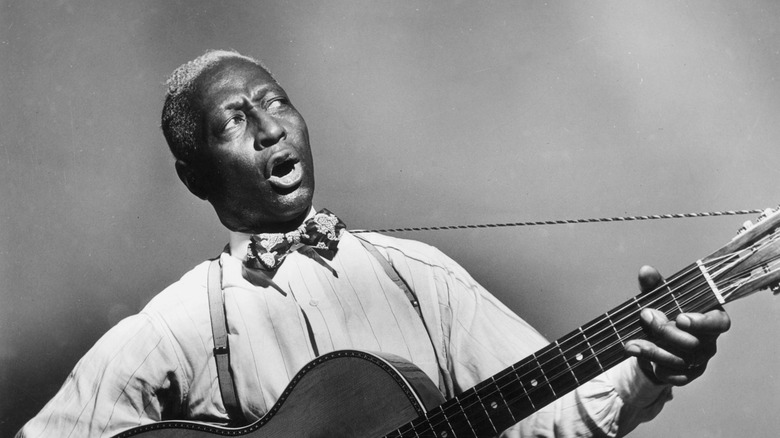
Before Ram Jam put their signature touch on it, Lead Belly recorded his version of "Black Betty" in 1939. This bare-to-the-bones number sees Lead Belly utilize only his soulful voice and claps to carry the catchy tune. It's a powerful and memorable performance, and it isn't too difficult to see where Ram Jam found the foundational inspiration for their own rock 'n' roll-laden adaptation.
However, Lead Belly didn't conceive "Black Betty" either. The first recorded version of the song happened in 1933 after father-and-son musicologist team John and Alan Lomax recorded the incarcerated musician James "Iron Head" Baker and other prisoners singing the track. So, does the authorship of the song belong to Baker or any of the men who sang it? That part remains uncertain.
What is Black Betty about?
Listening to "Black Betty," one might presume it's about a woman — perhaps someone named Betty, right? For Ram Jam's vocalist and guitarist Bill Bartlett, that's exactly how he approached his band's version of the song, thinking of it as a tribute to Bettie Page, per Loudersound. Others have debated if it's about a drink or something else entirely.
However, Alan and John Lomax, who first recorded James "Iron Head" Baker and prisoners singing the song, provided their own explanation in the book "American Ballads and Folk Songs." In it, the authors wrote the following: "'Black Betty' is not another Frankie, nor yet a two-timing woman that a man can moan his blues about. She is the whip that was and is used in some Southern prisons. A convict on the Darrington State Farm in Texas, where, by the way, whipping has been practically discontinued, laughed at 'Black Betty' and mimicked her conversation in the following song."
The Lomaxes' recording and description of "Black Betty" are the closest answers that anybody has to finding out the truth about this classic song. One thing that can never be disputed is its undying influence on pop culture. To this day, it's still one of the best songs used in a Super Bowl ad.