

5 Folk-Rock Hits With No Known Authors
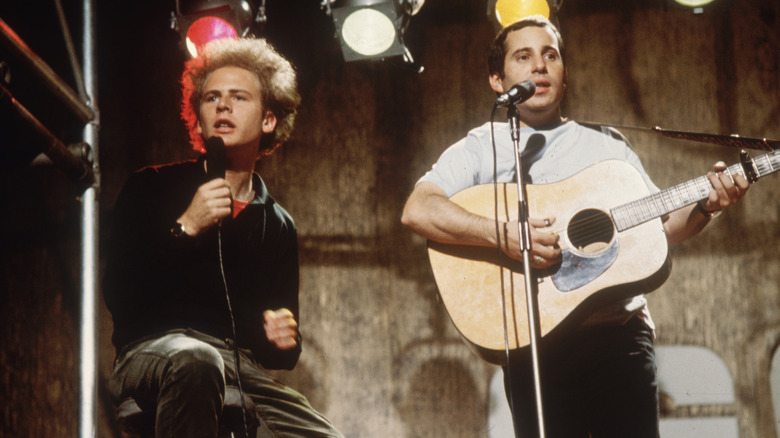
Bedrooms, street corners, showers, prisons, or even just a silent mind: Though songs can live anywhere, only a few make it to recording. Folk rock duo Simon & Garfunkel said as much in 1966's "The Sound of Silence" in the famous line, "People writing songs that voices never shared." And some works live on as hit folk rock tunes, no matter that we don't know who originally wrote them.
This is exactly what a "standard" is: An old song that's gotten played again and again to the point where it's embedded in sociocultural fabric, though we don't know where it came from. Timeless in quality and sound, examples include nursery rhymes like "London Bridge Is Falling Down" or "Mary Had a Little Lamb." Each has an unknown author, some kind of folkloric background, and history spanning hundreds of years. It's not a stretch to see how such standards got adopted for folk and folk rock music, as folk genres tend to focus on the singer and pared-back instrumentation while allowing the song's core composition to come to the forefront. In the hands of skilled musicians, such tracks can be instrumentalized and interpreted in ways that make them not only viable for the 20th and 21st-century music industry but also bona fide hits.
We mentioned Simon & Garfunkel, who masterfully interpreted "Scarborough Fair" into such a song. "House of the Rising Sun," "Whiskey in the Jar," and others likewise found life in the capable hands of artists who made good on the songs' unknown authors.
Scarborough Fair — Simon & Garfunkel
Have you ever thought that folk rock duo Simon & Garfunkel's "Scarborough Fair" sounds like slumping against the wall of a tavern with a tankard of ale in hand while listening to a medieval bard (if they even really existed)? All dubiously accurate imagery aside, "Scarborough Fair" is likely a Renaissance song dating back to at least 1670. That said, the song references an actual fair in Yorkshire, England, from the 1300s, so some folks think the track is actually medieval. Regardless, no one knows who wrote this standard that evolved into nearly 600 official covers across genres and decades.
Everyone knows the Simon & Garfunkel version of this song, though, released as "Scarborough Fair/Canticle" on 1966's "Parsley, Sage, Rosemary and Thyme," aka one of the song's most famous lines. Part of the fascinating history of their rendition relates to the word "Canticle," a reference to an earlier, anti-war Paul Simon song called "The Side of the Hill." Simon interwove this song's melody with "Scarborough Fair" to make a dual track influenced by the folk music revival of the time, despite being released post-1965 folk rock explosion.
Simon & Garfunkel's "Scarborough Fair" sounds dreamy. It's written in a very haunting Dorian musical mode, contains lots of acoustic fingerpicking, and doesn't exactly have loads of distorted power chords. But its polished sound, modern recording techniques, layered studio tracks, and mid-60s release not only provided us with a definitive version of the song but also a definitive folk rock version.
House of the Rising Sun — The Animals
In terms of sheer numbers, "House of the Rising Sun" is one of folk rock's most covered songs, if not the most, at over 860 official takes and counting. Guided by singer Eric Burdon's powerful vocals, an instantly recognizable main acoustic guitar line, and organ work suitable to a Wild West saloon showdown, the Animals' version of this song became our go-to rendition in 1964. And even though the Animals was a rock band, prominent covers from Bob Dylan, Joan Baez, and Joni Mitchell center it firmly in the folk-to-folk-rock lineage.
Clarence "Tom" Ashley, one of the musicians who recorded the first 1933 version of the song along with Gwen Foster, heard the song from his Civil War-era grandfather. There are also a couple locations in New Orleans, where the song is set, that might connect to its origin. First, there was a hotel called Rising Sun that burned down in 1822 that might have somehow served as inspiration for the song's brothel and themes of moral deterioration. Then, New Orleans saw another restaurant-type establishment called The Rising Sun pop up in the 1860s. But beyond these uncertain connections, we've really got no idea where the song came from or what events inspired it.
The Animals did a bang-up job instrumentalizing the tune, however, morphing it from light acoustic fare into something brooding, rocky, and even a bit disturbing. And of course, all credit to Lead Belly, whose 1944 solo guitar rendition was rhythmically driving enough to presage the Animals' version.
Whiskey in the Jar — Thin Lizzy
You already know the refrain if you're a Metallica fan: "There's whiskey in the jar-o." Okay, Thin Lizzy's Phil Lynott did the same "o" thing at the end of "jar." And yes, Lizzy did their cover way earlier in 1972, though it was only released as a single and didn't appear on any full-length release until 1991's CD reissue of the 1973 album, "Vagabonds Of The Western World." Thin Lizzy were Irish, the song remained No. 1 in Ireland for 17 weeks on initial release, it's folk-rock enough to make our cut, and it's about getting drunk and getting into fights. The song is so drunk, in fact, that it doesn't remember anything about who wrote it.
We at least know how old "Whiskey in the Jar" is — sort of. As Irish Central tells the tale, the song is about a highwayman, Patrick Fleming, who was hanged in 1650. All of the antics in "Whiskey in the Jar" seemingly refer to him: rapiers, cannonballs, Molly and her chambers, Captain Farrell, fowlin', imprisonment, and so forth.
The first modern interpretation of this folk standard dates to 1941 and singer/someone's grandma Lena Bourne Fish under the title "Gilgarrah Mountain." Her version sounds like someone stuck a mic in her kitchen while she was baking a pie and singing. As charming as this is, Thin Lizzy took the song and rendered it cool and rocky but with folk elements, crafting an arrangement that Metallica later mirrored for their 1998 version from "Garage Inc." This song of unknown origin has been officially covered over 230 times.
Where Did You Sleep Last Night — Nirvana
Disregard what Kurt Cobain said about Lead Belly before Nirvana launched into "Where Did You Sleep Last Night" during 1993's "MTV Unplugged." Lead Belly did not write "Where Did You Sleep Last Night," which he covered in 1944. But the legendary singer did lend the song his signature proto-rock sound, which echoed forward through artists such as Marianne Faithfull, the Osborne Brothers, the Grateful Dead (a folk-rock deep cut), and most famously, Nirvana. Cobain's anguished performance, especially his harrowing gaze, left a permanent mark on listeners and the music world as a whole. And no one knows where the song came from.
As far as we can narrow it down, "Where Did You Sleep Last Night" — aka "In the Pines," "Black Girl," "True Love True Love," "The Longest Train I Ever Saw," and other names — can be traced back to somewhere in late 19th-century Appalachia. Per KZSC Santa Cruz 88.1, researcher Judith Mculloh uncovered 160 versions of the song with tweaks in the lyrics, including early versions citing "Joe Brown's coal mine," a reference to Civil War-era Georgia governor Joseph Emerson Brown (in office from 1857 to 1865). No matter what, the core story features a wife or daughter going to a pine forest either to commit wrongdoing or escape consequences for wrongdoing, like a piece of folklore.
Cobain picked up the baton and crafted his own version of the song, using Lead Belly as his foundation. And bizarre as it is to hear, Nirvana's version is folk rock. That's what "MTV Unplugged" largely performances were, removed several decades from the Dylan-spearheaded '60s folk rock boom.
Gallows Pole — Led Zeppelin
Shifting from folk to folk rock and all-out rock by the end of the song, Led Zeppelin's take on "Gallows Pole" from 1970's "Led Zeppelin III" is easily one of the band's most underrated and overlooked songs. Starting with Jimmy Page's shimmering acoustic guitar work and layering a mandolin and banjo into the lush mix, it's almost enough to make you forget that the song is about someone getting hanged. Who got hanged, where and when it happened, or who wrote the song — we've got absolutely no idea. We don't even know what country the track comes from, which makes it the most mysterious of our choices in addition to being the least covered (around 90 official versions).
While the first recorded version of "Gallows Pole" dates to 1920's "The Gallows Tree" from Bentley Ball, the song has cropped up again and again across a host of countries from Russia to Sicily. It appears across Europe, even in non-contiguous landmasses like Scandinavia and England, meaning it had to travel over the ocean. In England, the track's story first appears in 1770 as a folk tale about a girl who gets hanged because she loses a golden ball and has been called "The Briery Bush," "The Prickly Bush," "The Maid Freed from the Gallows," "The Hangman Song," and "The Gallis Pole" (from Lead Belly, yet again).
Led Zeppelin took this traditional song and crafted a superb, one-of-a-kind, top-tier masterwork that built on all the songs that came before, including folk, bluegrass, and blues. Then, the band gave it their definitive rock slant.