

This 1975 Queen Masterpiece Took Years To Make — And It Almost Didn't Get Released
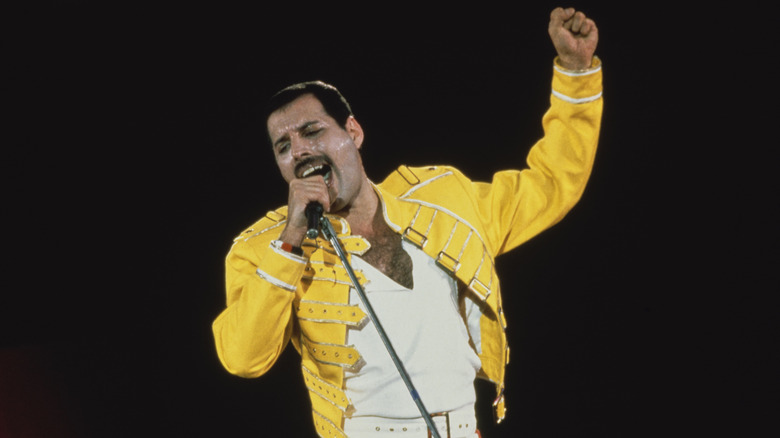
Despite the much-loved "Bohemian Rhapsody" being now considered among the finest songs ever recorded, the origins of the theatrical hard rock classic were torturous for the members of Queen. In fact, we now know that "Bohemian Rhapsody" nearly didn't exist at all, despite Freddie Mercury spending years building up the material for the classic song.
When it comes to rock songs of vaulting ambition, few can compete with Queen's "Bohemian Rhapsody." The grand operatic track, which spans six and a half minutes and features a capella harmonies, balladic piano passages, heavy riffs, and soaring solos, is like little else that has climbed the charts since the dawn of popular music. The tale of the song's creation is one of intense friction between members of Queen and their record label, and as usual in such arguments, it boiled down to whether it was commercially viable or not.
It is a testament to the originality of "Bohemian Rhapsody" that, back in 1975, Queen's own label seemed unwilling to take a risk on it, despite the band's growing worldwide fame.
The creation of Bohemian Rhapsody
"Bohemian Rhapsody" was primarily the creation of Queen's legendary frontman Freddie Mercury, into which he poured a wide array of disparate musical, historical, and theatrical references to create what many fans believe to be his masterwork. In fact, the song initially began as three distinct compositions that Mercury, Queen, and their studio engineers then stitched together to create what Mercury famously described as a "mock opera" (via Metro). Mercury was a big fan of the traditional genre, as "A Night at the Opera," the 1975 studio album on which "Bohemian Rhapsody" is found, explicitly reveals.
Reportedly, Mercury's vision for "Bohemian Rhapsody" predated Queen, with the musician beginning to form his ideas for the epic track sometime in the late 1960s. But it took until the mid-1970s for the technology required to produce it to become readily available. This was the era of the 24-track recorder, which allowed Queen to repeatedly layer countless vocal takes across a range of octaves to get the enormous operatic effect the track required.
Queen overcame record executive misgivings
The recording of "Bohemian Rhapsody" took many weeks, but what eventually emerged from the studio sessions was exquisite. Nevertheless, the long runtime, stylistic shifts, non-commercial arrangement, lack of a traditional chorus, and the famously cryptic, confusing lyrics of "Bohemian Rhapsody" meant that Queen's record label was initially unwilling to release the song as a single. "A Night at the Opera" was reportedly the most expensive album ever recorded at the time, and executives were far from comfortable with the idea of promoting the album with a single that they thought wouldn't be able to attract radio play or catch the ear of rock fans.
But the members of Queen stood firm in their belief that the song needed to remain in its entirety, even on rock radio. The label relented, and despite initial mixed critical reactions, "Bohemian Rhapsody" quickly took on a life of its own, peaking at No. 9 on the Billboard Hot 100 in 1976. In the U.K., the song hit No. 1, spending a total of nine weeks at the top of the chart, vindicating Mercury's belief that ambitious, progressive rock could still prove to be a commercial hit.
"Bohemian Rhapsody" has had several revivals, charting again in the wake of Freddie Mercury's death in 1991, and again after its inclusion in the movie "Wayne's World" in 1992, when it climbed even higher in the U.S., reaching No. 2. It made the Billboard Top 40 once more in 2018, following the release of the Queen biopic "Bohemian Rhapsody." It has since been included in the National Recording Registry by the Library of Congress for its artistic significance.