

The No. 1 Song On July 23, 1968 Sounds Even More Free-Spirited Today
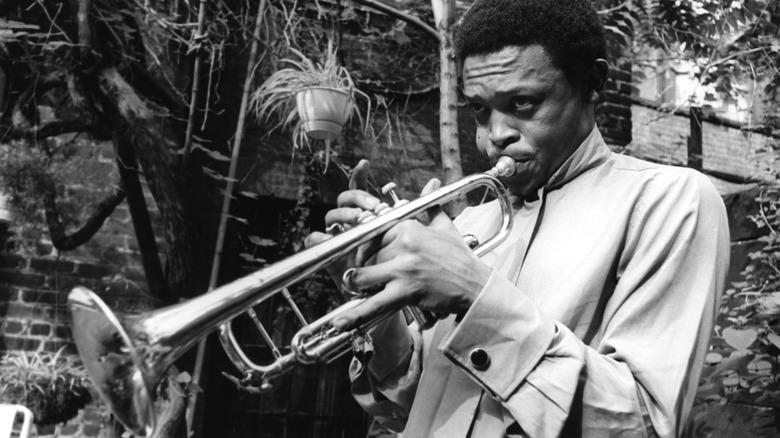
1968 was quite a transformative year in music. It was full of songs that defined rock history and some of the best bluegrass albums ever. But it was also when novelties and soft pop dominated the Billboard charts (it was the biggest flop of the decade for No. 1 hits). Yet the "flower power" spirit of the '60s gave us one last hit, a song full of freedom and joy: Hugh Masekela's "Grazing in the Grass," which reached No. 1 on July 23, 1968.
While not the first song that comes to mind when one thinks of the '60s, "Grazing in the Grass" is a triumph. Hugh Masekela was born in Witbank, South Africa, in 1939. Just short of his 30th birthday, this kid who grew up under the racist apartheid regime had reached the top of the charts in America. How he got to that point is itself a testament to the spirit of freedom — and it makes his sole chart-topping hit even more incredible.
A Zambian novelty song inspired Hugh Masekela's only No. 1 Hit
While raised by his grandmother, Hugh Masekela developed a love for music. He played piano and listened to jazz. As a teen, he became enamored with the trumpet after seeing "Young Man With a Horn," a biopic about jazz musician Bix Beiderbecke. Masekela's mentor, Bishop Trevor Huddleston, bought him a second-hand trumpet as a way to quell his rowdy behavior. "In two weeks, I was playing songs from 'Young Man With a Horn," Masekela said in "The Billboard Book of Number 1 Hits." "I was obsessed."
Bishop Huddleston was soon deported to England for his civil rights activities. The chaplain then helped Masekela earn a scholarship to the Royal Academy of Music in London, hoping to give him a life outside of the oppressive apartheid regime. A year after that, in 1960, singer-songwriter Miriam Makeba (with help from her friend, Harry Belafonte) secured Hugh a scholarship at the Manhattan School of Music. Masekela worked for Belafonte's music publishing company while playing with Makeba and starting his own career.
"I was in Zambia to visit my sister at the beginning of 1968," Masekela explained in "The Billboard Book of Number 1 Hits." "It was the first time I'd been in southern Africa in 10 years. A friend of mine who wrote a lot of songs laid a tape on me." The song was likely "Mr. Bull #4" by Freddie "Mr. Bull" Gumbi. When Masekela's eighth album, "The Promise of a Future," was short one song, his sax player suggested covering the novelty song. Philemon Hou, an actor/composer, helped compose the melody, turning the novelty song into Masekela's biggest hit.
A vocal version by the Friends Of Distinction went to No. 3 a year later
"Grazing in the Grass" was released in March 1968 and reached the top of the Billboard Hot 100 by July. Stereogum described it as "a sprightly, energetic tune that's dominated by its big central horn riff," and it certainly is a showcase for Hugh Masekela's skills. On "Grazing," his trumpet is absolutely radiant, like a magnificent sun on a cloudless day, overlooking a picturesque field of green. The easy-listening jazz vibe resonated with those who had been rocked by the turbulent '60s, resulting in the song selling 4 million copies.
A year later, the song once again found its way near the top of the charts. The Friends of Distinction, a soul pop group managed by football star Jim Brown, recorded a version, with singer Harry Elston whipping up lyrics to match the bovine vibe. "We'd drive past pastures, cotton fields, cornfields. I'd always see these cows, just grazing, so peaceful," Elston told Rebeat magazine, "and I'd think to myself, 'You know, they have it made.'" Their version peaked at No. 3 on the Hot 100.
Masekela's original version embodies this sense of freedom, a theme that would be constant throughout his work. "I don't think any musician ever thinks about making a statement," he told The Guardian in 2012. "I think everybody goes into music loving it." However, Masekela would make a statement with anti-apartheid songs like "Soweto Blues," "Bring Him Back Home" (about Nelson Mandela), "Been Such a Long Time Gone," and "Stimela (Coal Train)."