

The No. 1 Song On August 11, 1987 Sounds Even More Soul-Searching Today
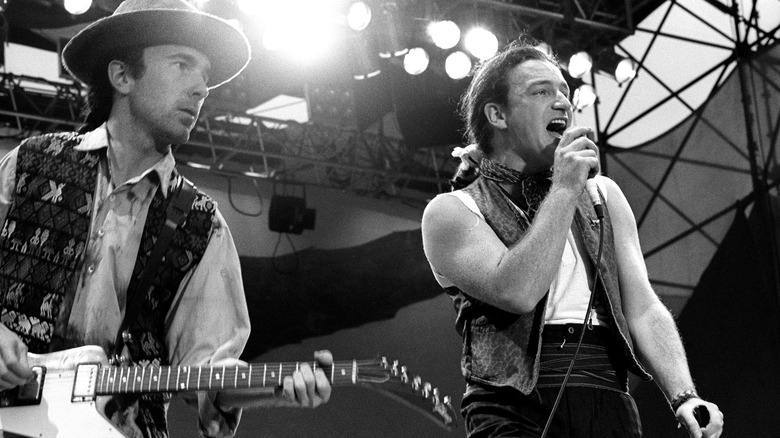
Irish rock gods U2 were riding high in the Summer of 1987 thanks to the success of "Joshua Tree," their first No.1 album, as well as the pair of No. 1 Hot 100 singles it spawned. After "With or Without You" dominated the spring, holding the No. 1 spot the longest in 1987, it was followed by "I Still Haven't Found What I'm Looking For," a contemplative blend of gospel and rock that spent two weeks at No. 1 in August.
There has been a lot of praise heaped upon the song in the years since its release, like Rolling Stone ranking it one of the 100 greatest songs of all time in 2004, and its success is tied to its uniquely hypnotic music and its almost mythological sense of yearning. "I Still Haven't Found What I'm Looking For" represents U2 at their best, blending their atmospheric post-punk-inspired rock with resonant lyrics that connect universal struggles and higher ideals. That combination of etherealness and timelessness is one reason why the soul-searching "I Still Haven't Found What I'm Looking For" sounds even better today.
Where I Still Haven't Found What I'm Looking For Came From
Unsurprisingly for a song as seemingly pitch-perfect as "I Still Haven't Found What I'm Looking For," it took a long time to reach its final form and went through many iterations in the process. Known at different points throughout '86 as "Under the Weather," "The Weather Girls," "Under the Weather Girls," and "Desert Of Our Love," the original kernel that would grow into "I Still Haven't Found What I'm Looking For" was a Larry Mullen Jr. drum line.
As producer Daniel Lanois told Hot Press, "We always look for those beats that would qualify as a signature for the song. And that certainly was one of those ... we just didn't want to let go of that beat, it was so unique." As Lanois goes on to explain, the Edge added his guitar to it next, and it continued slowly building, gradually taking on the more gospel-inspired qualities we know from the final product. Bono's input is responsible for the overwhelming majority of the religious components, and according to the Edge, they were just what the song needed.
In the Book "U2 by U2," Edge describes Bono's addition to the song by saying, "There are only a few moments of full-on electricity-in-the-air creativity that I remember from the making of [Joshua Tree], but the birth of 'I Still Haven't Found What I'm Looking For' is One." He describes how Bono "just nailed this fantastic melody that came out of a classic soul tradition" and from then, the song's greatness and eventual success started to become obvious.
The lyrics And Music of I Still Haven't Found What I'm Looking For
Despite how strongly Bono's Christian background pervades the lyrics of "I Still Haven't Found What I'm Looking For," they're written in a way that feels applicable to anyone searching inward for answers. It's about the meaning of life in a way that constantly contradicts itself, all to make it clear that there is no one meaning for all of us. In his symbolic manner, Bono reminds us that "honey lips" and "healing fingertips" might actually "burn like fire" to some, but — to contradict the contradiction — also ignite that "burnin' desire." And over and over, he reminds us that his long odyssey for answers only left him without what he's looking for.
Through one lens, "I Still Haven't Found What I'm Looking For" celebrates this lack of an answer, in a journey-is-the-destination kind of way. But it also expresses a genuine lack of faith and desperation to resolve that spiritual crisis. Bono once described the song to Rolling Stone as "an anthem of doubt more than faith," and it shows in the painful struggle the song's story conveys. The lyrics walk that tightrope between acceptance and desperation over life's lack of a unified objective, and it allows the song to speak to people on either side of the line, or as true for so many, those with contradictory feelings from both sides at once. No matter where you stand, "I Still Haven't Found What I'm Looking For" has a message for you of support and assurance, which helps explain why it still sounds so cool today.