

Guitarist Ranked Among Rolling Stone's Greatest Of All Time Celebrates 65 Today
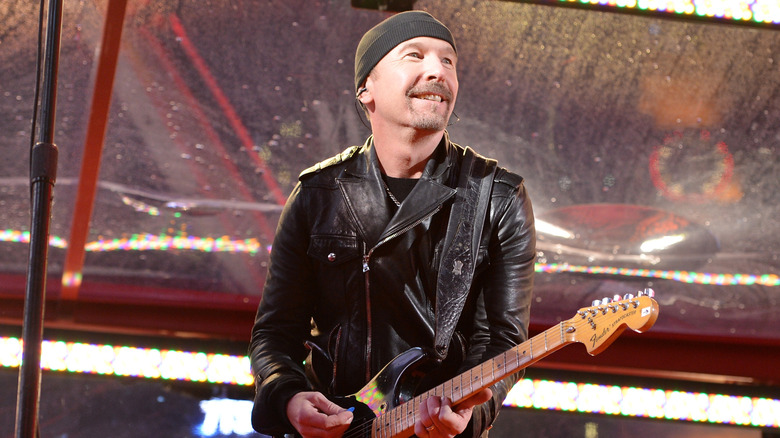
Perhaps more accurately described as "The Shimmer" rather than "The Edge," U2's one-of-a-kind guitarist stands out for precisely that reason: reverb-saturated, shimmering strums, a clean and clear tone, minimalistic, subtle chord shifts, and a focus on feeling and songwriting over flashy, attention-seeking shredding. Back in 2023, he made No. 47 on Rolling Stone's list of the best guitarists of all time. And on August 8, 2026, he turns 65.
The Edge, real name David Howell Evans, tends to get clowned on a lot in certain snobbish circles for not walking off-stage with bleeding fingertips every night. But does anyone else sound like him? Has anyone ever? Did another guitarist elevate U2's in their '80s "The Joshua Tree" heyday to become the biggest rock band in the world? We think not. The Edge began on the cutting edge of innovation, taking cues from punk in 1970's Dublin to fashion his own, effects-laden sound. He, Larry Mullen Jr., Adam Clayton, and Bono grew up in an Ireland afflicted by the Troubles, which inspired songs like Sunday Bloody Sunday. They knew each other at Mount Temple Comprehensive School, got together as teenagers to form U2, and have been together ever since, selling 111 million records worldwide, earning 22 Grammys, and changing the face of rock.
It's inconceivable to imagine U2's success, history, entire sound, and specific songs such as "With or Without You" (real meaning and all) without The Edge. His take on guitar music is what framed the lofty sentiments evident in U2's music and gave it the lift it needed to reach its heights.
The Edge's sound and legacy
The Edge has become such a prominent guitarist — and arguably the heart of U2's sound — because of his unique playing style. Echoing the minimalist prose philosophy of a person like George Orwell, The Edge cited the prevailing musical ethos of his youth, "Why play three strings when two will do?" to Off Camera with Sam Jones. The Edge is also a perfectionist when it comes to his guitar tone, but thrives off of spontaneous songwriting moments when the band is playing off each other.
Then there's the studio setting, in which U2 can craft and fine-tune sounds that wouldn't crop up otherwise, no matter that they consider themselves first and foremost a live band. Put differently, The Edge is who he is because U2 are who they are. In a different band with different people, he might not be Rolling Stone's No. 47 guitarist of all time.
As The Edge turns 65, it's reasonable to consider his legacy as well as his talent. Plenty of guitarists have cited him changing how they think of their instrument. As Rage Against the Machine's and Audioslave's Tom Morello said (via Guitar World), "The Edge has challenged conceptions of what an electric guitar should sound like." John Petrucci of Dream Theater said, "He has such a big, unique and unmistakably identifiable voice on the guitar," while Clint Lowery of Sevendust cites obvious Motown and funk elements blending into The Edge's playing in "Mysterious Ways," a song that proves that 1992 was U2's best year. Plenty of other guitarists also cite The Edge's creative use of effects and emotional playing, but even without such observations, fans can appreciate his legacy anytime they listen to U2.