

John Lennon Apologized For Rock's Most Infamous Remark 60 Years Ago Today
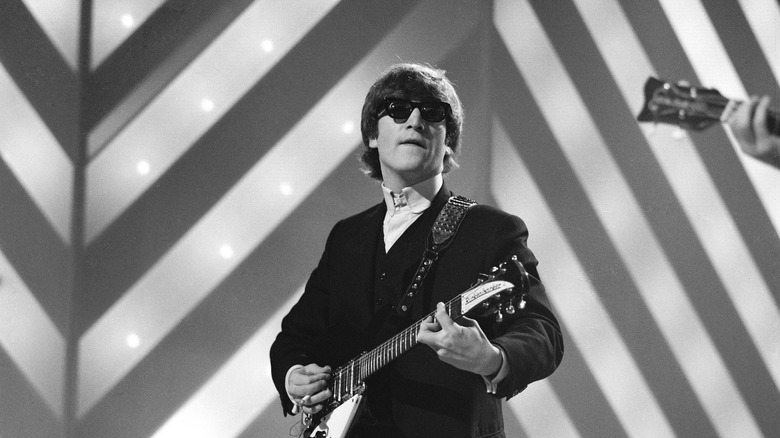
August 11, 1966, might be the day that the great Beatlemania wave finally broke, rolling back to reveal four scared, nervous 20-somethings fearing for their livelihoods — and their lives. It was on this day, 60 years ago, that John Lennon, flanked by Ringo Starr, Paul McCartney, and George Harrison, apologized for saying that the Beatles were "more popular than Jesus."
"I'm not anti-God, anti-Christ or anti-religion," a serious Lennon told reporters at Chicago's Astor Tower Hotel (per Rolling Stone). "I was not knocking it. I was not saying we're better or greater, or comparing us with Jesus Christ as a person or God as a thing or whatever it is. I happened to be talking to a friend, and I used the word 'Beatles' as a remote thing — 'Beatles' like other people see us. I said they are having more influence on kids and things than anything else, including Jesus. I said it in that way, which was the wrong way."
Lennon's comments have been viewed as rock's most infamous remarks, but the context of his comments has been lost in the past decades. And what we now see as a mild controversy had a profound effect on the Fab Four, leading the group to finally call it a hard day's night.
The backlash wasn't immediate
As the Beatles' legend grows, the "bigger than Jesus" comment becomes a point of parody. And while there are some myths you can stop believing about the Beatles, Lennon's comments are not one of them. The future "Imagine" singer made these remarks in the March 4, 1966, edition of the London Evening Standard while speaking with journalist Maureen Cleave for her series "How Does a Beatle Live?"
"Christianity will go," said a then-25-year-old Lennon. "It will vanish and shrink. I needn't argue about that; I know I'm right and I will be proved right. We're more popular than Jesus now. I don't know which will go first — rock & roll or Christianity. Jesus was all right, but his disciples were thick and ordinary. It's them twisting it that ruins it for me."
Lennon's comments didn't ruffle any feathers in the U.K. "In England, nobody took any notice," he reflected in 1974 (per the Daily Express). "They know this guy's blabbing off — who is he?" The same can't be said for America. In 1966, a few months after the interview, Datebook, a teen-oriented magazine, ran an article that took Lennon's comments out of context. The piece attracted the attention of Tommy Charles, an Alabama radio DJ and proto-shock jock who spearheaded a "Ban the Beatles" campaign. Al Benn, manager of the Birmingham office of United Press International, caught wind of the ban and filed a story about the Beatles causing a boycott. From there, the backlash took off.
John Lennon apologized on August 11, 1966: 'Never meant it to be a lousy anti-religious thing'
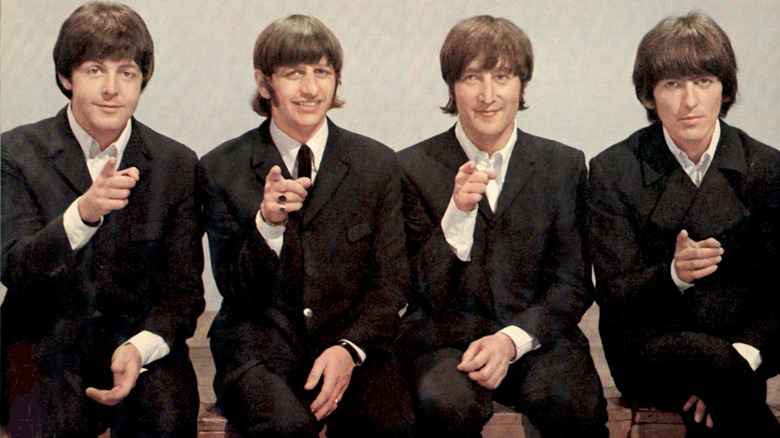
"The repercussions were big, particularly in what they call the Bible Belt," George Harrison said in the "Beatles Anthology" series. The hysteria wasn't just the South: Radio stations from New York to Salt Lake City jumped on the anti-Beatles boycott, pulling their music off the air. Churches organized burnings. The Vatican's official newspaper even commented that "some subjects must not be dealt with profanely, even in the world of beatniks."
Fearing the effect on the Beatles' 1966 U.S. tour, the band's manager, Brian Epstein, attempted damage control, resulting in Lennon speaking to the press in Chicago at the Astor Tower Hotel. "I never meant it to be a lousy anti-religious thing," Lennon told the reporters (via Rolling Stone). "I apologize if that will make you happy. I still don't know quite what I've done. I've tried to tell you what I did do, but if you want me to apologize, if that will make you happy, then — okay, I'm sorry."
"John had to apologize, not because of what he'd said, but to save our lives," Ringo Starr would say later on. The whole incident changed the band and how they approached the rest of the '66 tour. "I didn't want to tour again," Lennon said in Chicago, "especially after having been accused of crucifying Jesus when all I'd made was a flippant remark." And so, they didn't. After four years of nonstop touring, the group wouldn't play together again until their final public performance on the rooftop of Apple Corp. offices in 1969.