

The 5 Best Yacht Rock Solos Of All Time
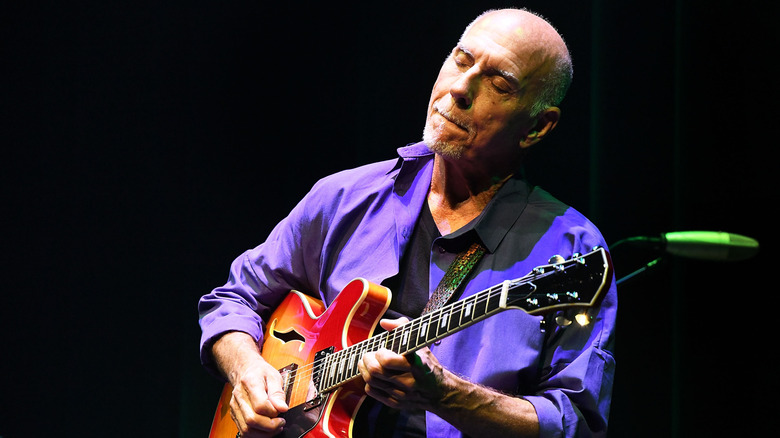
Nestled within the bizarre history of yacht rock is a wellspring of musical talent that deserves to be celebrated, including some superb solos. The concept of "Yacht Rock" occupies an unsteady place in the minds of many musicians. It's one of those terms like "smooth jazz" or "stadium country." Such expressions codify an enduring style of music that resonates with people the world over, but also signal mainstream banality and a grouping together of artists that are only superficially related.
With that in mind, we wanted to examine solos that showcase notable technical skill while still amplifying the gentle escapism that gives the genre its character. The best yacht rock solos are a feast for the ears and still manage to be atmospheric in the same breath. Whether it's the innovative jazz/rock fusion of the aforementioned Steely Dan or the psychedelic virtuosity of the Doobie Brothers, the musicians behind yacht rock have a lot to say in their solos.
25 or 6 to 4 — Terry Kath with Chicago
Speculation may abound with regards to the mysterious numerology in the song's title, but Chicago's "25 or 6 to 4," with Terry Kath's hard-rocking power-chord guitar riff and driving horn section, satisfies the heavier side of yacht rock (paradoxical as that idea may be). At the time of the song's release on 1970's "Chicago II", the band was still hungry and that youthful edge propels the track forward. But while the song was a smash in its own right, it was Kath's furious fretwork that emblazoned the track in the minds of a generation of guitarists.
Throughout the first two verse/chorus cycles, Kath injects high-octane electric blues that come off like a speed-demon Eric Clapton. That alone would be commendable, but the knuckle-busting phrases in the main solo are what set him apart. Where many guitarists of the era were happy to stay inside the four fret "blues box" so common to traditional rock soloing, Kath employs fluid legato phrasing that places him more in the camp of jazz masters. On top of that, his use of the wah-wah pedal infuses his leads with the kind of rhythmic cadences normally only heard in funk rhythm guitar.
It's a truly rip-roaring solo that illustrates why no less than Jimi Hendrix named Kath as a superior guitarist to himself, as well as the "best guitarist in the universe" (via Classic Rock History). The song would become a staple of the Chicago catalog and reach No. 4 on the Billboard Hot 100.
Green Earrings — Denny Dias and Elliot Randall with Steely Dan
With displays of instrumental virtuosity factoring so prominently in the Steely Dan catalog, it's only inevitable that the group would appear on any list of the best yacht rock solos. The more pressing question is which song to choose? Sheer technical capacity isn't enough, so instead, let's consider the atmospheric substrates of yacht rock. Enter "Green Earring."
Found on Steely Dan's 1976 LP "The Royal Scam," this up-tempo funk number, with its nonstop hi-hat groove and syncopated dialogue between accompanists, affords us two guitar solos courtesy of Denny Dias and Elliott Randall. In a song that celebrates beauty accentuated by exotic jewelry, Dias and Randall showcase their keen ability to capture thematic elements with technical mastery. Dias' solo enters first and builds to a deft fretboard harmonic, followed by lyrical, reverb-heavy phrases that capture the gentle feeling of faraway concerns on a relaxing tide.
Randall follows with a grittier edge, but one that gives the technical aficionados something to chew on, and while there's more wah-wah-drenched psychedelia in his phrases, they're no less full of escapism.
I Really Don't Know Anymore — Larry Carlton with Christopher Cross
It seems like every Larry Carlton guitar solo is the stuff of legend. A wealth of session gigs throughout the 1970's and a slew of virtuosic solo albums enshrined him as one of the signature guitarists of the yacht rock stable, and his work on Steely Dan's "Kid Charlemagne," just as with the real story behind the song, carries much historical weight. However, his solo on "I Really Don't Know Anymore," from Christopher Cross' 1979 self-titled LP, truly stands out.
What really sells the solo is Carlton's extraordinary tone control. When he's burning across the fretboard at lightning speed, each individual note still soars with the intoxicating fluidity of his sustained passages. That subtle command of soulfulness, no matter how intricate the phrases, gives Carlton his shine. The result is a solo that maintains and accentuates the up-tempo excitement of the song without ever losing that ethereal, drifting-away feeling that makes yacht rock attractive in the first place.
"I Really Don't Know Anymore," buttressed as it is by the instantly recognizable backing vocals of yacht rock mainstay Michael McDonald (one of the backup singers that put '70s rock on the map), would have been superb even without Carlton's involvement. Nevertheless, the jazz fusion maestro proves his enduring worth once again.
Let Me Love You Tonight — David Sanborn with Pure Prairie League
"Let Me Love You Tonight," Pure Prairie League's biggest hit at No. 10 on the Billboard Hot 100, is the full realization of the sonic innovation heard throughout their career. The album on which the song is included, 1980's "Firin' Up," saw Pure Prairie League prove that yacht rock's sophisticated jazz sensibilities were more than adaptable to cowboy culture. By that point, the band had spent the better part of a decade as purveyors of a more polished version of the template laid down by Lynyrd Skynyrd, Little Feat, and the Eagles: down-home good ol' boy sonic aesthetics blended with jam band interplay and radio-friendly hooks. And the evolution of the band's sound heard in "Let Me Love You Tonight" is down to the fiery alto saxophone work of session player David Sanborn.
A seasoned veteran of hired gun work, Sanborn lays down the kind of Motown-inspired soul in "Let Me Love You Tonight" that the League's back catalog up to that point seemed to be yearning for. It's fluid, lyrical phrasing that is never overdone, even when given the spotlight. The result is a song that proves yacht rock can find a home at any port.
Time Passages — Phil Kenzie with Al Stewart
If there's one saxophonist whose scorching solos define the yacht rock ethos, it's Phil Kenzie, and his performance on Al Stewart's (pictured above) 1978 hit "Time Passages" is a superb example. It's a stunning performance that begins with a reality-defying high-end screech and dips down into a series of emphatic benedictions by a soloist who never seems to run out of air. Kenzie knows how to hit the changes; each new chord seems to be yearning to keep up with him instead of the other way around.
Kenzie's extensive oeuvre includes sessions with Sir Paul McCartney, Leon Russell, and the Eagles among many, many more. But it's his work with Al Stewart that feels the most pertinent to yacht rock. Though Stewart is a hit maker par excellence in his own right, his two Top 10 singles, "Year of the Cat" and "Time Passages," both feature Kenzie. In the latter case, the solo is so stirring that the rest of the song seems to drop away as though it were meant as a vehicle for Kenzie all along.