

5 Patti Smith Songs That Prove She Was More Than A Punk Rock Icon
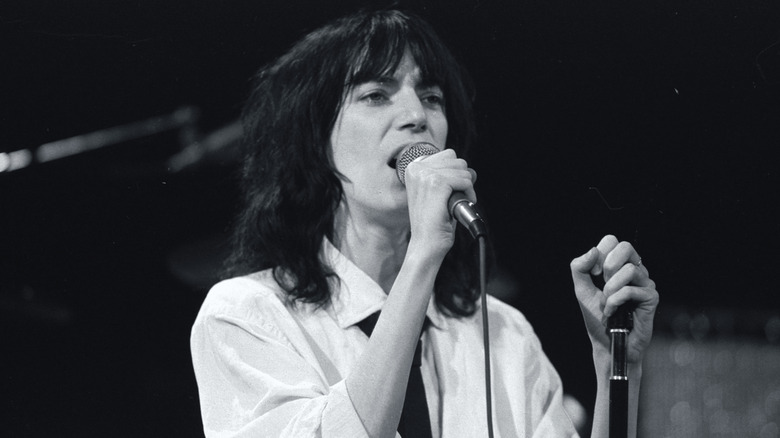
Now known as the "godmother of punk," Patti Smith's emotional and raw lyricism blended with classic rock 'n' roll, establishing a blueprint for the genre that still resonates with audiences today. However, Smith herself doesn't care much for the label, and while she's cited bands and artists such as Lou Reed, the Velvet Underground, and Television as some of her biggest influences, even her earliest albums didn't strictly adhere to the punk playbook.
Patti Smith's poetry, stage presence, and creative eye all help make her vision unique, but it was her part in the artistic revolution in New York in the '70s that truly sculpted her musical formula. Drawing inspiration from Native American folk music, pop, jazz, and melodic alt-rock, plenty of her most beloved tracks stray drastically from the punk rock sound. Even if they would become foundational to the culture's sound, Smith's approach was more sincere than stylized.
From a touching tribute to Amy Winehouse to a heartfelt song of longing for her absent partner, here are five stand-out tracks from across her career that prove she's more than a punk rock icon.
Ghost Dance
From Patti Smith's 1978 album "Easter," the track "Ghost Dance" definitely feels spatially different from the rest of the album. Acoustic guitar strums set the melody for a chorus of chants, embellished with rhythmic drums and tambourine rattles. Smith's own repetition of "Tayi-taya tay-aye-aye" throughout the song turns the motif into a prayer – a common theme throughout much of her work.
After Hollywood popularized an idealized concept of the "Wild West" during the '40s and '50s, musical acts such as Buffy Sainte-Marie – the first Indigenous person to win an Academy Award – and Redbone pushed back against stereotypical portrayals of Indigenous people in the '60s and '70s. Smith's "Ghost Dance" feels a lot more researched and careful than simply imitating tribal music, understanding the communal musical traditions and how they form layers within songs.
While Smith has other songs that remain culturally questionable, "Ghost Dance" almost reads as a recognition and honor of the native spirit of the country. Given that the track came out nearly fifteen years after the Voting Rights Act gave Indigenous people the right to vote in 1965, the song feels like an affirmation of how our histories are all interconnected.
Dancing Barefoot
There are plenty of standout tracks on Patti Smith's 1979 album "Wave," but the hypnotic melody, soaring vocals, and electric chorus of "Dancing Barefoot" feel both futuristic and present simultaneously. It's no surprise that U2 would cover the song in the late '80s, and the track would prove inspirational for the alternative rock subgenre, including '90s bands such as Placebo and Nirvana.
Co-written by Ivan Kral, Smith shared on her old, since-defunct website how the song came from the concept to "... write a lyric line that would have several levels — the love of one human being for another and the love of ones creator. So in a sense, the song addresses both physical and spiritual love." Smith dedicated the song to the mistress of Italian artist Amedeo Modigliani, Jeanne Hébuterne, and it was also heavily inspired by Jim Morrison of the Doors, down to the poetic structure and Smith's vocal execution. She wrote about how "I wanted the verse to have a masculine appeal and the chorus to have a feminine one," allowing her to embody Morrison's rhythmic musings throughout the verses before breaking out into poetry in the outro.
Frederick
The opening track off of "Wave" already sets a precedent for genre-bending, and Patti Smith's "Frederick" surely doesn't disappoint. Named after her then-future husband, Fred "Sonic" Smith, the electric interludes and upbeat drums bring an air of optimism and hopeful love, but the lyrics still manage to reflect some level of longing.
Being in a relationship with an artist can mean long periods of separation while touring, and Smith seemingly laments this in "Frederick." Lyrics such as "Frederick, name of care / High above in sky that's clear / All the things I've been dreaming of / Are expressed in this name of love" help to immortalize her idealization and love for her fiancé, interjected by a reminder of "Bye, bye, hey, hey." Her coming and going, despite affirming that "Frederick, you're the one," shows how love transcends greetings and farewells, lingering on eternally within the song.
The pair had two children together and remained married until Fred died of sudden heart failure in 1994, after which Patti moved back to New York and channeled her pain into poetry. However, despite the rather tragic tale of the real Frederick, the song still stands out as one of her brightest and most euphoric tracks from this era.
This Is the Girl
Artists tend to inspire each other, and considering Patti Smith's finger on the ever-evolving pulse of culture, it makes sense that Amy Winehouse remained on her radar. After the "Back to Black" singer's tragic death in July 2011, Smith shared with High Profiles how her 2012 song "This Is the Girl" off the album "Banga" was "like a little prayer" for the late singer.
The melancholic guitar melody, Smith's smooth vocals, and the building, almost gospel-like backing vocals in the chorus help the track truly feel like a swan song. Lyrics such as "This is the girl for whom all tears fall / This is the girl who was having a ball" help to celebrate Winehouse's profound sadness and effervescent presence, which Smith describes as being one of the central traits that drew her to the younger artist. In her High Profiles interview, she shared, "I was attracted to Amy Winehouse because she had an unbelievable voice."
She also explained how the piece occurred almost entirely by accident, saying, "I didn't know her, but when she died I wrote her a little poem and my bass-player just happened to write a little piece of music that fit[ted] it perfectly. It never occurred to me to write a song for her, it just happened." She also detailed how Winehouse was the same age as her own children, making her tribute more maternal than morbidly fascinated. Regardless, although not remotely punk in nature, "This Is the Girl" showcases how all musical strands are interconnected.
Because the Night
Her only true commercial hit, Patti Smith's "Because the Night" put the punk icon in a tricky spot. Despite having already amassed a cult following for her harder rock 'n' roll sound, she would hardly turn down the opportunity to take on Bruce Springsteen's unfinished work. Her punk vocal style was still present, and the combination of a classic rock chorus and Smith's genius lyricism helped to turn this scrapped track into a hit.
The story goes that producer Jimmy Iovine, who was producing Smith's album, knew that her musical prowess warranted at least one hit. He singled out Springsteen to write a love song for Smith, who graciously handed over a long-abandoned demo for "Because the Night." Smith shared in a 2010 interview with American Songwriter, "I listened to it over and over, trying to distract myself from waiting for Fred, and I was so agitated and so antsy. I hoped it could distract me from waiting for Fred. That's why the lyrics say, 'Have I doubt when I'm alone / Love is a ring, the telephone.'"
Being inspired by her muse, Fred "Sonic" Smith, and a very relatable scenario, it's no wonder the track peaked at No. 13 on the Billboard Hot 100 chart in 1978. It may not be punk, but anything Smith manages to touch becomes saturated with her sense of conviction and genuine heart.