

5 Dolly Parton Songs That Prove She Was More Than A Country Music Icon
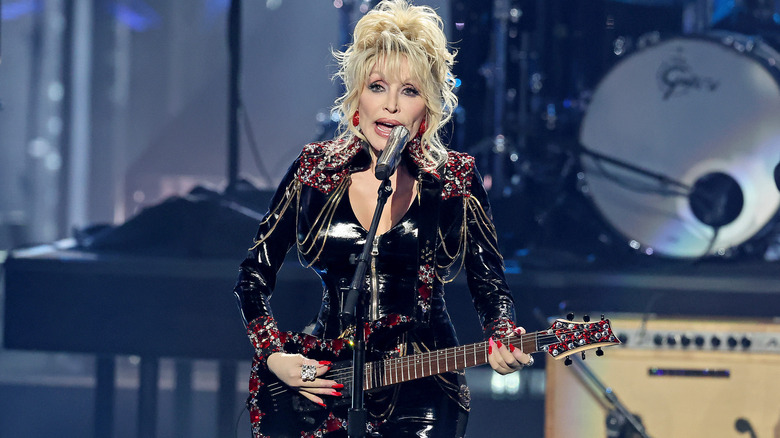
Calling Dolly Parton a country singer is technically true, but it's also an incredible understatement when considering the number of times she's successfully expanded beyond that genre. Parton (you could just say Dolly, and everyone would know who you mean), with her fame, philanthropy, and good vibes, is one of the few structures still doing the thankless work of holding the United States together and cheering up the people of the world. And she does it all with a wide smile and a gigantic blonde wig firmly in place.
She's a movie star, singer, songwriter, sex symbol, gay icon, women's empowerment success story, tycoon, theme park magnate (Dollywood is still going strong!), humanitarian, and more. Even if you focus just on her music, she's always been able to grow beyond country while keeping her roots planted just where they always have been. Breaking boundaries and taboos, Parton's music has always been bigger and bolder than it appeared at first glance. From an oil-themed precursor to one of her most famous tunes to the theme song of a Hollywood Parton vehicle, here are five of our favorite examples.
PMS Blues
Dolly Parton has never apologized for her gender, and has written and sung frankly about the female experience her whole career. But for every heartfelt tearjerker, she's written something sly, satirical, or just straight-up funny. So, when she turned her eye — and her guitar — on the often-unwelcome monthly visitor most women contend with, the result was the absolute humdinger "PMS Blues."
Parton's incredible lyrical genius is seldom on better display than in this song. Almost every line is quotable, though the star might be, "But a woman had to write this song, a man would be scared to / Lest he be called a chauvinist or just fall victim to / Those PMS Blues." Parton also has the musicianship (and understanding of a good joke) to set her words to a slightly up-tempo blues rhythm that blues lovers will clock right away — and that works perfectly for the bit. Some people still shrink at talking openly about the natural cycles of the human body, especially the female body; Parton sang it at full voice and got some well-earned laughs.
Banks of the Ohio
Dolly Parton has one of the most attractive personality traits a trailblazer can have: She knows exactly where she came from. Not only has she never lost sight of her native East Tennessee, but she also has an excellent understanding of American music history, allowing her to write, perform, and record across genres with authenticity and a love for her fellow musicians. And the famously upbeat Parton didn't even shrink from performing a classic American murder ballad (part of a long tradition of songs based on crimes), a version of "Banks of the Ohio" framed for a female voice.
Parton adds a quick verse at the beginning establishing herself as a prison journalist, and then she's off, with a male voice shadowing her as though to emphasize that she's quoting her interviewee. The song is a bleak one, telling the all-too-familiar story of a spurned man killing the woman he claims to love when she refuses him. Parton infuses the sinister tale with regret and humanity — perhaps more than the fictional killer deserves, but a testament to her craftsmanship nonetheless.
I'll Oil Wells Love You
Long before Dolly Parton wrote the immortal 1973 song "I Will Always Love You," she produced a punnier version written from the point of view of a refreshingly honest gold digger. "I'll Oil Wells Love You" describes meeting a Texas oilman with plenty of money and the narrator's understanding that Texas is a community property state, and so, if she can get him to the altar, she'll be rich.
Parton's wit flourishes here: "He looked into my eyes and thought he saw a love light shine / Little did he know that that light was dollar signs." But as mercenary as the tune is, it's not mean-spirited; the cash-hungry temptress and the lovestruck tycoon live happily ever after. And if Parton's accent was never quite as intense as that of dear Loretta Lynn, she knows well enough that her pronunciation of "oil" can be played for comic effect in the last line: "We'll live happily ever after 'cause all (pronounced like 'oil') is well that ends well." Playful but subversive, Parton's good-natured yet greedy gal is one of her most winning fictional females.
Why'd You Come in Here Lookin' Like That?
Dolly Parton has never fallen out of fashion and likely never will. More than that, Parton has long had a touch of bawdiness in her humor and a tendency to wink. Nothing crass, but we know this former farm girl knows how babies are made, and that comes out in songs like "Why'd You Come in Here Lookin' Like That?"
The male gaze gets more press (because it causes more problems), but let no one hearing this song doubt that Dolly has a female gaze — and that from time to time, she likes what she sees. The video presents Parton watching men audition for a part playing opposite her, giving her the agency to choose among the various knockoff Chippendales and Elvis impersonators lined up (before she notices a dishy stagehand). The lyrics, though they hint at a sad background story, pull no punches. Her ex is in the bar, and he's still hot: "In your cowboy boots and your painted-on jeans / All decked out like a cowgirl's dream." She knows a well-put-together man when she sees one.
Straight Talk
She can sell a song, but in her heyday, Dolly Parton could absolutely open a movie. She starred in some unquestioned classics, like "9 to 5," "The Best Little Wh***house in Texas," and even "Steel Magnolias," and she didn't even sing in that last one! But mercifully, blessedly, there is also such a thing as a Dolly Parton vehicle, in which she sings at least the theme song and stars as someone who was kind of Dolly Parton. Among the greatest of these is 1992's "Straight Talk," featuring Parton as a down-on-her-luck Southern gal who accidentally gets a job as a radio psychologist. And the song isn't half bad, either.
"Straight Talk" is not a good movie in the way movies get Oscars; no one survives cancer or World War II, and there's limited staring out at the ocean, but it's better: it's fun. The movie's catchy Parton-penned theme song is a big part of its appeal, of course, offering a thesis, a hummable refrain, and classic Parton sass in the lyrics: "Gimme some straight talk, straight talk and hold the sugar please / Straight talk, straight talk, sounds plenty sweet to me." She goes on, offering an anti-bullcorn litany of one-liners like "I hate a bunch of gibberish, so just spit it out real plain / Don't use big educated words from your BS Degree."
"Straight Talk," both the song and movie combined, is a perfect example of Parton's mid-level catalog: Her mid is a million miles above many people's star turns.