

5 Bruce Springsteen Songs That Prove 1984 Was The Best Year Of His Career
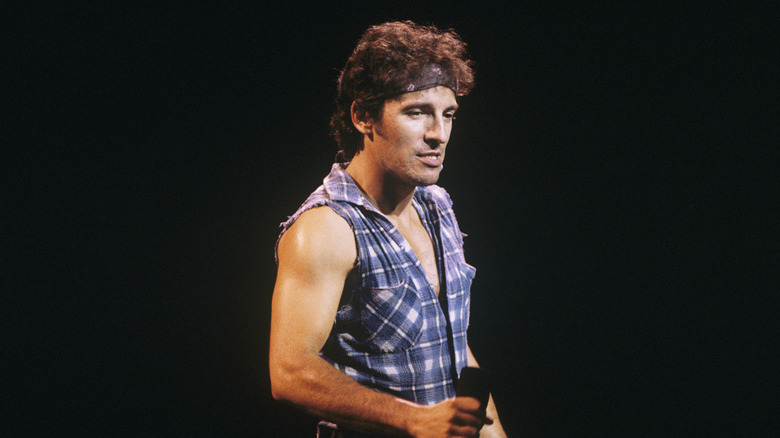
Rock 'n' roll legend Bruce Springsteen had an absolute hold on the masses at many times during his career, but there's one year when he was at a whole other level: 1984. Though years like 1975, his first major peak, gave the Boss extreme levels of commercial success, his work from '84 features more depth and an evolved sound yielded by Springsteen's decade and more in the industry — as well as a level of chart success that far surpassed his previous work.
1984 was the year that Springsteen released his smash hit album "Born in the U.S.A.," regarded by fans as one of the best rock records of the decade. This 12-song, 46-minute record compiled some of his best work to date, blending his innate mainstream catchiness with compelling content and arrangements that he'd built on from 1982's "Nebraska." "Born in the U.S.A." features many of his most memorable hits as well as some standout album cuts, all of which point very clearly to the undeniable quality of Springsteen's 1984 output. It was the best year of his career, among very stiff competition, and these five songs are why.
Born in the U.S.A.
"Born in the U.S.A." may not have been Bruce Springsteen's most successful song on the charts, but it may be his most iconic, and it's remained a rock 'n' roll staple to this day — as well as Springsteen's third most popular song, with over 600 million streams on Spotify alone. This American anthem features a distinctly '80s rock sound with rousing vocals and keys that feel made for radio play — and it indeed charted well, reaching up to No. 9 on the Billboard Hot 100 in early 1985 and spending a total of 18 weeks on the charts. The song blends his best traits as a songwriter and hitmaker for a clear example of his '84 greatness.
"Born in the U.S.A." is near the pinnacle of Springsteen's take on stadium rock, but with his own twist behind his heartfelt, raspy vocals and his knack for iconic melodies. The content of the song is more complex than its chorus implies, as Springsteen tells the story of a Vietnam veteran returning home. Despite the song's upbeat feel, its details and ending are a jarring contrast that make it a truly great rock song: "Down in the shadow of the penitentiary / Out by the gas fires of the refinery / I'm 10 years burnin' down the road / Nowhere to run, ain't got nowhere to go."
Dancing in the Dark
Though is doesn't embody the same protest power of "Born in the U.S.A.," "Dancing in the Dark" was Bruce Springsteen's most successful single ever thanks to its infinitely sticky melodies and chorus. Springsteen notably never achieved a No. 1 in the U.S. across his illustrious career, but this catchy track was the closest he ever got, peaking at No. 2 in the summer of 1984 and remaining on the charts for 21 weeks. It's an obvious mainstream success, though it's a different sound from the stadium rock that Springsteen was known for — instead, this song finds a simultaneously moody and groovy, subdued sound that is perfect, fittingly, for dancing.
The magic of "Dancing in the Dark" is best captured in its chorus, a simple but salivating handful of lines that Springsteen delivers perfectly: "You can't start a fire / You can't start a fire without a spark / This gun's for hire / Even if we're just dancing in the dark." The patently '80s instrumental behind it utilizes a quick drum groove and stellar synths to create an exceptionally cinematic atmosphere that plants the listener right into the song, whether it's their first listen or their hundredth. The charts and sound each reflect that this is Springsteen's best pop hit, showcasing his versatility as a rock 'n' roll mastermind. It's his most popular song today, with nearly 1.3 billion streams on Spotify.
Glory Days
"Glory Days" is the 10th track on "Born in the U.S.A.," and it brought a deep-track energy all the way to the Top 5 in the U.S. This nostalgic anthem ties "Hungry Heart" and "Brilliant Disguise" as Bruce Springsteen's second-biggest hit ever at No. 5, and it held a chart spot for 18 weeks. From its first note, the song has all the trademarks of an excellent Springsteen rock number: bright keys, light guitars, and an evocative feel that reflects its larger body of work — in this case, a distinctly American aesthetic.
"Glory Days" is simultaneously high energy and pensive, as Springsteen reflects on people he knew and the times they all look back on. Each verse is a different vignette, showing off the versatility of his writing: "I had a friend was a big baseball player ... Saw him the other night at this roadside bar / I was walking in, he was walking out / We went back inside, sat down, had a few drinks / But all he kept talking about was / Glory days / Well, they'll pass you by, glory days." Hardly any track on this album was truly a deep cut, and "Glory Days" shows off Springsteen's generational balance of thoughtful themes behind a catchy and show-stopping sound — both which were on full display in 1984.
I'm on Fire
Though it was released as a single in early 1985, "I'm on Fire" was first included on 1984's "Born in the U.S.A," and, like "Dancing in the Dark," it showcases Springsteen's chops as a blender of pop and rock. This Bruce Springsteen classic would end up peaking at No. 6 and spending 20 weeks on the charts across '85. This was another excellent success from the record, thanks to its completely infectious sound. The song is every bit as cinematic as "Dancing in the Dark," with a groovy bass line and mellow guitar chords that feel like a cool summer night.
"I'm on Fire" is short and sweet at only two and a half minutes, and Springsteen's voice pairs perfectly with the spacey production, especially as he sings the iconic opening that implies an affair with a married woman: "Hey, little girl, is your daddy home? / Did he go away and leave you all alone? / I got a bad desire / Oh, oh, oh, I'm on fire." You just can't beat the smooth power of this song, and fans today agree, as it has been streamed over 800 million times on Spotify — the second most popular of Springsteen's songs today, with each of the top three hailing from his 1984 record.
My Hometown
This last entry of the best Bruce Springsteen songs of 1984 — though the entirety of "Born in the U.S.A." could be placed here — is the album's final track, closing the definitive Year of the Boss on a contemplative and gorgeous note. "My Hometown" immediately follows "Dancing in the Dark" for a stylistic switch-up and a satisfying conclusion to an album that helped define Springsteen's career. Don't be fooled by the quiet, sentimental sound — "My Hometown" was still a major hit for Springsteen, reaching up to No. 6 in January of '86 after a December entry and holding a chart spot for 15 weeks.
"My Hometown" is instrumentally soft, without the rousing percussion of most of the album's tracks, which is an intentional canvas for Springsteen's final statement on the album. The song tackles serious themes of racial tension, violence, and economic decline, which, together with personal and wholesome memories, ground his masterpiece's story of the complex America that Springsteen calls home: "I'm 35, we got a boy of our own now / Last night I sat him up behind the wheel / And said, 'Son, take a good look around / This is your hometown.'"