

4 Aerosmith Songs That Prove 1989 Was The Best Year Of Their Career
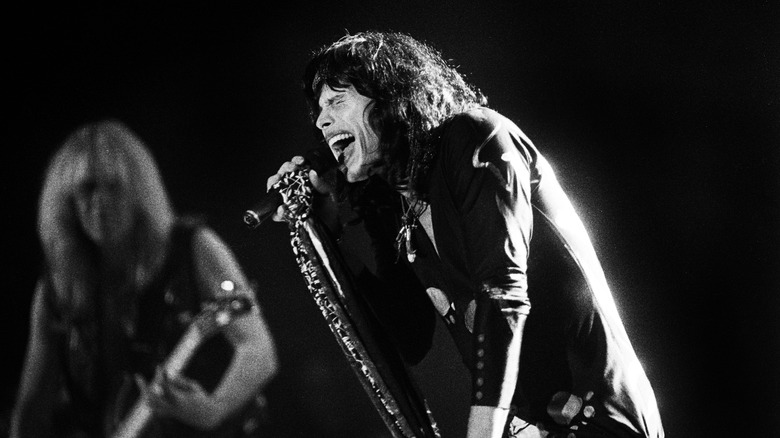
It seems hard to believe now, but in the late '70s, Aerosmith seemed destined to be one of rock's also-rans. The "Bad Boys from Boston" staked a reputation as one of America's hottest bands by the middle of the decade, but only a few years later, they were a shadow of themselves. The group's chief songwriters, singer Steven Tyler and lead guitarist Joe Perry, were on the outs ever since Perry quit the band in 1979, and Tyler was contending with his own personal issues. Yet exactly 10 years later, they were back on top in 1989 — easily enjoying their best year as a band thanks to killer cuts from their 10th studio album, "Pump."
It wasn't an overnight change: the original line-up reunited in 1984, and two years later, an unlikely cover of the band's hit "Walk This Way" by rappers Run-DMC (with Tyler and Perry making a guest appearance) became a Top 10 hit. However, we've settled on 1989 as the year of peak Aerosmith thanks to that year's LP "Pump," which definitively proved that the band could craft rock hits that moved a new generation excited for hair metal and MTV. The LP also gave Aerosmith three back-to-back Top 10 hits, a feat they only achieved once, and two of which easily made our list. From the pounding comeback rocker "F.I.N.E." to the masterful ballad "The Other Side," these are the tunes that show Aerosmith at their apex in 1989.
Love in an Elevator
While the 1989 LP "Pump" marked a new, sober chapter for Aerosmith, its lead single "Love in an Elevator" was inspired by a wild night in Steven Tyler's troubled past. He and a group of female fans headed up to his hotel suite after a dip in a hot tub, when some wild antics began occurring. "Just then," Tyler said in "Walk This Way: The Autobiography of Aerosmith," "the elevator door opens into the crowded lobby."
The wacky encounter was fused to a killer groove by Joe Perry, inspired by the rhythm of Buddy Miles. With an irresistible singalong chorus, a pulsating beat from drummer Joey Kramer, vocal harmonies and punctuations by the whole band (who wouldn't fist pump to those "whoa, yeah"s?), and plenty of room for solos by both Perry and guitarist Brad Whitford, it's no wonder "Elevator" became the first of three Top 10 hits from "Pump."
F.I.N.E.
Turning to the beginning of the album, "Pump" might open stronger than any disc in Aerosmith's discography. First track "Young Lust" roars out of the stereo like a drag racer, with Joey Kramer flooring his bass drum pedals like a madman all the way through. After a cacophonous drum solo, the song segues right into the next: "F.I.N.E.," a hip-shaking groove counterbalanced by a comeback-kid chorus where Tyler checks off names of people saying he's alright, including music activist Tipper Gore (a target of Tyler's offstage criticism) and Perry himself. (The one-two punch was so strong that, nearly a decade later, one of the soundtracks to Walt Disney World's Aerosmith-themed roller coaster started with the same songs.)
Perry was such a fan of F.I.N.E. (which, he said, stood for "F—ed Up, Insecure, Neurotic, and Emotional") that he wanted it to be the album's title. Brad Whitford eventually picked "Pump" after noticing the Aerosmith logo's similarity to an old gas station sign.
What It Takes
For all their rock 'n' roll bona fides, Aerosmith had a softer side, too. Their breakthrough hit, "Dream On," was a kaleidoscopic ballad, and on 1987's "Permanent Vacation," they teamed with songwriter Desmond Child to craft the power ballad "Angel," consequently the biggest hit of their career to that point. Could "Pump" ballad "What It Takes" make lightning strike a third time? Indeed it could, as "What It Takes" became Aerosmith's third straight Top 10 hit, spilling the success of their 1989 album over a new calendar page and into 1990.
Joe Perry explained in "Walk This Way: The Autobiography of Aerosmith" that "What It Takes" (also written with "Angel" co-writer Child) took on a different sort of musical vibe than the band was known for. "It started out as a country and western song that we ended up putting on electric guitars — a Leslie [amp] and Les Paul — to make it sound heavier." Of course, the keyboard lines that sound like accordions kept a little bit of that flavor, as did a music video where the band plays the song for a crowd of cowboys who soon start a roadhouse brawl.
The Other Side
For the last single off "Pump," Aerosmith got a little soulful. Written with songwriter Jim Vallance, "The Other Side" had everything: a stomping rhythm, classic harmonies between Steven Tyler and Joe Perry, and a blaring horn section led by producer Bruce Fairbairn. Vallance later noted the band unusually flipped his intended arrangement, using his verse melody for the chorus. "This is a perfect example of Steven's genius," Vallance later wrote on his website. "He sees things from a completely different perspective. It just took me a while to catch up to him!"
Unfortunately for the band, the law almost caught up to them, too: "The Other Side" had a chorus melody that sounded a lot like "Standing in the Shadows of Love," a Top 10 hit for Motown group the Four Tops. Any legal fireworks were defused when the band agreed to add the "Shadows" songwriters, the legendary Holland-Dozier-Holland writing team, to the song's credits, and the band safely avoided any accusations of the musicians stealing their biggest hits.