

5 Rock Legends Who Composed Music For Classic Video Games
Gamers anywhere will tell you that a banging soundtrack is integral to a great gameplay experience. Who better to provide said accompaniment than our beloved rockers, the purveyors of pummeling passion themselves? Sure, we all have our picks for the most stressful video games ever made or the most mind-blowing final boss levels in video game history, but we can all agree that gaming lore is full of some amazing collaborations between programmers and performers.
What's often more intriguing, however, are the stories behind these collaborations. Sometimes it's a pop megastar who loves to save woodland creatures, sometimes it's a brooding master of sinister industrial hymns scoring a legendary first-person shooter. In every case, it's an opportunity to delve deeper into the production process for two different artistic mediums and examine how rock and pop artists can bring a new layer of depth to digitized storytelling.
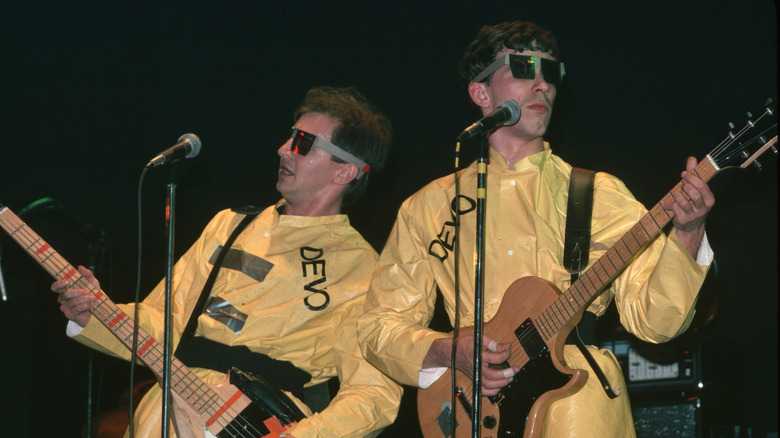
Devo — Neuromancer
William Gibson's 1984 novel "Neuromancer" is a landmark work of science fiction that brought the underground world of cyberpunk into the literary mainstream. As such, it seems only right that Devo, the reigning kings of '80s computer rock (though they might have to share the throne with Kraftwerk), would be tapped to contribute to the soundtrack for the desktop computer game adaptation.
Released in 1988 across an array of computer formats, Interplay's "Neuromancer" was originally conceived as a movie tie-in product for a planned film adaptation of the novel. Despite having "Blade Runner" director Ridley Scott on board to direct and Mel Gibson attached to play Case, the story's computer hacker protagonist, the film project was ultimately scrapped. As such, Interplay found itself in the unenviable position of still being contractually obligated to complete the game as a standalone project.
Daunting a task though it was, the company had a secret weapon left over from the remains of the aborted film: Devo had been on tap to do the soundtrack. The band behind the mega smash hit "Whip It" had composed "Some Things Never Change," a track originally planned for the "Neuromancer" movie. Thus, a digitized version serves as the game's theme song, while Devo released their own studio cut on 1988's "Total Devo." In either incarnation it captures both the ice-cold inhumanity of a fully computerized future and the stiff, unsociable nerd sensibilities of Devo's cerebral world.
Brian May — Rise of the Robots & Rise 2: Resurrection
By the time Queen guitarist Brian May was approached to contribute to 1994's "Rise of the Robots" soundtrack, he had already proved that hard rock sci-fi film scores were well within his wheelhouse. In collaboration with his bandmates in Queen, May had composed soundtrack material for 1980's "Flash Gordon" and 1986's "Highlander." As such, "Rise of the Robots" seems like a shoo-in for the guitarist from a band that had long fused heavy metal with symphonic flourishes.
While the concept was certainly in May's wheelhouse — and his participation was hyped to the point of being included on the game's box art — his only actual contribution ended up being a digitized version of "The Dark," an existing track from his solo album "Back to the Light." That was one of many shortfalls for the game that critics at the time skewered as an overhyped mess that relied on impressive graphics to make up for a near total lack of playability. "Rise of the Robots" would go on to be a legendary failure of style over substance.
Though the game was widely panned, a sequel was nevertheless produced, 1996's "Rise 2: Resurrection." This time the production made good on advertisements touting May's involvement by featuring an original song, "Cyborg," another version of which was included on May's 1998 solo album "Another World." The track is a solid science fiction metal headbanger that, notably, features Foo Fighters drummer Taylor Hawkins pounding the skins.
Nine Inch Nails — Quake
Before Nine Inch Nails mastermind Trent Reznor was working with longtime collaborator Atticus Ross on major Hollywood soundtracks, the former studio janitor behind some of the most iconic '90s hits was lending his brand name to the creation of id Software's 1996 mega-hit "Quake." That, coupled with his production work on the cultural juggernaut that was Marilyn Manson's "Antichrist Superstar" LP, was proving that the man responsible for taking industrial rock mainstream had more to offer than just unbridled sonic rage.
Falling between the releases of Reznor's 1994 breakout classic "The Downward Spiral" and its ambitious follow up, 1999's "The Fragile," much of the game's soundtrack comes off as an instrumental Nine Inch Nails album in its own right. There's the menacing walls of guitar distortion, the thundering, tribalistic though mechanical percussion, and other staples of the Reznor sound stable around every corner. But amidst all that mayhem are long stretches of ambient drones and ominous atmospherics that hint at the kind of work Reznor would produce in his later collaborations with Atticus Ross. Tracks like "The Hall of Souls" and "Parallel Dimensions" have the kind of darkly seething aura heard on the duo's soundtracks to "The Social Network" and "The Girl With the Dragon Tattoo."
Thus, the "Quake" soundtrack isn't a mere side gig for Reznor: it's an early and critical manifestation of his compositional maturation process. As for the game itself, Reznor's involvement is so indelibly linked with the final product that the band's "NIN" logo is included on boxes of ammunition for the nail gun.
John Petrucci — Digital Pinball: Necronomicon
Some games are notable for their collaborations with major rockers, but in the case of 1996's "Digital Pinball: Necronomicon" from Kaze Co. Ltd., the fact that it features soundtrack work by Dream Theater's John Petrucci might be the only reason it's remembered at all. Released on the ultimately unsuccessful Sega Saturn platform, "Digital Pinball: Necronomicon" is a fairly traditional pinball simulator, albeit with the Lovecraftian set dressing suggested by the title.
What keeps the game from disappearing into the failed console memory hole altogether is Petrucci's (as always) dazzling virtuoso guitar performances in the game's intro and outro sequences (called "Prologue" and "Epilogue," respectively). The result is a fiery display of intricate shred metal guitar heroics that alternates between '80s slasher horror soundtrack pastiche and progressive metal masterclass.
The game comes on the heels of Dream Theater's 1994 LP "Awake," and as such, Petrucci's contributions feel like a carryover from that album's emphasis on a darker, heavier, and more gothic sound. Never before has a cinematic sequence of a lone monk taking a book off a shelf in a library sounded so utterly drenched in demonic cool.
Michael Jackson — Sonic the Hedgehog 3
Speculation had reigned among Sega fans for decades as to whether or not Michael Jackson had in fact been involved in the soundtrack to "Sonic the Hedgehog 3." Such conjecture arose as Jackson aficionados began to notice similarities between the in-game music and the King of Pop's classic hits; "Ice Cap Zone" strongly echoes "Smooth Criminal," for example. Thus, the question was bandied about among Sonic and Jackson fandoms for decades. The possibility seemed all the more plausible considering that Jackson had existing ties to Sega through its successful arcade and console adaptation of his 1988 film "Moonwalker."
After decades of speculation, project insiders confirmed the rumors, though Jackson's actual involvement was complicated. In conversation with "The Retro Hour," "Sonic 3" project manager Roger Hector explained that Jackson's involvement came about by pure happenstance. The singer, by that point a major Sonic fan, had requested a private tour of the Sega Technical Institute studios. In the course of the visit, a team member off-handedly pitched the idea of Jackson doing the soundtrack. The singer instantly accepted.
That's a promising start, but then things get murky. The game's official composer, Brad Buxer, would go on to claim that the tracks had been a collaborative effort, with Jackson handing much of the work off to him. Thus, the degree of Jackson's actual involvement was already debatable. Hector, for his part, argued that Jackson was heavily involved in the process but that Sega distanced itself from the singer due to controversies in his personal life and commissioned a new score full of soundalike material in the 11th hour. Thus, the final soundtrack is more a reflection of Jackson's musical vibe than his actual compositional work. Nevertheless, it remains a rare instance of a fan theory proving true.