

The Former Studio Janitor Behind Some Of The Most Iconic '90s Hits
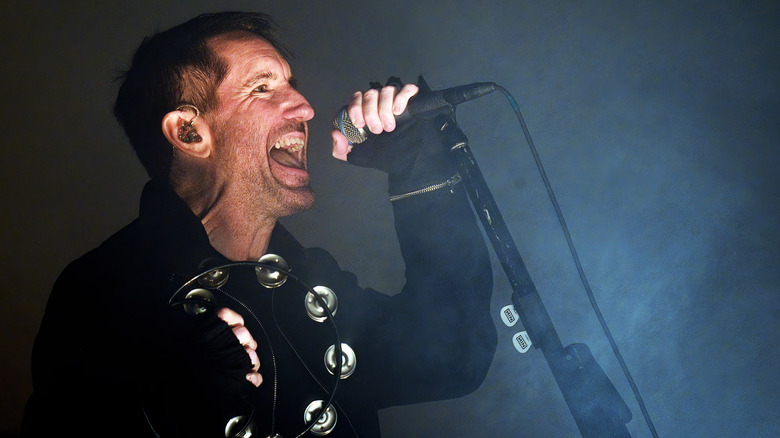
Under his Nine Inch Nails artist imprint, the songwriter/producer/multi-instrumentalist mastermind Trent Reznor released some of the most groundbreaking and innovative work of the 1990s. It was a decade of tremendous accomplishment, but things weren't always so glamorous. In the early days of his career, young Trent was paying his dues as a janitor and assistant engineer at Right Track Studios. The soon-to-be industrial rock god parlayed his custodial duties into complementary studio time, a move that laid the groundwork for the first Nine Inch Nails release, 1989's "Pretty Hate Machine."
Early standouts such as "Head Like a Hole" would give way to MTV staples like "Closer" and "The Perfect Drug," only to close out the '90s with the sprawling double-disc concept album "The Fragile." And if that weren't enough, he had time to produce a couple of hit albums for Marilyn Manson (their long-standing feud is explained here) and score the soundtrack to the classic computer game "Quake." But it was the exposure and experimenting he got to do at Right Track Studios that led to his signature sound of blending industrial rock with electronic elements and potent vocals.
Laying the Foundation

Trent Reznor and those who knew him throughout his childhood have long maintained that it was a strikingly normal upbringing. The boy who would be the alternative-rock king enjoyed a quiet small-town upbringing with early childhood piano lessons evolving into stints in high school band. To that end, his performances on tenor saxophone were captured on the recording "This Could Be The Start of Something Big," a 1982 vinyl recording by his high school's band, The Mighty Mercer Mustang Marching Machine and Jazz Ensemble.
The title of that album was nothing if not prophetic. Though Reznor was, by all accounts, a well-adjusted youth though somewhat disinterested in school, he made no bones about the fact that he yearned for a life beyond the confines of small-town Pennsylvania. After having a lukewarm reaction to Allegheny College, Reznor relocated to Cleveland, Ohio, after being offered a sales position at Pi Keyboards and Audio. The move solidified Reznor's new direction in life and set him on the path to Right Track Studios.
The move to Cleveland opened Trent Reznor up to the city's music scene and work at Right Track Studios, where he "got a job in a studio doing the jobs nobody else wanted to do," he said in an interview (via Moog Music/YouTube). He was also able to spend time at the studio teaching himself "some degree of engineering, and I had the ability to kind of work on my own music ...." He also acquired from the studio an Oberheim Xpander, an old retrofit Minimoog, and a PPG Wave 2.3, which he called a "rig that felt like it could cover all the bases at the time."
Sequencing Success
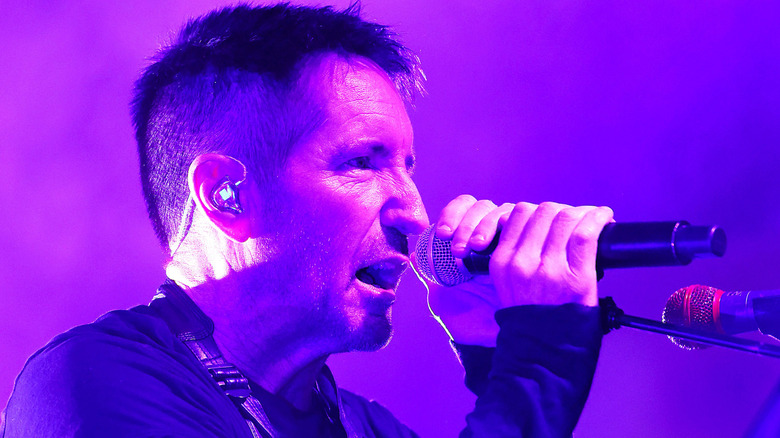
One of his early musical projects, the new-wave influenced Exotic Birds, even garnered local media coverage. It might seem far-fetched to think that the cheerful echoes of Culture Club and Ultravox heard in the Exotic Birds sound might be hiding the beginnings of Nine Inch Nails, but it was there.
Central to that early dance-pop sound was a penchant for using digital samplers, the keyboard synthesizers that play back user programmed musical loops. Reznor's industrial stylings built on innovations already made by the likes of Peter Gabriel and Thomas Dolby to create intricate, looping passages with mechanical precision. For Reznor, that kind of sequencing can be heard in the tightly oscillating synth patterns of "Terrible Lie" or the robotically stiff sixteenth-note drum grooves of "Down in It."
Reznor would further infuse that sampling ethos with distorted hard-rock guitars and further explorations of darker themes on 1992's "Broken" EP, a release that laid the groundwork for his magnum opus, "The Downward Spiral," which would come in at No. 74 on Apple Music's 100 Best Albums. The album's most successful single, "Closer," is built around sequencing extracts from Iggy Pop and Roxy Music alongside guitars and bass manipulated to barely sound like string instruments. "The Downward Spiral" would shoot to No. 2 on the Billboard 200, thus enshrining Reznor as a breakout '90s musical innovator.