

5 Classic Hit Love Songs That Were Way Bigger Outside The US
There are certain love songs that resonate with audiences so deeply and have for such a long time that they become classics. These epic and affecting tunes, covering many different types of love, are the soundtracks to the big life moments of millions, American and otherwise, although they were originally way more popular in countries besides the United States. Great and beloved love songs can come from any genre, like rock, pop, folk, soft rock, soul, or new wave, because they speak to the same end: defining and clarifying the complex, confusing, and life-changing suite of emotions we collectively nickname love. They're classics for good reason, because they say with music what we all wish we could say.
Such love songs loom so large in the collective consciousness that one might assume they were much bigger hits. But they weren't particularly or historically successful, at least not in the U.S. Fans around the world came around sooner, sending these love songs by the likes of Lobo, Jennifer Rush, Stevie Wonder, Bob Marley and the Wailers, and Depeche Mode to the top of the pop chart (or very near it) in numerous other countries.
I'd Love You to Want Me – Lobo
Passionate and sensitive folk singer Kent Lavoie performed under the enigmatic stage name of Lobo and became a hitmaker during the early 1970s singer-songwriter movement. Of his eight Top 40 singles, his biggest was the 1972 single "I'd Love You to Want Me," a disarming love song about devotion and yearning, which spent two weeks at No. 2.
While locking down No. 2 for a fortnight is a lovely achievement, "I'd Love You to Want Me" was an undeniable chart-topping sensation on nearly every inhabited continent on the planet. In North America, Lobo went to No. 1 in Canada; in Africa, he topped the singles chart in South Africa; in Asia, the song went all the way up in Hong Kong and Singapore; and it led all songs in Australia and New Zealand. The love song fared particularly well in Western Europe, as it was a No. 1 single in West Germany, Austria, and Switzerland, where it ruled over the pop chart for 11 weeks.
The Power of Love – Jennifer Rush
While she possessed a strong and evocative voice that could really sell a love song, Jennifer Rush had trouble making headway on the Billboard charts of the late 1980s, despite her material being of high quality. She's only appeared on the Hot 100 twice, and her best-known song, "The Power of Love," peaked at a middling No. 57 on the Hot 100 in the spring of 1986. Sometimes cover songs are more famous than the original, and that's what happened here. It took soft rock titan Celine Dion to make "The Power of Love," a poetic, sensual, and rapturous declaration of love from a woman to her chosen man, a true hit. This cover spent four weeks at No. 1 in early 1994.
Dion's version could only muster a No. 4 chart placement in the U.K., however, perhaps because the country's love of Rush's "The Power of Love" couldn't be fully overtaken. In 1985, the classic recording by the American singer spent five weeks at No. 1 in Britain and was eventually the year's best-selling single. Moreover, as of 2026, it's the 47th most successful single ever in the U.K.
Isn't She Lovely – Stevie Wonder
It's not a romantic tune — Stevie Wonder's "Isn't She Lovely" is really about his just-born daughter and the overwhelming feelings of unconditional love and parental pride that come along with such a special and profound moment. Wonder just had to tell the world that his baby is "lovely," "wonderful," and "precious" even as she's "less than one minute old." "Isn't She Lovely" is one of the many highlights of "Songs in the Key of Life," Wonder's critically adored 1976 double LP that won the Grammy Award for album of the year. The set generated two No. 1 singles, "I Wish" and "Sir Duke," but "Isn't She Lovely" didn't even grace the Hot 100.
As it appeared on "Songs in the Key of Life," "Isn't She Lovely" ran for six and a half minutes, lengthened by a musical accompaniment of Wonder bathing his infant. Motown Records wanted to cut that for the radio and a 45, but Wonder wouldn't allow it. As a result, "Isn't She Lovely" wasn't issued as a single in the U.S. A decades-later cut-down version managed to make it to No. 94 in the U.K., however.
Is This Love – Bob Marley
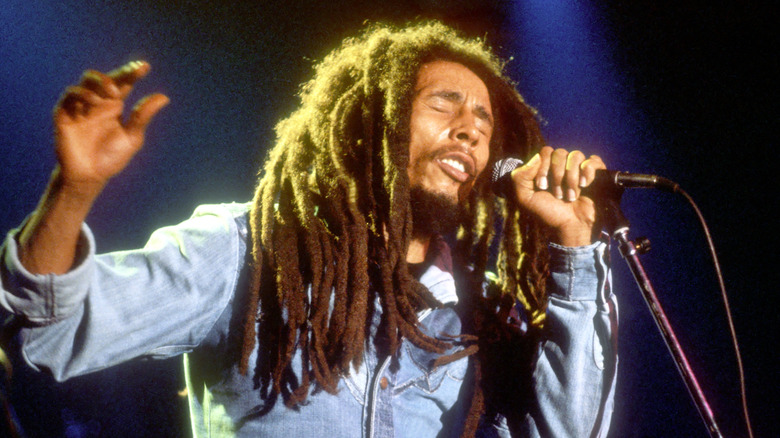
With certified sales of 18 million copies, "Legend," the career retrospective of Bob Marley and the Wailers, stands among the best-selling albums in American history. It first hit stores in 1984, three years after Marley's death. As far as the U.S. is concerned, Marley is a celebrity who became far more famous after he died. In his lifetime, he appeared once on the Hot 100, with "Roots, Rock, Reggae" hitting No. 51 in 1976. At the time, there wasn't much of a place for Marley and Jamaican reggae, a style of music new to much of the world that he and the Wailers helped spread and popularize. Most of the tunes on "Legend" are hyper-familiar to millions of Americans today, such as "Is This Love," a sweet and vulnerable love song told from the point of view of a person falling in love and realizing that such a fundamental change is happening.
Reggae hit bigger and faster in other regions, as evidenced by the global success of "Is This Love." The sentimental favorite from the late '70s was a Top 10 hit in the U.K., Norway, and New Zealand and made the Top 20 in Sweden and Australia.
Just Can't Get Enough – Depeche Mode
When Depeche Mode first appeared about 45 years in the past, they sounded like the future. While other bands of the era produced synthetic music on keyboards and drum machines that sounded inhuman and icy, Depeche Mode's carried soul, depth, and warmth, particularly in the 1981 single "Just Can't Get Enough." A simple love song in both melody and lyrics, it bounces along with infectious glee as singer Dave Gahan croons about the virtues of a lover with whom one encounter will never be sufficient and whose absence he can't handle. While "Just Can't Get Enough" would eventually become one of Depeche Mode's signature songs as the British band's American popularity steadily grew over the '80s and '90s, upon release, U.S. mainstream musical outlets found the song too alien; it didn't reach any major pop or rock chart Billboard published at the time.
U.K. listeners embraced the song right away, taking it to No. 8 on the pop chart and No. 1 on the independent music list. Elsewhere, "Just Can't Get Enough" went Top 5 in Australia and the Netherlands.