

5 Santana Songs That Prove 1970 Was The Best Year Of Their Career
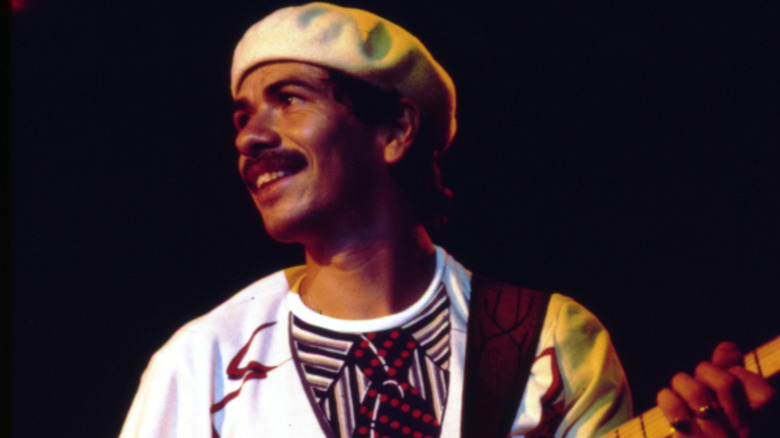
It's odd to think that Santana achieved the peak of their creative powers on just their second album. The group, founded by guitarist Carlos Santana, has woven together blues, psychedelic rock, and jazz with Latin rhythms for the past sixty years. Surely their best year would come later in such an illustrious career, right? But listen to "Abraxas," the groundbreaking album that gave us songs like "Oye Cómo Va" and "Black Magic Woman," and it's easy to see why 1970 was indeed Santana's best year.
Carlos's first iteration, the Santana Blues Band, fizzled out soon after forming it in 1966. His subsequent lineup included some more serious players and a shortened name. This group, i.e., the one inducted into the Rock and Roll Hall of Fame in 1998, consisted of Carlos, Gregg Rolie (vocals/keys), Jose "Chepito" Areas (percussion), David Brown (bass), Michael Shrieve (drums), and Mike Carabello (percussion/vocals). They played their first gig in June 1968 at Bill Graham's Fillmore West. The famed promoter helped Santana get their big break by getting them booked for a festival the following year: Woodstock.
Months after that iconic Woodstock performance (which was wilder than you realize), Santana released their self-titled debut album. But their second album really homed in on their revolutionary sound. Yes, Santana achieved far greater commercial success with 1999's "Supernatural" (going to No. 1 on the Billboard 200 while topping the Hot 100 with "Smooth" and "Maria Maria"), but the foundations of Santana's sound had already exploded into view with "Abraxas."
Soul Sacrifice
Along with "Abraxas," 1970 was a good year for Santana thanks to the "Woodstock" concert film, released the year after the Woodstock Music and Art Fair in Bethel, New York. Arriving at the festival around noon on Saturday, August 16, 1969, Carlos found out from his friend, Jerry Garcia of the Grateful Dead, that Santana would play two bands after the Dead (who were scheduled to play at 1 a.m. on Sunday morning). So, Jerry gave Carlos some mescaline to help him pass the time.
"Two hours after I took it, there was a face in my face that said, 'You need to go on right now, otherwise you're not going to play.'" Carlos told The New York Times. The band then delivered an electric, transformative performance; Carlos himself said that only Sly and the Family Stone and Jimi Hendrix were better. "Everybody else has to fight with us for No. 3," he added.
Santana were still largely unknown nationally; their debut album would come about a week after Woodstock on August 22. Word of mouth built buzz around the new band, which propelled "Santana" to No. 4 on the Billboard albums chart. The band received another major boost with the release of "Woodstock." The Academy Award-winning film brought the concert experience to the masses. A highlight of the film was Santana's instrumental epic "Soul Sacrifice," which was included in the film's soundtrack (also released in 1970), a triple-LP set that topped the Billboard album chart.
Samba Pa Ti
Released on September 23, 1970, Santana's "Abraxas" expanded the vision of their debut album. Carlos Santana has always been one to inject spirituality into his music, and the stunning instrumental "Samba Pa Ti" is one example. It's a reflective moment, buoyed by Carlos' guitar playing off Gregg Rolie's Hammond organ and David Brown's bass. And it was born out of a chance moment in NYC.
At the time, the band was recuperating in NYC after their first European tour. While woozy from jet lag, Carlos went to open a window to get some fresh air. "I saw this man in the street," he explained to In The Studio with Redbeard. "He was drunk and he had a saxophone and a bottle of booze in his back pocket ... He kept struggling with himself. He couldn't make up his mind which one to put in his mouth first: the saxophone or the bottle."
"Samba Pa Ti" remains popular among Santana fans and part of the band's set list to this day. For Carlos, the song is about freedom. "It really came from me seeing how all of us can be out of [prison] and still be prisoners, of our own habits, or routine or whatever," he said in 2025. "You have to break all those things; that's the freedom that we have to really achieve ... from not being bound to anything or anyone, except to your inner pilot, which lives in your heart."
Incident at Neshabur
Santana's "Incident at Neshabur" is considered an early example of jazz fusion, the genre born in the 1960s that melded jazz's improvisation and harmony with rock's heavy riffs. Santana's instrumental track features guest keyboardist Alberto Gianquinto, whose piano playing adds an element of sophistication at the start. While the song's inspiration is questionable, it's supposedly about Haitian revolutionary Toussaint Louverture triumphing over Napoleon Bonaparte.
Carlos told Guitar Player that "Incident at Neshabur" was his early attempt to sound like Miles Davis, the jazz visionary who created "B****es Brew," the landmark jazz-fusion album released in April 1970. "[I was] bending notes and getting all inside your heart," said Carlos. "See, the beginning [riff] came from Alberto. He and I wrote the song, but he had lyrics which went, 'Can you dig, can you do, can you do the pimp thing?' And the words at the very end of the riff went, 'Go ahead brother, right on.' When I heard that, I was like, 'Really? Okay.'"
Carlos really lets loose and delivers a blistering performance before segueing into a meditative second half. Carlos explained that this part "has two chords that are a bit like [The Beatles'] 'Fool on the Hill.' I just took those two chords and played everything that I was hearing at the time."
Oye Cómo Va
Although "Oye Cómo Va" became a Santana signature (the song went to No. 13 on the Hot 100), the track is actually a cover of a deep cut from Tito Puente's 1962 Latin jazz masterpiece, "El Rey Bravo." Santana had previously entered Puente's orbit with great success, thanks to their manager, Bill Graham. He encouraged Santana to cover "Evil Ways" by Willie Bobo (who'd been a member of Tito's band). Santana's "Evil Ways" was a top ten hit, so Carlos figured the band should cover Puente's track.
"I thought it was like [Richard Berry/The Kingsmen's] 'Louie Louie' — a forever Friday and Saturday party song," Carlos told Guitar Player. "I had a feeling that 'Oye Cómo Va' was that kind of party song that makes people drop their sorrows or problems." The lyrics capture that party sensation perfectly; per Genius, the song goes "Oye cómo va (listen how it goes) / Mi ritmo (my rhythm)/ Bueno pa' gozar (good for having a good time)."
"Oye Cómo Va" became one of their most recognizable hits, one that also introduced Tito Puente to a wider audience. "He put our music, Latin rock, around the world, man," Puente said at the end of his 1999 live album, "Mambo Birdland" (via NPR). "And I'd like to thank him publicly, because he recorded the tune and he gave me credit as the composer of the tune. So since that day all we play is Santana music."
Black Magic Woman
1970 was fantastic for Santana. The "Woodstock" performance of "Soul Sacrifice" showed them bridging the spirit of the '60s into the new decade. "Samba Pa Ti" demonstrated the group's spirituality, while "Incident at Neshabur" showcased their musical talents. And "Oye Cómo Va" helped establish Santana as one of Latin rock's defining acts. But the cherry on top had to be "Black Magic Woman." Released in November 1970, the song peaked at No. 4 on the Hot 100 and became the band's signature track.
Santana's "Black Magic Woman" is one of those classic rock hits that you might have no idea is actually a cover, and it's far more famous than the original. No disrespect to Peter Green, who wrote the song for his band, Fleetwood Mac. Included on the compilation albums "English Rose" and "The Pious Bird of Good Omen," both released in '69, Fleetwood Mac's "Black Magic Woman" leaned more into the blues than the psychedelic version Santana released a year later.
Santana's keyboardist and vocalist, Gregg Rolie, suggested the band cover the song. "Whenever we play 'Black Magic Woman,' I remember the first time we played it in a soundcheck in Fresno in a parking lot," Carlos Santana told Rolling Stone. "And I remember saying, 'Hmm, I can bring a little bit of Otis Rush here and a little bit of Wes Montgomery here.'" With Carlos's guitar work and Rolie's haunting vocals, Santana transformed the song into a Latin rock masterpiece.