

5 Classic Rock Hits You Had No Idea Are Actually Covers
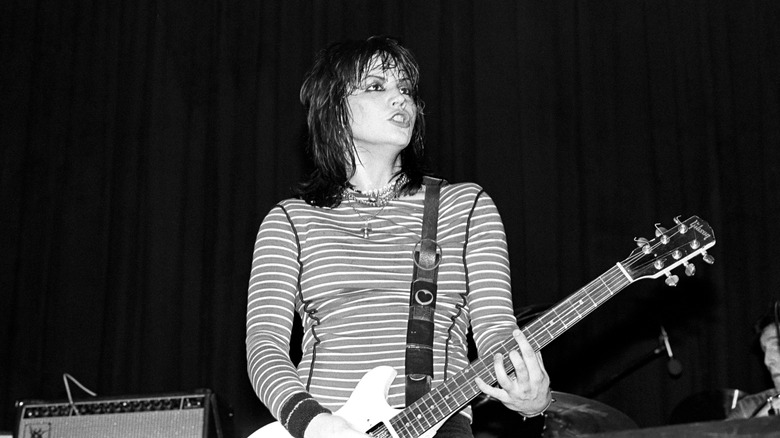
Rock 'n' roll is full of hit songs that we all know are covers, but many of us have gone our whole lives unaware that some of our favorite artists' signature tracks were also cover songs. This can come as a nasty surprise for fans; after all, does Joan Jett really love rock 'n' roll, even if she didn't write the defiant song proclaiming it? Does Dan McCafferty really think "Love Hurts," despite his band not being the first or even the second to record that now-classic heartbreak anthem? Does Carlos Santana's breakthrough hit still have some of its "black magic" when you discover that it was written by a bloke from England?
However, dig a little deeper and the reasons become clearer. For a song to become a hit, a lot has to go right and in the right order, and from legal issues to poor marketing, music history is littered with flops that should have become hits. But let's not detract from those musicians who picked up these songs, then reimagined them as renditions that went on to become gigantic rock hits.
Love Hurts — Nazareth
Rockers understand that heartbreak has a distinctive sound. It begins with a subtle, psychedelic guitar melody. Then, there's a pair of thunderous drum blasts accented by crashing symbols, replicating the agonizing beat inside your chest. The sequence repeats before a titanic voice bellows out those iconic words: "Love hurts." That voice belongs to Dan McCafferty of Nazareth, and every rocker who's ever been dumped knows the song well. But they might not know that Nazareth's "Love Hurts," a '70s one-hit wonder that earned respect from younger generations, was actually a cover of a song first recorded by a country duo, the Everly Brothers.
Don and Phil Everly recorded "Love Hurts" — a song written by songwriting couple Boudleaux and Felice Bryant — for their 1960 album, "A Date with the Everly Brothers." However, they couldn't release it as a single due to legal issues. While the Everly boys were in legal limbo, their manager shopped the song to his other client, Roy Orbison, who included it as a B-side to "Running Scared." If that wasn't bad enough, Gram Parsons recorded a duet version with Emmylou Harris for his posthumous 1974 album, "Grievous Angel."
Nazareth recorded its version of the song in 1974 as a B-side to "Hair of a Dog," the title track of its sixth album. But when "Love Hurts" got more airplay, the band released it as an official single, and it went to No. 8 on the Billboard Hot 100. "What we used to say is that if you're going to cover a song, there's no point just doing a version and making it sound the same," said bassist Pete Agnew in a 2022 interview with The Rockpit. "We used to treat the original as a demo ... And we made 'Love Hurts' the first rock ballad ever, I think, and to this day I think it's still the best vocal on any rock ballad."
Don't Let Me Be Misunderstood — The Animals
Considering that the Animals didn't write most of its early hits, such as "The House of the Rising Sun," "We Gotta Get Out of This Place," and "It's My Life," it might not be that shocking that 1965's "Don't Let Me Be Misunderstood" was originally released by the incomparable Nina Simone one year earlier.
"Nina was a force of nature," Eric Burdon told Tidal in 2024. "Her version of 'Don't Let Me Be Misunderstood' was like a revelation. So powerful, so soulful, it just hit you right in the gut." That power was transferred when the Animals covered her song, turning the introspective ballad into an organ-fueled classic that proves 1965 was the decade's best year for blues rock. The song went to No. 3 in the U.K. and No. 15 in the U.S.
"Her music, her spirit, spoke to us on a deep level. It really shocked me that our version was the most popular one," said Burdon. Simone shared that sentiment, as the Animals' version stole a bit of thunder from her original. When she and Burdon finally crossed paths, she let him have it, accusing him of being the guy who stole her song. Burdon recalled responding (via the Independent), "I said, 'I am, but what about the songs that you recorded that were written in Angola State Penitentiary in Louisiana by guys who are incarcerated for life?' She stopped right there and said, 'Sit down, what would you like to drink?'" This contentious clash between two strong spirits sparked a friendship between Simone and Burdon that lasted until Simone's death in 2003.
I Love Rock 'n' Roll — Joan Jett & The Blackhearts
It might shock some fans to discover that Joan Jett didn't write her signature track, "I Love Rock 'n' Roll." The former Runaways star first released the song in 1979 as a B-side to her debut solo single, "You Don't Own Me," and then again in 1982 with her new band, the Blackhearts. This second version, aided by a music video that aired extensively on the fledgling MTV channel, was a commercial success: it went to No. 1 on the Billboard Hot 100 for seven weeks and was quickly certified platinum by the RIAA. Not bad for a cover of a flop from the U.K. glam rock band, the Arrows.
Formed in the mid-1970s, the Arrows released a handful of songs, including "Touch Too Much," which went to No. 8 on the U.K. singles chart. "Arrows needed a fourth single," front man and guitarist Alan Merrill told Guitar Player in 2016, "and Mickie Most, our producer and owner of our label, suggested I try to come up with something, as our first three singles had been written for us."
With instructions to write a rock anthem, Merrill came back with "I Love Rock 'n' Roll." Even odder, the song was a low-key diss track aimed at the Rolling Stones. "The Stones had just released 'It's Only Rock 'n Roll,' which sounded a bit apologetic to me," said Merrill. "I wanted to say it loud and clear." However, the single did not chart upon its release. And had Joan Jett not seen the band play it on television in 1976 while she was touring the U.K., it might have been lost to time.
Black Magic Woman — Santana
"Black Magic Woman" not only gave rock one of the best guitar solos of all time, but also Santana's first Top 10 hit on the Billboard Hot 100. Released in 1970, the witchy track went all the way to No. 4 in 1971, cementing Carlos Santana's place as one of rock's greatest guitar gods. So, needless to say, Santana is forever grateful to Peter Green, who originally wrote and released the song with his band, Fleetwood Mac, two years prior.
Initially released as a non-album single, Fleetwood Mac's "Black Magic Woman" scraped the bottom of the Top 40 in the U.K., peaking at No. 37. "We were in the beginning," Santana told Rolling Stone in 2019. "And Gregg Rolie [Santana's lead singer and keyboardist] brought the song from Fleetwood Mac, Peter Green. And I remember saying, 'Hmm, I can bring a little bit of Otis Rush here and a little bit of Wes Montgomery here.' Because I just think like that. It's kind of like a chef, bring a little bit of oregano and jalapeños and garlic and onions."
Got My Mind Set on You — George Harrison
Had things gone differently, George Harrison would have covered James Ray's "Got My Mind Set on You" way earlier than he did. The future "My Sweet Lord" singer first encountered Ray's music in 1963 while on a pre-Beatlemania trip to the United States, where he browsed record stores and, among others, picked up a copy of James Ray's self-titled LP that contained "Got My Mind Set on You."
Harrison took Ray's music back to his fellow Beatles, and the band went on to play a cover of another track from the LP, "If You Gotta Make a Fool of Somebody," as part of its set. But while the pre-Fab Four toyed with covering "Got My Mind Set on You," Ray and songwriter Rudy Clark's arrangement wasn't right for the lads from Liverpool, and they soon ditched the covers to start writing their own music anyway. So, Harrison pocketed the track until the late 1980s, when he recorded a revamped version of it for his 11th solo album, 1987's "Cloud Nine."
"Got My Mind Set On You" gave Harrison — who was nearly two decades removed from his last chart-topper — a late-career hit. The song went to No. 2 in the U.K. and topped the U.S. Billboard Hot 100. It was Harrison's last big solo hit before he died in 2001.