

5 Rolling Stones Songs That Prove 1969 Was The Best Year Of Their Career
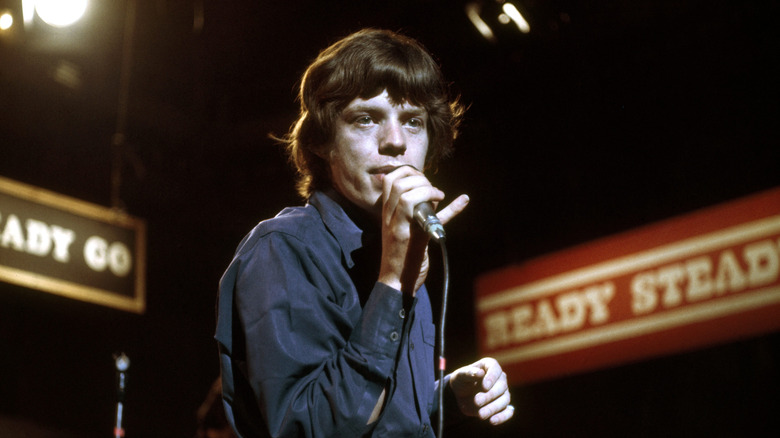
The 1960s were an era of cultural and political turmoil in the United States, right up to the final moments of 1969. On their televisions, Americans watched the first man set foot on the moon, the Stonewall riots, and the beginning of the modern LGBTQ rights movement, while the nightly news delivered frontline footage of the Vietnam War. At the center of this cultural upheaval were the Rolling Stones, whose 1969 album "Let It Bleed" mirrored the misery and melancholy felt at the end of the decade. Their songs from that year defined (and, in hindsight, memorialized) the cultural strife of the period, but also became some of the most timeless of the band's career.
Released on November 28, 1969, "Let It Bleed" saw the Rolling Stones in the midst of a four-album run that springboarded the band — and rock 'n' roll — into the '70s. The songs on this list helped define a new era for the Rolling Stones that truly started in 1969. The same year John Lennon secretly quit the Beatles also saw the Rolling Stones reinvent themselves through darker themes and new stylistic experiments, which produced some of their most iconic songs at the peak of their career.
Gimme Shelter
"Gimme Shelter" isn't just one of the Rolling Stones' greatest songs — it's one of the greatest rock songs of all time. Released at the height of the Vietnam War, the 1969 song captures the anger and anguish felt by those watching the war unfold nightly on their televisions. "It was a very moody piece about the world closing in on you a bit," Mick Jagger said in an interview with NPR. "When it was recorded, early '69 or something, it was a time of war and tension, so that's reflected in this tune."
A studio singer at the time, Merry Clayton received a late-night phone call and was brought in to duet with Jagger on the chorus. She screams repeatedly until her voice begins to rip apart at the seams from the strain, most notably on the word "Murder!" In a retrospective comment about her performance, Jagger said, "You do these things at two in the morning, and then you come in the next day and you go, 'Bloody hell, that's good.'" Critics agree: Rolling Stone magazine ranked it No. 13 on its list of 500 best songs of all time, and Pitchfork placed it at No. 12 in its list of 200 greatest songs of the 1960s.
Love in Vain
"Love in Vain" is so many things: a love letter to American Delta Blues (and its king, Robert Johnson), a heartbreaking manifestation embodying the death of the peace and love movement, and a prime example of the Rolling Stones as connoisseurs of American music. Originally recorded in 1937 by Johnson and covered by the Rolling Stones in late 1969, this song is a heart-wrenching requiem for unrequited love.
Mick Jagger's performance keeps the best part of the song, the tear-stained lyricism, in the spotlight: "When the train left the station / It had two lights on behind / The blue light was my baby / And the red light was my mind." Johnson recorded the song alone, accompanied by his parlor guitar and signature fingerpicking. The Stones' version emulates the fingerpicking, but adds several other elements, including drums, mandolin, and slide guitar. As Jagger said in a Rolling Stone interview, "We put in extra chords that aren't there on the Robert Johnson version. Made it more country ... Robert Johnson was a wonderful lyric writer, and his songs are quite often about love, but they're desolate."
Midnight Rambler
"Midnight Rambler," a nearly seven-minute odyssey from 1969's "Let It Bleed," is loosely based on the Boston Strangler. It's dark, yes, but it's also a quintessential example of the brilliant power of Keith Richards and Mick Jagger's collaborative songwriting. Composed while on holiday in Italy, the pair worked through the song's lyrics, chord progressions, and tempo changes.
This song is significant for its three-part structure, which is an uncommon departure from the typical 12-bar blues. A traditional blues song consists of three four-measure sections that follow a repeating chord progression. "Midnight Rambler" also consists of three distinct sections, but transposes the changing-measure concept to the entire song; rather than just changing chords, it changes the feel entirely, like a suite in classical music.
The song is expanded and embellished when performed live, as demonstrated by the version the band included on their live LP, "Get Yer Ya-Ya's Out!," released in 1970. The middle section is slowed down even more than the version on "Let It Bleed." Jagger draws out his lyrics and wails like a banshee on the harmonica, while Richards and Mick Taylor shred their guitars with a ferocity unheard on the studio version. The song has become a popular mainstay of the band's setlist, including on the band's 2024 Hackney Diamonds Tour.
You Got the Silver
If you're wondering why Mick Jagger's voice sounds so different on "You Got the Silver," it's because he's not singing; this is the first Stones song to exclusively feature Keith Richards on solo lead vocals. This is also the last song to feature the Stones' co-founder and original member, Brian Jones, who was dismissed from the band in mid-1969 and tragically died less than five months before its release on "Let It Bleed"; "Midnight Rambler" is the only other song on the record with a contribution from Jones.
The song leans more into country blues than the rest of the songs on "Let It Bleed," and is characterized by dueling acoustic and electric slide guitars. Amid an album full of songs about melancholy and turbulence, the relatively short "You Got the Silver" stands out for its sincerity and joy. The narrator sings about someone they're head over heels in love with, but that the object of their affection might already be involved with someone else. "You got my heart, you got my soul / You got the silver, you got the gold / You got the diamonds from the mine / Well, that's all right, it'll buy some time."
While not as famous a song as "Gimme Shelter" or "You Can't Always Get What You Want," the track still has its admirers. Susan Tedeschi of Tedeschi Trucks Band covered it as the opening track of her 2005 Grammy-nominated solo album, "Hope and Desire," and the band Crooked Still covered it on their 2010 album, "Some Strange Country." The Rolling Stones have also added it to their setlist, performing it as recently as 2024.
You Can't Always Get What You Want
"Let It Bleed" is capped off by one of the Rolling Stones' most iconic and most-performed songs, "You Can't Always Get What You Want." The song begins as a somber ballad introduced by the resplendent London Bach Choir, and then strips back into a single acoustic guitar accompanied by a radiant French horn. The ballad gradually evolves into an upbeat rock tune, but the choir re-enters around the bridge for solemnity. This is mirrored by the lyrics, which also seem to have an uplifting, but altogether sobering message: "You can't always get what you want / But if you try sometimes, well, you just might find / That you get what you need."
The subversion implied by the music is also present in the lyrics. Each verse depicts a different scene where the narrator interacts with either a group or an individual that defies their expectations. The chorus then comes in to explain that the subversion is a trait of living; the universe defies your expectations. But then the song is bookended by an interaction with a woman holding a glass at a reception. In the first verse, a bleeding man is at her feet, but in the final verse, the bleeding man is in her glass, and she has blood-stained hands.
In 2018, Mick Jagger gave us a peek behind the curtain on this lyrical mystery, saying, "[It's a] sort of doomy ballad about drugs in Chelsea" (via CNBC). As the '60s came to a definitive close and society stared at the oncoming decade with unsure eyes, this record's final line reverberated a message of consolation: if you just try, maybe you'll find what you need.