

Not The Rolling Stones, Not Faces: The Ronnie Wood Group That Set The Blueprint For Hard Rock
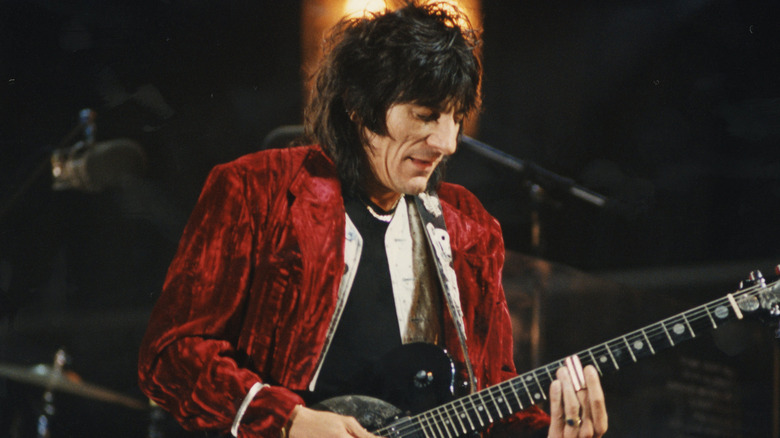
As a guitarist for both the Faces and the Rolling Stones, Ronnie Wood is a two-time inductee into the Rock & Roll Hall of Fame. One of the most successful band member replacements ever, Wood left the Faces and took over for Brian Jones in the Rolling Stones. But before he was a vital but non-starring member of those giants of classic rock, Wood was in another group that would have a tremendous impact on a new kind of music that would be very popular in the latter decades of the 20th century. For a couple of years, Wood was the bass player in the Jeff Beck Group.
A milestone in Jeff Beck's illustrious career, the first incarnation of the Jeff Beck Group was a trio consisting of the eponymous leader on guitar, along with Wood, and on vocals, Rod Stewart. The Jeff Beck Group ranks among the best supergroups in history, if not for the personnel and careers it boosted, but because its early albums were foundational to the development of hard rock. Here's how Ronnie Wood, with a big assist from Jeff Beck, helped create in the '60s the louder, edgier rock that would define the '70s.
The Jeff Beck Group made heavier rock feasible
Ronnie Wood and Jeff Beck had similar aims with their guitar-based rock in the 1960s. Wood's first signed group, the Birds, turned R&B songs into bombastic rock performances. Around the same time, Beck had replaced Eric Clapton in the major band the Yardbirds at the behest of member Jimmy Page. Wood admired the Yardbirds, and after taking in a show one night, notable for the band's deeply heavy take on Muddy Waters' blues classic "I'm a Man," he approached Beck and suggested they start a band together, should the latter ever leave the Yardbirds. It just so happened that Beck was on his way out of the group that was one of the first to generate and utilize electric guitar feedback.
While it was erroneously credited as a Beck solo album, the Jeff Beck Group's first LP was 1968's "Truth." The core sound came from Beck's style that was as complicated, imaginative, and bold as jazz and influenced by the blues but remained within the rock milieu, coming out ferociously heavy, loud, and aggressive. Wood played bass for the Jeff Beck Group, providing a more powerful and prominent low end that hadn't really been present in mainstream rock yet. Rod Stewart's half-shouted and raspy vocals completed the soundscape.
The Jeff Beck Group burned out quickly
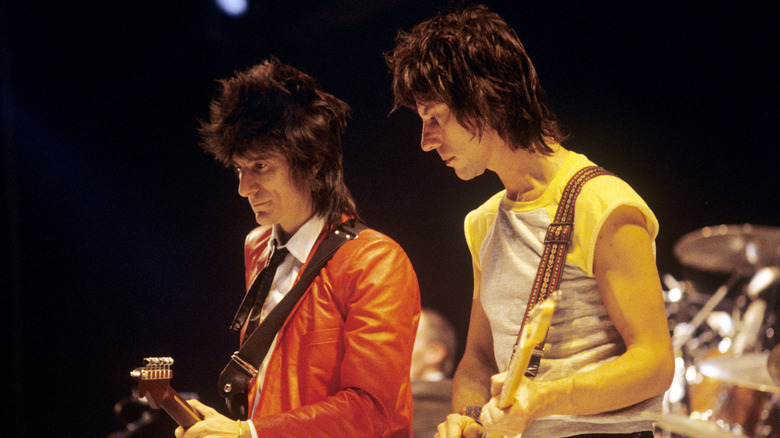
The Jeff Beck Group presented its prophetic notions about the future of hard rock primarily through transformative covers. "Truth" was packed with new versions of the Yardbirds' "Shapes of Things" and Willie Dixon's "I Ain't Superstitious," establishing a sound that would be later adopted by acts like Led Zeppelin and various other harder, metallic, and punk musicians. Album No. 2, 1969's "Beck-Ola," offered more of the tantalizing same, with the techniques applied to songs made famous by Elvis Presley and his ilk.
By 1970, the Jeff Beck Group was over, as Ronnie Wood and Rod Stewart departed in favor of the Faces. After recuperating from an auto accident, Beck created a second iteration of the Jeff Beck Group, but it didn't resonate the way their first efforts did. Beck rode out his career as a solo artist and sideman, contributing his unique approach to whoever would have him, doing what he felt came naturally. "I play the way I do because it allows me to come up with the sickest sounds possible," he said in 2009, via the BBC. "In fact, if I don't break the rules at least 10 times in every song, then I'm not doing my job properly."