

5 Rock Singers Who Went Full Gibberish — And It Worked
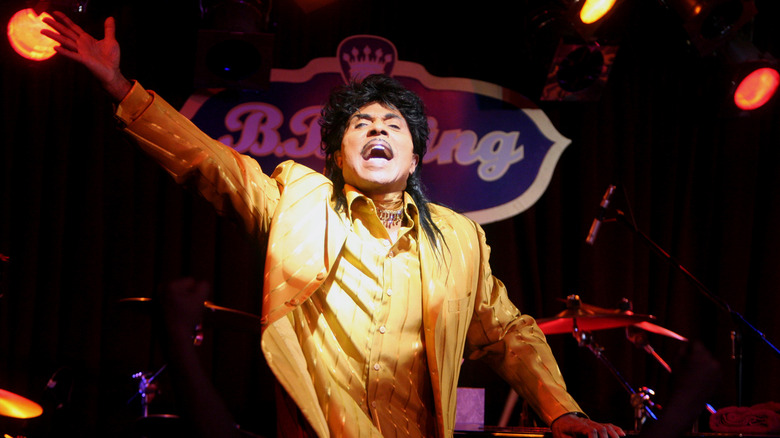
Fans imagine rock singers pondering and mulling over lyrics, blending poetry and ambiguity to get listeners curious about the true meaning of songs. While most lyricists tend to invest a lot of time in this exercise, there are some who became all about the vibes and went full gibberish. Now, whether it's because they grew tired of trying to figure out words, or it's an intentional creative choice, it's remarkable how some of these tracks have become accepted and beloved even if they feature utter nonsense in them. Hey, it works, so who are we to judge?
From John Lennon to Jonathan Davis, a number of high-profile musicians haven't been afraid to embrace the strange and let the words (or noises) freefall out of their mouths. To be fair, how many of us, as listeners, also make up gibberish when we mishear songs and make up lyrics? It's all fun and games when it's rock 'n' roll, baby!
I Am the Walrus — John Lennon
To call the Beatles' "I Am the Walrus" weird would be doing it the ultimate disservice. The psychedelic track off the 1967 film "Magical Mystery Tour" gives you the same sort of feeling as when your friend hands you a bag of mushrooms, and you realize they weren't intended to be chopped up and put in a pasta sauce.
Credited to John Lennon and Paul McCartney, but primarily sung by Lennon, "I Am the Walrus" talks about eggmen, walruses, and getting "a tan from standing in the English rain." It's more like a stream of consciousness where a bunch of random words get strung together, yet none of these "real" words are the best part of the song. Instead, this honor is bestowed on the phrase "goo goo g' joob." It appears several times throughout the track, but what does it mean? Maybe it's meant to be a duet with a walrus. Maybe it's a walrus saying, "Keep my name outta your mouth!" Who knows.
As it turns out, "I Am the Walrus" was essentially a troll job orchestrated by Lennon. When he realized that the Beatles' songs were being dissected and debated for interpretation, he decided to confound everybody by throwing this head-scratching track out there. Taking some influence from Lewis Carroll's "The Walrus and the Carpenter," and other substances, "I Am the Walrus" stands out as one of the best — but most bizarre — songs about a walrus.
De Do Do Do, De Da Da Da — Sting
Look, Sting does say, "Words are hard to find," fairly early in the Police's "De Do Do Do, De Da Da Da," which is off their 1980 album, "Zenyatta Mondatta." So, there's fair warning. For the most part, the track doesn't sound too off-kilter until the chorus, which is mostly a repetition of "de do do do, de da da da" broken up by actual words here and there.
This isn't about Sting sending a message in Morse code (rather than a bottle) or using placeholder lorem ipsum-inspired noises that slipped into the final recording. In fact, the man himself aired frustration to NME about how people failed to interpret the song. "The lyrics are about banality, about the abuse of words," he said (via Sting.com). "Almost everyone who reviewed it said, oh, this is baby talk. They were just listening to the chorus alone, obviously. But they're the same people who would probably never get through the first paragraph of 'Finnegans Wake,' because that's 'baby talk', too."
Even if the general intent goes over people's heads, there's no denying it's still an arresting song with a chorus that slithers inside like an inescapable earworm. Proving its mettle and appeal, "De Do Do Do, De Da Da Da" peaked at No. 10 on the Billboard Hot 100 chart.
Sussudio — Phil Collins
It's a testament to Phil Collins' talent that he can conjure up a random word, and everybody accepts that it must somehow exist and mean something in the English language. However, if you grab your dictionary and look up "Sussudio," well, it's nowhere to be found. This No. 1 Billboard Hot 100 hit features a title that is entirely gibberish, but it doesn't matter to anybody who loves to sing, "Su-sussudio," because it sounds cool to say, doesn't it?
"It's a word I made up," Collins revealed on "Late Night" in 1985. "I didn't even make it up. It just came out of my mouth when I was recording at home. [...] I was originally going to replace it, but I couldn't find a word that meant anything. Scanned as well. So I got stuck with it."
If anything, "Sussudio" demonstrates the sheer force of nature that Collins was in the '80s music scene. Everything he touched turned to gold, as he racked up seven No. 1 singles. Like one YouTube commentator wrote under the "Sussudio" music video, "At this point in time, Phil Collins could've recorded the alphabet song and released it as a single, it would be number 1 in the charts." No lies detected here. Collins deserves a movie about his life, especially this period of time that brought him tremendous success; that's for sure.
Freak on a Leash — Jonathan Davis
When Korn arrived on the music scene, fans noticed they were different from everything else out there. As the flagbearers for nu metal, they broke all the rules and sounded good while doing it.
One of their signature songs is "Freak on a Leash" — off the 1998 album "Follow the Leader." The track is a firm favorite among Korn fans and secured a Grammy nomination for best hard rock performance in 2000. While the song features hard-hitting instrumental sections and the emotional outpouring you'd expect from Jonathan Davis and co., it takes a left turn around the halfway mark. Davis unleashes a sizzling scat (not the first time in Korn history, though), making a succession of noises akin to "boom-da-da-boom" that impressively sound in key but add another eerie layer to the brooding track. A build-up follows, Davis screams, "Go!" and "Freak on a Leash" explodes into a moshpit-approved breakdown. Nothing about this should work on a technical level, but in the hands of Korn, it's a sonic spectacle that needs to be experienced.
While the scatting is pure gibberish, it was inspired by Davis' musical education and appreciation for hip hop and beatboxing. "That comes from Doug E. Fresh and s*** like that, old school hip-hop," Davis told The Fader. "Doug E. Fresh was the best beatboxer back then. That was my 'Doug E, Doug E.'"
Tutti Frutti — Little Richard
The voice is an instrument, but what happens when it turns into a different instrument altogether? If it's anything like Little Richard in 1955's "Tutti Frutti," you create rock 'n' roll history. Unquestionably, it was a rock song ahead of its time that still stands as one of the greats today.
The released version of "Tutti Frutti" finds Richard singing playfully about women, though its sanitized lyrics conceal the song's far more suggestive origins. While the thumpin' "Tutti frutti, oh rooty" gets the tailfeather shakin' like a pack of fleas was unleashed on you, it's the opening of the song and last part of the chorus ("A wop bop-b-luma b-lop bam bom") that turns this into a party. The gibberish may not make any sense, but it has such a rich percussive quality that makes it undeniable. Heck, it's as if Richard is playing a drum solo with his voice!
As it so happens, Richard had sung this bit at his shows before, but when it became a part of "Tutti Frutti," it transformed into something else entirely: a timeless track that's even been inducted into the Grammy Hall of Fame. Try to think of this song without this section; it's unfathomable — and proof that magic in music happens when you least expect it.