

5 Songs That Prove 1982 Was The Best Year For Funk
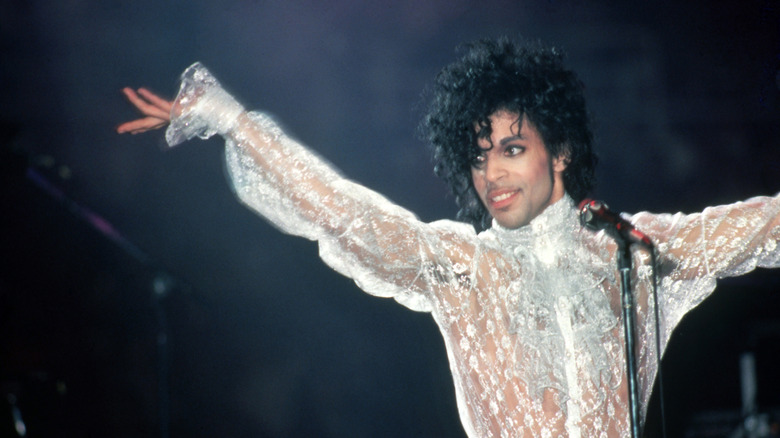
Funk music was having a serious moment in 1982, propelled by a cadre of ace singers and players who'd honed their craft through the decades prior. It felt like the mainstream music world had made a little extra space for R&B's jauntier, sassier cousin. The songs that made 1982 funk's finest year asserted themselves in dance clubs and expanded the genre in exciting ways that pointed toward its future. The crossover power of many funk tunes also helped build a runway for the budding hip-hop scene while showing listeners of all stripes a rousing good time.
We're funk fans around here, helplessly drawn to the snappy bass lines, innovative keyboard work, and soulful vocal razzmatazz. The finest examples in our all-encompassing mental record collection comprise a five-song set from 1982 that reinforced the genre's framework. Artists like Prince, Dazz Band, and George Clinton all chipped in unforgettable contributions and turned the year into a historic funk fest. Most of these songs may have missed major chart success, but their sonic inventiveness and playful attitude gave that year an unforgettable array of funkified sounds that still hold up more than four decades down the line.
D.M.S.R — Prince
Prince was coming into his purple era in 1982, expanding his musical prodigy status as a one-of-one performer by dropping his funk-defining "1999" album. It was a pop-friendly funk fest that reeled off timeless pop hits, "Little Red Corvette" and the title track, that led to a decade that put him at the top of the charts again and again. But the track list also featured "D.M.S.R.," one of the zippiest, synth-driven funk songs in his catalog up to that point, complete with back-slap bass and the Purple One's trademark howl.
The initials stood for "Dance, Music, Sex, Romance," which serves as the chant-along chorus of the song and describes all the aspects Prince captured in his musical vibe. With images like "I say do whatever we want / Wear lingerie to a restaurant," this freedom anthem fits the hedonistic "party like it's 1999" theme of the album's better-known title track. It let him keep his subversive spirit in place, even as his visibility grew exponentially and his career started to skyrocket. It also went on for more than eight groovy minutes, giving the crowd plenty of time to get on the dance floor and "Shake it like you just don't care." Prince may have later blown fans' minds with his 180-degree shift to Jehovah's Witness, but this 1982 dance floor celebration of the party zone was instrumental in making the year one of the best for funk.
Let It Whip — Dazz Band
It seemed like you couldn't get away from Dazz Band's funk-defining single "Let It Whip" in 1982. The synthesized sound is pure '80s gold, decorated with a snaky synth bass line with whip cracks that made the cut-loose-and-dance spirit of the title unmistakable. The harmonies and vocal break in the bridge are soaring Motown bliss, a natural touch given the band's beginnings in traditional soul and R&B. A little drum machine action that picked up on the electronic elements of contemporary soul music gave the tune a cross-genre personality that felt classic and fresh at once.
Dazz Band wasn't new to the music scene when they broke through with this club smash; they launched under the moniker Kinsman Dazz in 1976 and perfected their soulful R&B style enough to land a recording session with Motown legend Marvin Gaye. In 1980, they renamed themselves Dazz Band and signed with Motown Records. After modest success with a more traditional R&B sound, the sizzling modern funk of "Let It Whip" became a breakthrough hit. It won on the charts, too, holding the No. 1 spot on the R&B chart for five weeks and peaking at No. 5 on the Billboard Hot 100. It also won a Grammy for best R&B performance by a duo or group with vocal, while broadening the funk audience and drawing in more mainstream music listeners.
Atomic Dog — George Clinton
The pioneering spirit of funk's innovative granddaddy, George Clinton, gave the sound its spacey foundational elements and expanded the growing repertoire in the '70s and '80s. This magical, musical mastermind twisted the cube even further with the synth-heavy dancefloor favorite, "Atomic Dog," a pulsating piece of electro-funk that sounded like it arrived in 1982 from the far-off future. The space-age synth-saturated banger went to No. 1 on the R&B charts and stuck around for four weeks, marking the last time Clinton and his musical mischief-makers would reach that mark. And now, you can't throw out a guttural "Bow-wow-wow, yippie-yo, yippie-yay" within earshot of a Gen X funk-lover without getting a truncated "Bow-wow, yippie-yo, yippie-yay" back in return.
The lyrics of this funk standard were an extended metaphor for men as "dogs" chasing women as so-called "cats" — not the most enlightened theme of the era, and one that translates terribly in modern times. But coded as a buzzy slab of cyber-funk, it created a sonic sensation that even came with its own dance, the Dogcatcher, which the flamboyant Clinton demonstrated for his audiences. Parliament-Funkadelic, Clinton's hitmaking project that became a funk institution in the '70s, still takes its grooving tunes on tour, in shows featuring the fusion-fed fan favorite. It turns out this dog has legs.
Dance Floor — Zapp
You'd be easily forgiven if you mistook funk staple "Dance Floor" by the groove-tastic synth-funk specialists Zapp for a Prince song; the song has all the hallmarks of the Minneapolis maestro, right down to the vocal grunts and wonking guitars. It's only when lead singer Roger's robotic talkbox-enhanced voice comes in that you realize this is funk of a slightly different flavor. Zapp consisted of the Troutman brothers — Roger, Larry, Lester, and Terry "Zapp" — whose musical background included decades of experience playing R&B and soul. The band's infectious sound was a big part of their Dayton, Ohio, hometown being dubbed "Land of Funk" when the sound was making major waves in the '70s. With 1982's "Dance Floor," Zapp hit No. 1 on the Billboard R&B chart, which helped the band to be named No. 37 among Billboard's 50 best R&B groups.
Further down the line in the '80s, Roger would score solo success, including a major No. 3 crossover hit with 1987's "I Want to Be Your Man." After his shocking 1999 murder by his brother Larry Troutman, who committed suicide after the incident, the band struggled but ultimately reassembled to honor the funk tradition they and Roger had so greatly contributed to. With the banner achievement that was "Dance Floor," Zapp gave 1982 an extra blast of funk that pushed it over the top and made it the sound's finest year.
If you or someone you know is struggling or in crisis, help is available. Call or text 988 or chat 988lifeline.org.
Dance Wit' Me — Rick James
"Dance Wit' Me" was a celebratory Rick James tune that dialed back his trademark freakiness, focusing on his invitation to a woman to dance. The background noise of other partygoers makes the request seem downright innocent compared to James' notoriously wild real-life antics. But the backing tracks are pristine here, with James foregoing the usual guitar or synth solo in the middle of the song and opting instead for a mellow vibraphone sequence. It gives the song an unexpectedly whimsical twist and shows that James wasn't afraid to take risks with his funky formulation and evolve the overall format in the process. Then the sax solo kicks in and things feel sublimely joyful, especially with partygoers cheering on the soloists in the background.
"Dance Wit' Me" only reached No. 64 on the Billboard Hot 100 in June 1982, not nearly as successful as his touchstone tune "Super Freak" from his blockbuster album "Street Songs" the year before. But it did prove that James' contributions to the world of funk music would continue into the new decade. The song's expansive textures also reinforced the idea that funk could expand beyond the genre's best-known hits and polished up 1982's status as the ultimate year for funk, both as a musical category and a cultural force.