

5 Concert Venues Immortalized By Classic Live Albums
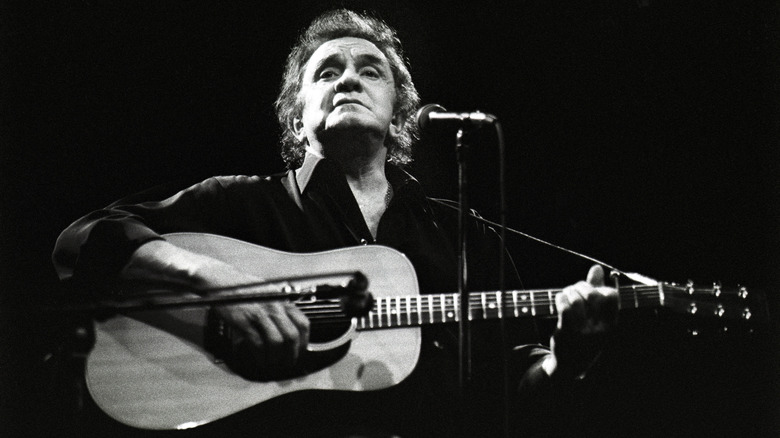
A good live album is more than a mere tour souvenir. The best live albums of all time are a window into the organic evolution of the musicians behind our most cherished studio recordings, and some of them are so profound as to alter career trajectories and, on occasion, become inextricably linked with the venue where it all happened.
Kiss's breakout success with 1975's "Alive!" or the unstoppable behemoth that was Peter Frampton's "Frampton Comes Alive!" are exclamatory proof that a live album is an opportunity to let those screaming multitudes transport our mind's eye into those extraordinary concerts. But what about the proto-heavy metal pioneers who helped turn a Japanese sporting arena into a god-tier concert experience, or the country legend who gave one of his most memorable concerts at a state prison? Today, we're looking at the live albums whose impact was so extraordinary that the venues themselves became hallowed ground forevermore.
The Budokan — Deep Purple
Although the entirety of Deep Purple's "Made in Japan" was recorded over three nights, the Tokyo sessions at the Nippon Budokan served as an early document of the location's burgeoning appeal to Western artists, an almost mythical milestone.
Originally built as a sporting venue for the 1964 Olympics, Tokyo's Nippon Budokan became known primarily as a concert venue after the Beatles performed there. Subsequent performances by major Western artists, including The Monkees, Grand Funk Railroad, and Led Zeppelin, further enshrined the venue's new identity.
Recorded over two nights at Osaka's Festival Hall and one at Tokyo's Nippon Budokan, "Made in Japan" captures Deep Purple stretching some of their most memorable material — including "Smoke on the Water" — into sprawling performances filled with extended solos and full-band jams. To that end, the band comes off more like an overly enthusiastic electric jazz-fusion combo than burgeoning heavy-metal legends. The result is a living document that is as much a record of hard rock's evolution from the psychedelic jam bands of the '60s to the polished machines of metal's heyday.
With a specific focus on the Budokan material, "The Mule" emerges as the standout performance. Though the track's centerpiece is an epically protracted drum solo from Ian Paice, he unabashedly pulls focus even during the full band sections. But left to his own devices, his feature moment proceeds in the vein of John Bonham's "Moby Dick" with its steady maintenance of intricate patterns across a slowly building, sculptural form. That an album fixated on such furious chops could become a massive hit speaks all the more to its extraordinary power.
The Village Vanguard — John Coltrane
It's all in the name: a club in New York's Greenwich Village where the vanguard of jazz artists come to move the genre forward one intimate night at a time. The perfect place for one of jazz music's all-time greatest legends to showcase the kind of material that would define his later period sound.
By the time he recorded the material that would make up "Live! at the Village Vanguard," John Coltrane had essentially nothing left to prove. His early career had seen him rise in the ranks of Miles Davis' band and become the dominant force on 1959's "Kind of Blue," the album that helped establish modal jazz as a major direction for the genre. That alone would have forever enshrined him in jazz history, but his work as a bandleader and sideman had seen him come to dominate the genre during its mid-century period.
"Live! At the Village Vanguard," which Rolling Stone would later clock at No. 15 in its list of the greatest live albums of all time, features just three cuts (though the later released complete recordings would clock in at four and a half hours). The material sees Coltrane at home in himself, kicking out phrases that echo the early hard bop that made him a legend and blistering across the kind of rapid-fire changes that made "Giant Steps" such a foreboding classic.
As such, the album serves to capture not just the atmosphere of the Village Vanguard but its cultural ethos as well. While more than 100 albums have been recorded at the venue, Coltrane's is regarded as one of the most important records to emerge from the tiny, dark club.
Folsom Prison — Johnny Cash
There aren't many things that could make a fella want to go to prison, but there are likely plenty of listeners who would have shot a man in Reno just to watch the performance documented in Johnny Cash's "At Folsom Prison." Recorded in 1968 at the titular California penitentiary (certainly an atypical concert venue, but immortalized nonetheless), the LP would become a milestone achievement in Cash's career with triple platinum sales. While impressive, those numbers were outshone by the album's social impact, with Cash becoming a major advocate for prison reform.
That latter point speaks to the charm at the heart of the album's enduring appeal. It isn't just the searing live performances by a singer so in his musical element that he seems to have wholly forgotten he's surrounded by convicts. What makes the album resonate so warmly is Cash's deeply humanizing rapport with his audience. They cease to be sinister criminal villains that occupy our collective unconscious and become souls just as lifted by music as the rest of us.
"This show is being recorded for an album release on Columbia Records, and you can't say 'hell' or '****' or anything like that," announces Cash in the final seconds of "Dark as a Dungeon." The snarky quip meets with laughter and good-natured applause from the inmate audience. There's no hint of malice or primal anger, just joyful approval from the downtrodden who were likely grateful for the momentary reprieve. Despite all the dark lyrics and gallows humor, that's the reality of what Johnny Cash's Folsom Prison concert was really like: imposing in its themes and gentle in its delivery, just like the man in black himself.
The Apollo Theater — James Brown
There's an old saying that all of philosophy is a "footnote to Plato." That's paraphrasing what Alfred North Whitehead actually said, but the sentiment could easily apply to James Brown's influence on the evolution of Black music. Revered as the "Godfather of Soul," he has a legacy that resonates across jazz, funk, R&B, hip-hop, rock, and indeed the whole of modern music. His legendary "Live at the Apollo" set is a landmark testament to that reputation.
Harlem, New York's Apollo Theater is a notoriously tough room. Since being established in 1913 (though it didn't open its doors to African Americans until 1934), the theater has carried on a proud legacy as a major cultural hub for Black music genres, and that legacy is maintained by a crowd that expects to see that legacy upheld with every performance. Into that gauntlet stepped the utterly unfazed James Brown, prepared to record a live album that he was financing himself due to label issues.
Any sense of trepidation in the face of the momentous performance is invisible in the euphoric delivery. The album became Brown's first major hit album and firmly established him as a commercial juggernaut. Moreover, as Robert Christgau observed in his commentary on the recording, the album is also a crucial historical document of the Chitlin' Circuit, the concert venues that catered to Black audiences during segregation.
History paints a more complex picture of James Brown in what's come out about him since he died. His dark side was as notorious as it was undeniable, but what must forever be acknowledged is his consummate skill as a performer, as well as his crucial role in the development of Black music.
The Amphitheater of Pompeii — Pink Floyd
There are few justifiable reasons to record a live album with nobody in attendance, but Pink Floyd pulled it off with their concert film, "Live at Pompeii." Filmed just prior to the conception of their massive breakout album, "Dark Side of the Moon," the performance captures a band of musical experimenters slowly coalescing into prog-rock hitmakers and performing some captivating sonic alchemy in the process.
Built around 70 B.C., the venue was used for gladiatorial spectacles and other events, making it a central hub for city life in its heyday. That historical significance alone makes the site noteworthy, but Roman amphitheaters are known for their extraordinary acoustics; Pompeii, believed to be the oldest surviving permanent amphitheater in the ancient Roman world, carries that tradition proudly. Those precise acoustics, born out of the need to make spoken voices as clear as possible, continue to be studied by architects and acoustic engineers to this very day. As such, it seems only natural to want to know how modern music would sound in such an environment.
Pink Floyd's performance, recorded without an audience as part of director Adrian Maben's vision for an "anti-Woodstock," is a solemn and haunting affair. There is something distantly unnerving about the empty seats, but even the less pristine recording equipment of the time captures the otherworldly reach of electronic tones filling that sprawling stone space. The Floyd could have only made a more powerful historical statement if they'd performed on the literal dark side of the moon.