

The 4 Best Country Rock Supergroups Of The '70s
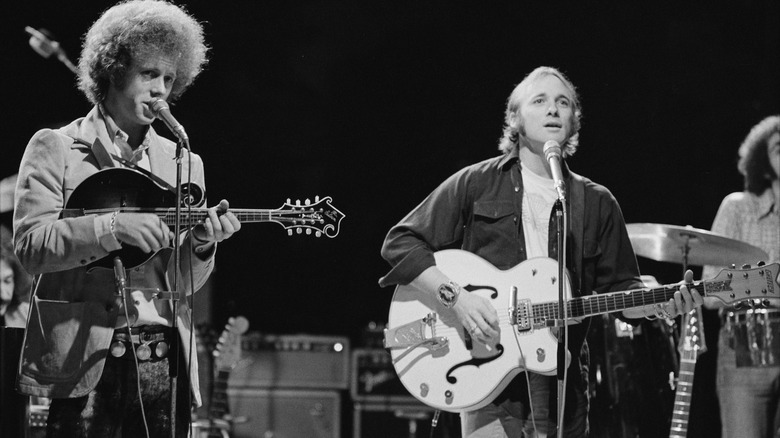
Digging into country rock's history reveals a relatively close-knit, insular genre, especially in its infancy. With Los Angeles as its epicenter, various members of groundbreaking bands such as Poco, Buffalo Springfield, and the Byrds formed new groups, split up, and then formed other bands that all pushed the genre further. Thanks to such cross-pollination, particularly in the '70s, several outstanding country rock supergroups came to the fore that sometimes lasted, but more often imploded quickly.
Our entries were chosen for their importance to the genre's birth and growth, the stature of their members, and in one case, their attempt to take country rock in a more contemporary direction. Any country rock fan will recognize some familiar names in these groups, such as Stephen Stills, Chris Hillman, and J.D. Souther. But what all these groups had in common (besides sharing band members), from the Flying Burrito Brothers to McGuinn, Clark, & Hillman, was their ability to make great music.
The Souther-Hillman-Furay Band
In 1973, Chris Hillman, a staple of country rock supergroups and other groundbreaking acts, including Rick Nelson and the Stone Canyon Band, joined forces with Richie Furay and J.D. Souther in the short-lived supergroup aptly named the Souther-Hillman-Furay Band. At the time, they were all free agents and were brought together by Asylum Records founder David Geffen.
Souther had already written for numerous star acts, from the Eagles to Linda Ronstadt and Bonnie Raitt, and the equally talented Hillman and Furay brought their own musical skills to the project, which produced a self-titled album in 1974. The band also featured pedal steel player Al Perkins, who had been in Shiloh, a pre-Eagles band with Don Henley, as well as the Flying Burrito Brothers and Manassas.
The band's first album was lauded by several critics and reached No. 11 on the Billboard 200. The Furay-penned single "Fallin' in Love," with its beautifully layered guitar sound and vocal harmonies, was the album's biggest hit, reaching No. 27 on the pop charts. The Souther-Hillman-Furay Band's playing was incredibly tight, but with three songwriters in the mix, the album sounded less like a coherent musical statement and more of a showcase for each of their talents. Even so, the band put out a second record, "Trouble in Paradise," in 1975 before going their separate ways.
The Flying Burrito Brothers
Ex-Byrds Chris Hillman and Gram Parsons, their session pedal-steel player "Sneaky" Pete Kleinow, and Chris Ethridge of Parsons' earlier group, the International Submarine Band, formed the Flying Burrito Brothers in 1968. While the International Submarine Band is credited with creating the first truly country rock album, "Safe At Home," it was the Byrds, driven on by Parsons, who helped take the genre mainstream with their album, "Sweetheart of the Rodeo." The Flying Burrito Brothers pushed things further with their first album, 1969's "The Gilded Palace of Sin," and even further with "Burrito Deluxe" a year later.
"Burrito Deluxe" included ex-Byrds drummer Michael Clarke and future Eagles guitarist Bernie Leadon. The album features the Rolling Stones' "Wild Horses," which Mick Jagger and Keith Richards had penned and given to their friend Parsons to record after he had turned them onto country music — the Stones' version wouldn't come out until the next year.
Hillman kicked out Parsons after their second album, but the Flying Burrito Brothers recorded two more studio albums, with a self-titled release in 1971 and "Last of the Red Hot Burritos" in '72 with Rick Roberts on guitar and lead vocals and Al Perkins on pedal steel. The band broke up with Hillman and Perkins joining Manassas, although Ethridge and Kleinow briefly reformed the group in 1975. While they were never commercially successful, the band was pivotal in solidifying country rock's enduring reach.
Manassas
Another '70s country rock band that time has seemingly forgotten is Manassas, Stephen Stills' supergroup that he formed in the wake of the breakup of Crosby, Stills, Nash & Young (CSNY) in 1970. Stills brought together CSNY's drummer Dallas Taylor and bass player Calvin "Fuzzy" Samuels, the Flying Burrito Brothers' Chris Hillman, Al Perkins, and fiddler Byron Berline, and Joe Lala, percussionist for the Byrds (among others). The band was rounded out by Paul Harris, who'd played keyboards for Poco and would later join the Souther-Hillman-Furay Band. The Rolling Stones' Bill Wyman also played bass on two songs and co-wrote "Love Gangster" from the band's first, self-titled album.
The two-record set of "Manassas" featured a kaleidoscopic sound that merged rock, country, bluegrass, Latin, and folk with tight vocal harmonies and virtuosic musicianship. Stills, who felt the album was one of the best he'd done, believed the band pushed country rock further than anyone else. "We knew we were on the cutting edge of something," he recalled in "Stephen Stills: Change Partners." "It took what the Flying Burrito Brothers and all of them were supposed to be and made it more of a marriage between Rolling Stones rock 'n' roll and country."
The album went to No. 4 on the Billboard 200 with two singles, "It Doesn't Matter" and "Rock & Roll Crazies," both reaching the Hot 100. Unfortunately, the band only put out one other album before breaking up just two years after forming.
McGuinn, Clark & Hillman
In 1977, three former members of the Byrds — Roger McGuinn, Gene Clark, and Chris Hillman — reunited to form a new band, McGuinn, Clark & Hillman. Many fans and critics were expecting a rehashing of the Byrds' original sound, but were sorely disappointed.
The band's self-titled 1979 album was a concerted effort to push country rock into a contemporary framework that leaned into soft rock with some disco flourishes, similar to what the Eagles were doing. Although many music industry critics felt the sound fell flat, the LP was marginally successful and saw the band, which also featured Joe Lala and Paul Harris from Manassas, pushing in different directions. Horns, strings, and Latin percussion all added a different flavor to "McGuinn, Clark & Hillman," and one track, the lilting, Caribbean-esque "Don't You Write Her Off," reached No.33 on the Hot 100.
The band recorded a second album, "City," in 1980, under a slightly different name, Roger McGuinn and Chris Hillman featuring Gene Clark, after Clark experienced health issues while on tour and grew unhappy with the band's direction. The new LP did a better job of updating the Byrds' original sound for the early 1980s on songs like "City."