

The Best One-Hit Wonders From The British Invasion
The British Invasion made stars of countless U.K. bands as they arrived in the U.S. to try and replicate the Beatles' rise to prominence following their game-changing appearance on "The Ed Sullivan Show" in 1964. The Rolling Stones, the Animals, the Who and more became some of the biggest acts of the era and retained their fanbases for decades. However, not everyone that crossed the pond was able to sustain lasting fame — even if the song they broke through with was truly great.
Here are four singles from bands who were part of the British Invasion of the 1960s, but who failed to replicate the success of their major hits. For this list, we're defining "one-hit wonder" from a purely U.S. perspective. Some of these bands had several more singles that performed admirably well on British soil. But stateside, these British bands all share the characteristic of having one career-defining song that performed far better on the Billboard Hot 100 than anything else they put out.
Tobacco Road — The Nashville Teens
Despite their name being a nod to Music City U.S.A., the Nashville Teens are in fact a British group, who formed in 1962 when a band called the Cruisers recruited two new lead vocalists — Arthur Sharp and Ray Phillips — and decided to change how they billed themselves. Like the Beatles, the Nashville Teens developed their musical skills playing long club nights in Germany, performing regularly in Hamburg, Cologne, and Frankfurt.
"Tobacco Road" is their 1964 international hit single, which went to No. 16 on the Billboard Hot 100 and has become their defining song. The track is a surprisingly rough-and-ready garage rock number, the stomping rhythm of which is interspersed by breaks in the instrumental that allow the group's delicate vocal harmonies to come through. Featuring boogie-woogie piano and a thick bass tone, it's still a bop, and there's no surprise it appealed to rock fans the world over when it was first released.
Though the Nashville Teens had another major hit in the U.K. with their follow-up single "Google Eye," they would never again break the U.S. Top 40. Nevertheless, the band has continued to perform with Phillips still at the helm of the band ever since.
Have I the Right? — The Honeycombs
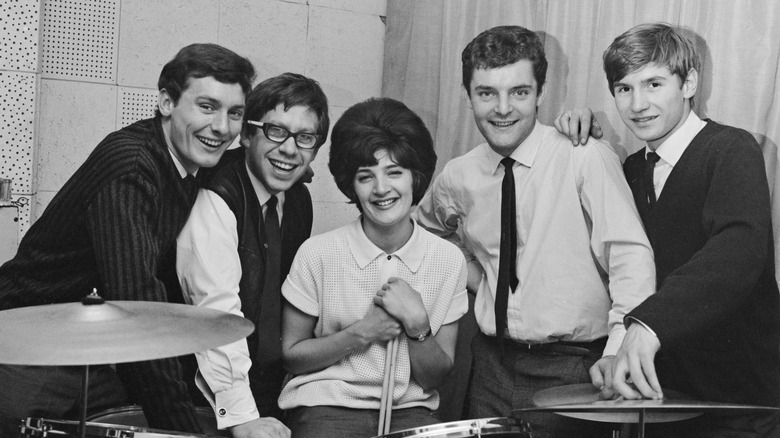
In the early days of rock, women were vanishingly rare in bands — especially women drummers. But the British Invasion band the Honeycombs broke the mold with a mixed gender line-up that included drummer Honey Lantree. Lantree was typically at the center of the band's press images, which helped to differentiate the Honeycombs from the typically all-male bands of the era.
Formed in London in 1963, the Honeycombs found almost immediate fame. Their 1964 single "Have I the Right?" was produced by Joe Meek, and combines conventional, inoffensive pop vocals — although the title phrase does have some bite to it — with a heavy four-to-the-floor rhythm section and an infectious tremolo-heavy guitar part and wailing organ. In many ways it is obviously inspired by Phil Spector's famous "wall of sound" production style, but in its pounding tempo also seems to anticipate the sound of glam rock that would arrive around a decade later. The increase in intensity during the song's chorus remains a thrill, especially when listened to with generously high volume.
The track hit No. 5 on the Billboard Hot 100 in October that year, and performed incredibly well in the band's home country, topping the singles chart. It was an auspicious start, but the band would never have another Top 40 hit in the U.S. despite some more muted success at home, and they split in 1967.
You Turn Me On (Turn On Song) — Ian Whitcomb and Bluesville
British-born Ian Whitcomb's band Bluesville was actually made up of Irish musicians who had formed the group while attending Dublin's Trinity College, but they nevertheless became part of the British Invasion when they toured the U.S. with major English acts such as the Rolling Stones. Bandleader Whitcomb was a fixture in the Dublin music scene as he embraced skiffle — the genre performed by John Lennon's group the Quarrymen before transforming into the Beatles — and rock 'n' roll with various groups, and he also played in cafes in Seattle, where he spent time on vacation.
Fronting Bluesville, Whitcomb enjoyed a brief spell of fame in the U.S. thanks to "You Turn Me On (Turn On Song)," which peaked at No. 8 on the Billboard Hot 100 in 1965 and led to widespread touring opportunities for the group. While Whitcomb didn't manage to maintain the level of celebrity of other British Invasion performers, his life still revolved around music. He continued touring and performing as a solo artist decades after his commercial peak, turning toward traditional genres like ragtime and Titanic-era parlor music. Indeed, listening to his hit single with this knowledge in mind, you can hear the ragtime piano style that underpins it.
Fire — The Crazy World of Arthur Brown
"I am the god of hellfire, and I bring you ... " That unforgettable line opens "Fire," the 1968 hit from the eccentric British group the Crazy World of Arthur Brown, which flew to No. 2 on the Billboard Hot 100. It's a moment that heralds a new level of theatricality in the world of pop music, the result of vocalist and ex-Foundations bassist Arthur Brown's passion for cinema, staged drama, and classical poetry.
On stage, Brown would perform in costume as the god he invokes, with a painted face and helmet adorned with actual flaming horns. The drama of the song is also heightened by Brown's spine-tingling vocals, which begin commandingly before building into a soaring, anguished shriek.
The band began performing in London in 1967, gaining a following through the experimental-leaning UFO Club and attracting the attention of the controversial Who manager Kit Lambert, who produced their debut album alongside Pete Townshend. The self-titled release is considered a '60s classic, and while Brown had largely dropped out of the music industry by the 1990s, but he enjoyed a prolific resurgence as a popular touring act and recording artist in his home country especially.