

The 5 Longest Guitar Solos In Psychedelic Rock History
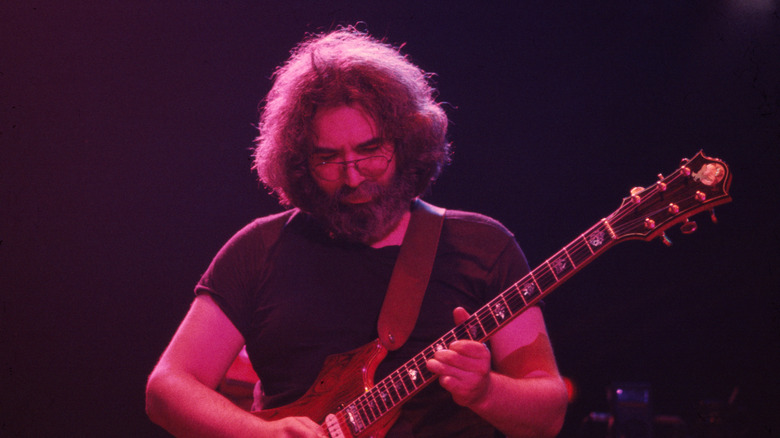
Psychedelic rock is known mainly for two things: wild, far out sounds and hyperextended, multi-part solos. That is true of drummers, bassists, and even vocalists, but when it comes to rock, the kings of the longform solo are the guitarists. It's not uncommon for psychedelic rock songs to reach 10 or 20 minutes in length, and live in concert, guitarists are known to stretch that to be twice or even three times as long. What's more, the free-form nature of many psychedelic bands' performances means that the lines between a solo and the rest of the song can become blurred, leading to lead guitar parts that never seem to end, even through verses and choruses.
In the hands of the genre's best guitarists — names like Eric Clapton, David Gilmour, Jimi Hendrix, Jerry Garcia, and Trey Anastasio — solos only improve the longer they are allowed to run free. They often get more psychedelic, too, as the guitarists and their band begin iterating, chasing new flashes of inspiration, and playing off each other to build something entirely new. We've collected here five of the longest solos in psychedelic rock history, all of which feature one of these legends of guitar, and all of which take you into a long, winding trip through the sonic cosmos.
Spoonful (Wheels Of Fire version) — Cream
Cream has often been called the world's first supergroup, with all three members of its powerhouse lineup enjoying musical success before even forming. With all their tremendous musical ability and a surplus of youthful energy and ambition, the group took music which might have otherwise been labeled as mere blues and pop and transformed it into innovative and dynamic sonic novelty. A major facet of those transformations, of course, was guitarist Eric Clapton, whose propensity to go off improvising at length regularly took songs to the next level. The longest example of this within the band's discography is the live version of "Spoonful" on disc 2 of "Wheels of Fire," the vast majority of which is all Clapton and all tour-de-force.
Like Black Sabbath, Cream had a knack for taking down-tempo blues grooves and imbuing them with an acidic grunge that allowed them to transcend their roots. Although the core riff of "Spoonful" is pure blues, the performances stacked atop it, especially Clapton's that night at The Fillmore, send it into the stratosphere. The "Wheels of Fire" version is a hefty 16:44 in length, and roughly 12 to 13 of those minutes is one big Clapton jam. Slowhand is rarely slow throughout, and eschews a lot of the usual stock blues licks in favor of playing high, fast, and fiery. A credit is also owed to Jack Bruce, who quickly drops the core bass line in favor of free improvisation, which allows Clapton to do the same. Even by the 12-minute mark, Clapton has already taken listeners on a frantic sonic odyssey.
Echoes (Live at Pompeii) — Pink Floyd
A lot has been said about Pink Floyd's masterpieces "The Dark Side of the Moon," "The Wall," and "Wish You Were Here," and rightfully so, but the rest of their extensive catalogue has a trove of treasure lying within. One of the best is a long experiment in progressive rock and ambient psychedelia known as "Echoes," which takes up the entire second half of their 1971 album "Meddle." A live version is the highlight of their concert film "Pink Floyd: Live at Pompeii," and though split into two parts for dramatic effect, their combined length clocks in between 24 and 26 minutes, depending on the release. Though it's not all David Gilmour soloing, the legendary guitarist does carry the majority of the song, especially the roughly 14-minute instrumental break in the middle that makes up the song's bulk.
When Gilmour and Richard Wright finish singing the first couple of verses and choruses around the five-minute mark, Gilmour takes off. True to his nature, he builds his part slowly before eventually wailing away like an operatic singer in distress. In between spurts of bends that sound like fireworks, Gilmour retreats into the groove, letting the relative calm highlight his explosive playing by contrast. He always returns to his impassioned bends in time, though, and even when the band descends into an ambient musical void, his bends merely morph into haunting, alien cries. Floyd has used "Echoes" as a bombastic encore, and both its length and cinematic scope ensured audiences did not leave unsatisfied.
Machine Gun (Isle of Wight version) — Jimi Hendrix
No discussion of psychedelic rock guitar would be complete without mentioning Jimi Hendrix. He was a once-in-a-generation force of nature, pushing the boundaries of not only guitar technique but production in general, and when given the space to improvise in concert, he pushed even harder. One of his indisputably peak performances came in the form of the live album "Band of Gypsys," of which "Machine Gun" is the standout track. Though that version is kept to a modest 12:33 in length, the version included in "Blue Wild Angel: Live at the Isle of Wight" jumps past 22 minutes, nearly all of which is Hendrix soloing.
This version of "Machine Gun" has a few verses, though Hendrix continues playing lead through all of them, and aside from around three minutes for a Mitch Mitchell drum showcase, Hendrix's leads never stop. The original version of the track is known for the way Hendrix emulates sounds of war like gunfire, bombs, and screaming with his playing, but in the Isle of Wight performance, he trades in that immersion for pure, blistering solo work. There are few moments during "Machine Gun" in which Hendrix isn't playing loud, aggressive, and at the top of his instrument's register. There are moments where he even sounds like a genuine shredder, which makes sense — the album was recorded on August 30th, 1970, only three weeks before his death. In a very real way, this version of "Machine Gun" shows Hendrix at the absolute peak of his skill.
Dark Star (Live versions) — Grateful Dead
The late, great Jerry Garcia was a singular figure in the world of improvisational music, and by the time of his passing, was widely regarded as one of the art form's best and brightest talents. Though he and the rest of the Grateful Dead were infamous for transitioning their live shows into extensive, free-form jams — it was very much what fans packed their concerts for — there is perhaps no better example of their ability to extend and evolve their songs than the live versions of "Dark Star."
The original "Dark Star" recording is less than three minutes and is driven by its vocals more than anything, with nary a solo in sight. Yet when the band played the song live, it grew into a series of colossal monuments to Garcia's technical ability and seemingly boundless invention. The first live version the band released, on the album "Live/Dead," grew to a solid 23:15 in length, but one live version was released on its own, simply titled "Dark Star," and clocked in at just under 40 minutes. Aside from about a minute of vocals towards the end of side one and another towards the end of side two, and a two-minute drum-solo interlude, the entire piece is essentially wall-to-wall Garcia exploring sounds. Garcia takes the crowd through so many different styles, techniques, and energies that it's impossible to find a single throughline other than his unquestionable creativity. Both parts need to be heard back-to-back to experience the full effect of all the many peaks and valleys that make up the "Dark Star" trip.
Runaway Jim (Live versions) — Phish
Anyone familiar with current jam band kings Phish will not be surprised to see their performances mentioned alongside the word "longest." The band has made a career out of expanding their setlist into staggeringly long marathons of improvisational back-and-forth, with guitarist Trey Anastasio frequently the highlight. Anastasio carries on the tradition of Garcia by blending myriad genres, styles, techniques, and tones during his lengthy jams, and the band has no jam lengthier than the rendition of "Runaway Jim" played in Worcester, Massachusetts in 1997.
The scant verses and lyrics of "Runaway Jim" are essentially a straightforward bluegrass-folk ditty, but in signature Phish fashion, that home base is quickly left behind for more sonically experimental territory. For the vast majority of its length, the song sounds nothing like bluegrass or folk, and rarely do any two sections sound the same. What is consistent is Anastasio and company exploring a whole palette of moods, and some are as psychedelic as anything you'll hear.
With a good helping of effects and an excess of fretboard knowledge, Anastasio manages to fit dozens of songs into one. The best moments, however, are when he and the rest of the band slow down and let their sounds reverberate on end, making the arena feel like a gravity-less pocket of space. At just shy of an hour, "Runaway Jam" might be a more accurate song title, but wherever Anastasio is running off to in a given moment, it's worth following to find a whole new sonic landscape.