

5 Japanese Rock Bands That Made It Big In America
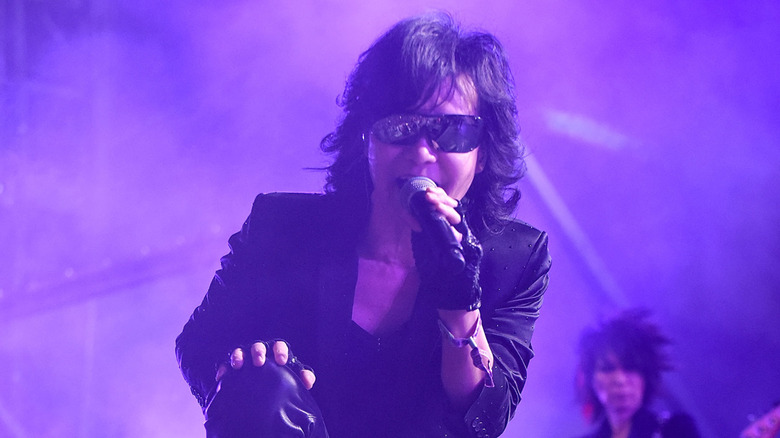
The concept of being "big in Japan" is a long standing (and, in some instances, derisive) expression to describe Western artists who attain remarkable success in the Land of the Rising Sun while wider popularity continues to elude them. So although plenty of classic rock hits have smashed in Japan, the reverse, unfortunately, is less common. While Japan has gifted the Western world some extraordinary pieces of popular culture — from anime to Nintendo — their musical exports haven't landed as hard, nor as consistently.
With that in mind, we wanted to take a look at some of the Japanese bands who managed to make a seismic impact on Western shores. Whether we're talking about legendary hair metal exports lionizing their rock 'n' roll crazy nights or a girl group adopting the outer extremes of death metal, there's some incredible stylistic innovation that deserves attention and appreciation. Most of these artists didn't make it big through radio play and hit singles — it was devoted cult followings and the continued interest of the underground music press that brought these majestic megazoids to our attention. Let's find out why.
Loudness
A band so legendary as to be synonymous with the very concept of Japanese metal, Loudness comes off like the country's answer to Judas Priest. That's high praise, but Loudness' classic period — which lasted from their 1981 inception until the firing of original vocalist Minoru Niihara following 1988's "Jealousy" LP — more than justifies the comparison. An unrelenting battery of razor-sharp speed metal led by the furious fretwork of guitarist Akira Takasaki shreds the culture barrier and instantly stands alongside their Western metal brethren.
While the band was quickly greeted with European acclaim, courting the U.S. market remained a more daunting task. To that end, they assembled the commercially-minded but no less hard-driving "Thunder in the East" in 1985. Bolstered by the single "Crazy Nights," the album managed to peak at No. 74 on the Billboard 200, a relatively minor showing but one that earned the band distinction as the first Japanese metal band to make headway in the United States.
Sigh
Japan has a long and celebrated tradition of musical experimentation, merging international forms with the country's own indigenous music that goes back decades, but Sigh takes the practice to the furthest possible extreme. Something of a musical laboratory, Sigh blends black metal, jazz fusion, Japanese traditional music, Western classical, progressive rock, world music, and whatever else tickles bandleader Mirai Kawashima's fancy. The band's output fearlessly merges musical styles with zero regard for convention.
Initially signed to Deathlike Silence Productions for their 1993 debut "Scorn Defeat," the early Sigh sound was relatively consistent with label owner and Mayhem guitarist Euronymous' Norwegian black metal leanings. But even at that early stage, the brutal guitar and visceral, screaming vocals are augmented with belligerent stabs of outside styles being shoved in with willful but skillful abandon. Those early stirrings of experimentation increasingly dominate subsequent releases to the point that 1997's "Hail Horror Hail" comes with a disclaimer advising that difficulty appreciating the material is the result of the listener's conscious self being "ill-equipped to comprehend the sounds produced on this recording." That commitment to stylistic surrealism became a worldwide hit with underground music fanatics with the release of 2001's "Imaginary Sonicscape," an unrelenting foray into metal infused with psychedelia, jazz, classical, and electronica.
While conventional standards of mainstream success have always eluded Sigh (not that they ever pursued them), the band nonetheless maintains a rabid international following, with their United States and European fandoms reportedly eclipsing their popularity in their native country. Consistently active on the international touring circuit for decades, the group finally announced plans to the slake the thirst of their stateside listeners with their first U.S. tour in 20 years.
BABYMETAL
The words "Japanese girl group" probably bring to mind images of painfully adorable schoolgirls, Hello Kitty aesthetics, and synchronized dance routines, and BABYMETAL is no exception. It's the rip-roaring death metal band backing them up that sets them apart. The idea to merge Japan's aggressively marketed kawaii (cuteness) culture with the outer reaches of metal's most popular subgenres might not sound like it would work on paper, but it has definitely scored big on the U.S. sales charts.
While the group's self-titled debut only barely flashed on the U.S. charts, hitting No. 187 on the Billboard 200, each subsequent release has charted significantly higher than the last. "Metal Resistance" hit No. 39 in 2016, "METAL GALAXY" hit No. 13 in 2019, and "Metal Forth" reached No. 3 in 2025. What started as a bizarre novelty act quickly caught on, riding the early 2010's wave of U.S. interest in Japanese popular culture into a career with remarkable staying power.
BABYMETAL's vocal trio of SU-METAL, MOAMETAL, and YUIMETAL (no relation) enjoyed quick worldwide notoriety after the success of their 2014 single "Gimmie Chocolate!!" What seemed to have all the makings of a one-off novelty act proved to be an ongoing worldwide sensation. And the combination of saccharine pop vocals and apocalyptic shred guitars never fails to sound cohesive.
X Japan
Though U.S. recognition of X Japan remained elusive for decades, their importance to the Visual Kei movement in Japan is comparable to the Beatles and the British Invasion or Nirvana and grunge. The concept of Visual Kei is, first and foremost, a fashion trend born out of a willfully over the top blending of glam rock, punk, and heavy metal aesthetics that X Japan themselves described in their catchphrase as a "psychedelic violence crime of visual shock."
Such statements are hardly hyperbolic when brought in line with the band's actual music. Initially conceived of as an '80s speed metal band by drummer/pianist Yoshiki and vocalist Toshi (they prefer the mononyms) the band soon began incorporating melodic elements and instrumental virtuosity more closely associated with European power metal as heard on signature songs such as "Kurenai." As the group's popularity expanded, so did their repertoire with ballads that infuse the Enka pop tradition (a '70s precursor to modern J-pop) with overtones of hard rock power balladry.
It was a winning formula for the band in their homeland, but cultural and language barriers made them a tough sell in the U.S. during their '90s heyday. Western expansion finally opened to the band with their inclusion on the "Saw IV" soundtrack, a move that brought X Japan to their U.S. concert debut in Chicago, Illinois with an appearance at 2010's Lollapalooza. By that time, the band hand endured considerable internal strife, not the least of which was Toshi's involvement in the controversial New Religious Movement known as Home of Heart and the death of guitarist Hide. Thus, their ultimate success in the U.S. market came as a long overdue career capstone.
Boris
Boris' initial underground material made guitarist Wata one of the most criminally overlooked women of the '90s shoegaze scene. Since then the group has gone on to enjoy a massive stateside popularity that began with the Southern Lord label's reissue of the 2005 "Pink" album, bringing their drone-heavy, doomy post-metal to the Western masses.
"Pink" became an underground hit with critics, with Pitchfork calling it "a 47-minute frenzy that welcomes 2006 with open arms, bludgeoning fists, and a call to arms against MOR complacency." Opening with the ironically titled "Farewell," Pink is an album that builds slowly, with sprawling ambient washes of guitar distortion that seem less like riffs and more like free-standing sound sculptures surrounded by the wider accouterments of a rock band. Even more up-tempo fare like the title cut seem structured around ambiance rather than moving the mosh pit.
With that in mind, Boris' stateside success comes as a part of a turn-of-the-century drone renaissance spearheaded by the aforementioned Southern Lord who spent the mid to late 2000s releasing LPs in a similar vein by Sunn 0))), Earth, and Zoroaster. The plucky Japanese trio has made good on that initial push through the subsequent decades, with dozens of releases that encompass a wide array of experimental styles, all of it rooted in Wata's endlessly creative guitar work. There's no way to fully anticipate what's coming on a new Boris LP, just a guarantee that it will sound like it's drifting in dreamily from another dimension.