

5 Criminally Overlooked Women Of The '90s Shoegaze Scene
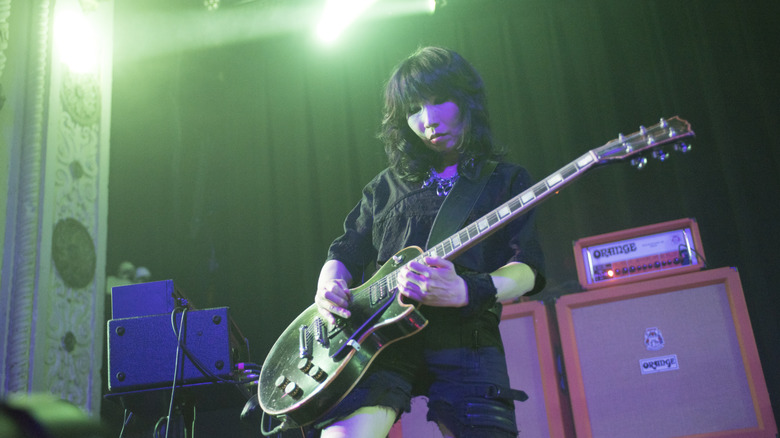
As a genre, shoegaze never had a No. 1 hit. For that reason alone there's plenty of stellar artists within its ranks that fall through the cracks. Sadly, many of those are often women. Even a genre with such luminaries as My Bloody Valentine's Debbie Googe and Bilinda Butcher or Mazzy Star's Hope Sandoval isn't immune from letting the contributions of women fall by the wayside. As such, we wanted to put the spotlight on some of the overlooked sisters of the genre, such as Wata from Boris and Lisa Baer from Ozean.
Being overlooked as an artist can happen in a variety of ways and for different reasons. Shoegaze as a style takes its name from the downcast gaze and low-key stage presence of its performers. That alone lends the style to added degrees of obscurity. Some artists were the victims of poor business decisions, some retreated into self-imposed exile, and some just didn't prioritize public persona enough to stand out. But whatever the case, there's real artistic contributions that went by unnoticed.
Like so many underground genres, there's plenty of debate to go around as to what is and is not shoegaze. As such it's important to cast a wide net and consider works that broadly encompass the genres stylistic trademarks: thick, slow riffs, heavy feedback, and dreamy vocals that fade into a wall of sound among other stylistic accouterments. With that in mind, let's take a look at some of the unsung female heroes of the scene.
Kendra Smith — Opal, The Dream Syndicate
Artist obscurity in Shoegaze is often self-imposed. To that end, vocalist/bassist Kendra Smith is arguably the genre's J.D. Salinger. A contributing member of Opal (which reformed as Mazzy Star following her departure) and The Dream Syndicate as well as other minor '80s projects, her output halted abruptly in the '90s. But it's the maturity of those recordings that make her disappearance unfortunate.
Aside from a writing credit on "Fell From the Sun" off Pale Saints' 1990 LP "The Comforts of Madness," Smith's 90s output focuses on two solo releases. The first, 1992's "Kendra Smith Presents the Guild of Temporal Adventurers," finds the shoegaze genre's signature drones and jangly guitar riffs tempered by a sense of balance and proportion. The overdriven haze is gone, replaced by a more restrained, listener-friendly mix that places the vocals in the foreground.
That compositional growth is further realized on 1995's "Five Ways of Disappearing," Smith's only full-length solo album. Released on 4AD, the album again showcases the core elements of shoegaze tempered by worldbeat and synthwave elements. The feedback-laden guitar and dreamy vocals are there but tracks like "Aurelia" and "Temporary Lucy" demonstrate prominent layers of worldbeat instrumentation that add new layers to the arrangements.
Following the release of "Five Ways of Disappearing," Smith ducked out of the public eye once again. Reportedly living a hermetic life in the woods of Northern California, she has remained professionally uninvolved in music ever since. Though her '90s work may be overlooked due to her own unwillingness to stay in the game, it is nonetheless a tragedy that such innovative output stopped so abruptly.
Wata — Boris
Boris, and their powerhouse guitarist Wata, looms large among Japan's notable noise rock artists. Speed demon bands like Guitar Wolf and Zeni Geva have been cranking it well beyond 11 in the land of the rising sun for decades. But it's Wata's focus on down tempo riffage and sustaining walls of sound that keep their extensive back catalogue either firmly inside the shoegaze genre or adjacent to it.
Boris exploded into stateside underground popularity when the Southern Lord label reissued 2005's "Pink." That finally brought some long overdue attention to their first two albums, 1996's "Absolutego" and 1998's "Amplifier Worship," but unfortunately not soon enough to make them a major player in a '90s musical landscape they'd participated in since 1992. That meant that the decade came and went without truly celebrating Wata's unique instrumental voice.
And what a fascinating voice it is — even early singles like the video edit of "Absolutego" (an hour-long song in its album version) reveal an accomplished sense of melodicism nestled inside all of that ferocious distortion. It's especially apparent in the solo which has the kind effects-tempered vibrato reminiscent of Robert Fripp. Wata would go on to expand on that harmonic and sonic palette throughout Boris' prolific recording career, adding keyboard synthesizes to the mix. Like so many shoegaze artists she's famously quiet in person but her creativity continues to expand in all directions.
Lisa Baer — Ozean
Even in a genre defined by willful avoidance of the limelight, Ozean's flash of existence is notable for its brevity. The Lisa Baer-fronted quintet released one self-titled EP in 1992 before parting ways. The recording would be forgotten until it was reissued by Moon Sounds Records in 2017.
Guitarists Eric Shea and Mike Prosenko began laying the groundwork of Ozean with drummer Mark Baldwin in 1991, arguably the best year of the decade for shoegaze music. Baer was DJing in a San Jose club when guitarist Mike Prosenko approached her about joining the newly forming Ozean. She initially declined the offer but eventually accepted when Prosenko followed up again a few months later.
A fan of bossa nova/Latin jazz artists like Astrud Gilberto and Gabor Szabo as well as the proto-shoegaze stylings of Cocteau Twins and The Jesus and Mary Chain, Baer fills the EP's 14:19 runtime with dreary, reflective vocals reminiscent of 1960s pop divas. Ozean's dense shrouds of Britpop style guitars and mid-century pop throwback grooves would have fit nicely alongside Mazzy Star and Lush, but fate had other plans. The group played only one show before disbanding. For Baer, who experienced stage fright and social anxiety, this came as a relief.
Eileen Henry — Chimera
Sometimes artists with potential are staggered by mishaps on the business end of things, which was certainly the case with the Eileen Henry-fronted Chimera from Northern Ireland. That sort of bureaucratic shuffling is inevitable in the music industry, but it's all the more disheartening when it sidelines a group that was showing real signs of genre-expanding musical innovation.
Chimera's sonic realm is one where Celtic worldbeat overtones intersect with electric guitars that sound like factory machine noise twisted into a coherent musical context by sheer force of will. Henry's vocals come off like a melancholic Enya and in the world of shoegaze, that's quite the complement. It's a sound that manages to be edgy and ethereal in equal measure without sacrificing the potency of either. The band released their UK debut, "Lughnasa," in 1993, and theywould go on to release the "Day Star" EP in 1995 and the full-length "Earth Loop" in 1996, both through Grass Records.
Extensive stateside touring followed and the band began making promising inroads into the booming U.S. alternative rock market. Sadly, further label issues hampered their upward trajectory. Grass Records would eventually restructure as Wind-Up Records and focus its attention on burgeoning arena rock legends Creed. Chimera fell by the wayside as audiences embraced the stylings of Scott Stapp with arms wide upon.
Elizabeth Freesh — Bang Bang Machine
Bang Bang Machine slides under the shoegaze umbrella with enough of the stylistic accouterments (endless reverb, psychedelic guitar tones, and melodic feedback) to justify inclusion but those elements often seem like window dressing on a more straight-ahead alternative rock group. To that end, Elizabeth Freesh's vocals are notably more chameleonic than many of her shoegaze frontwoman contemporaries. Songs like "Give You Anything" and "Love That Burns" have a huskier, more aggressive vocal delivery than the waifish, emotionally detached template laid down by Mazzy Star and Cocteau Twins. That aura of barely-concealed aggression gives the whole sound a sort of riot grrl punk edge.
A notable high point for the group was a massively popular appearance on the legendary "Peel Sessions." A creation of famed BBC DJ John Peel, the sessions were conceived of as live-in-studio performances by prominent bands. Luminaries have included Led Zeppelin and Nirvana. Bang Bang Machine's 1992 appearance featured an extended nine-minute performance of "Geek Love" that sailed up Peel's year-end Festive 50 chart, beating out PJ Harvey and Ministry for the top slot. Said Peel of the recording, "Even if they never made another record, they'll have achieved more than most of us do in our entire lives."
The group released two albums, "Eternal Happiness" and "Amphibian" before disbanding in 1996, never fully realizing the potential of their promising formative years. Freesh responded warmly to a fan petition for a Bang Bang Machine reunion in 2007 but declined the suggestion citing her focus on motherhood and family life.