

The 5 Most Beautiful Male Voices Of The '70s
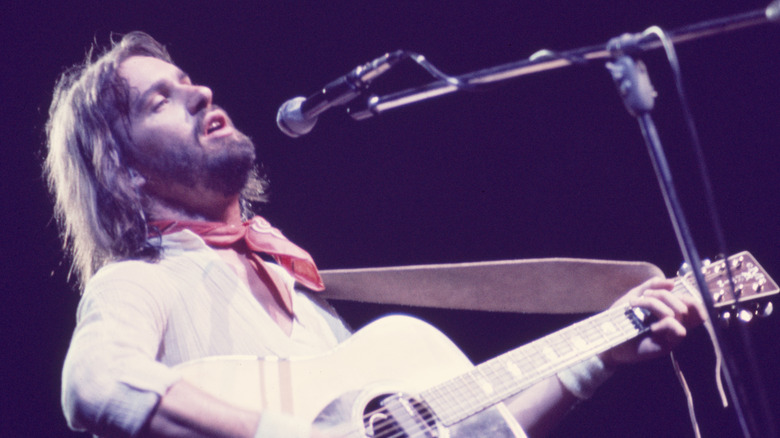
It's easy to call out a beautiful male voice when you hear one, but a bit more difficult to track back through all the music of a decade as explosive as the '70s and select the five most beautiful of all. It's only when you start examining the singers whose music conveyed the most emotion without sounding like they were gargling glass shards or trying to hold in a sneeze that you begin to see the pristine vocal talent truly reveal itself. In a pool of Bruce Springsteens and Barry Gibbs — both highly expressive singers in their own rights — it's the more nuanced voices that come into focus as the epitome of beautiful '70s male vocal power.
There's no entirely objective way to identify the five most beautiful male voices from any era, let alone isolating the options to just the '70s. Obviously, beauty is in the ear of the beholder, which to us means singers with rich tones and mellow delivery who show off a fair amount of technical skill. Sometimes this translates to the offerings of a modern crooner like Bryan Ferry; other times, it manifests in a folk warbler like Tim Buckley. For every songsmith we chose, the common ground was smooth voices that soothe rather than startle, from singers who knew how to put their vocal instrument to its greatest uses.
Bryan Ferry
Bryan Ferry slunk onto the 70s music as lead voice of British glam-art rock group Roxy Music. His voice gave shades of David Bowie, but with more control and technical polish. But to appreciate how beautiful Ferry's voice really was, you have to look past some of the bands biggest hits, songs like the punky "Love is the Drug" and the jaunty "All I Want is You," to find his silky tones. Rather, it was peak Roxy offerings such as the ultra-smooth "Dance Away" and even the harp-heavy "Angel Eyes" from 1979 that gave away the game: Ferry was playing hide-and-seek with a supremely satiny set of pipes that just needed a little more time to mature.
Listen to the Roxy Music catalog from the start and you can hear how Ferry's vocals became more stately as the decade rolled on. His tone seasons gorgeously, softening to match his suave, suited persona and melding into a more elegant form. He spent the '70s refining his delivery and evolving his image into a more adult figure, primed and ready for the sophisti-pop scene that coincided with the '80s advent of the New Romantic movement. It would lead to even better uses of his vocal prowess on Roxy classics like "Avalon" and his own solo hit "Slave to Love." But in the '70s, fans who followed closely had early glimpses of this beautiful male voice as it developed.
James Taylor
With his hangdog physical presence and his laid-back surfer soulfulness, James Taylor made for a perfect folk pop figure, giving the world a wise and knowing voice that always maintained its mellow tone. It seemed like no matter what Taylor wrapped his golden pipes around, the song was sure to soothe and assure listeners in need of comfort. The confident vibe made Taylor one of the strongest singers on the '70s adult contemporary circuit, even without flashy runs or gravelly rock-heavy growls to add emphasis and compete with other musicians. Taylor knew where his range worked best, and he turned it into an institutional tool for the ages.
How versatile was Taylor's beautiful voice? It could hop from contemplative confessionals like "Fire and Rain" to the anthemic "Shower the People" and circle around to the joyful soft rock classic "Your Smiling Face" — and make each one sound like only he could sing them properly.
Taylor's appeal transcended the '70s and kept him in the hearts and minds of listeners as the decades passed. Now, his early catalog serves as a portrait of a young singer-songwriter with an earnest soul and a voice that was more than sincere and beautiful enough to convince even cynical listeners to shed a tear or two — or even dance a little. Such was Taylor's multifaceted vocal talent in his heyday.
Tim Buckley
Tim Buckley was one of the most celebrated folk singers of the 70s, adding his sweet tenor to original songs and covers that became richer for his contribution. The calming warmth of his voice was a trademark that made his music instantly recognizable. His 1970 masterpiece "Song to the Siren" is a rapturous display of Buckley's haunting, emotive vocals applied to his equally evocative songwriting with lyricist Larry Beckett. The nine albums he released between 1966 and 1974 created a trove of folk-pop infused with jazz, progressive, and psychedelic touches. Every tune was enriched with Buckley's inimitable voice as the binding golden thread running through it all.
Buckley's tragic death in June 1975 at age 28 from a heroin overdose left a notable absence in the music world; his silenced voice removed a gentle grace from not just the industry, but the realm of creators with natural gifts to share. His son Jeff was just a baby when his father died, but Buckley had passed his talent onto his son. Jeff Buckley would find modest success as a performer on the New York small club scene in the '90s. Sadly, Jeff's fate of dying young would mirror Tim's, when the younger Buckley died in an accidental drowning in May 1997 at age 30.
Lou Rawls
Nobody's baritone voice reached deeper or soared higher in the '70s than the one Philly soul singer Lou Rawls delivered in his best-known hits. Rawls could conjure up romance and sensuality without breaking a sweat, never losing control of his delivery or overselling what the lyrics were trying to convey. When he crooned, he reminded the world of a sound that was slipping into the past, and when he belted, he affirmed that the new sounds were every bit as compelling. More than anything, Rawls was an interpreter of love songs whose beautiful voice represented what craft and composure could be in the sphere of contemporary music.
It was Rawls who helped carry the Philly Soul style into the '70s. The lush "Lady Love" and "You'll Never Find (Another Love Like Mine)" maintained Mowtown-esque R&B roots while flirting heavily with disco. And the playful spoken-word opening of "See You When I Git There" from 1977 gave listeners a taste of the singer's ribcage-rattling basso speaking tone to assert that yes, his voice does in fact reside pretty much at the soles of his feet. Rawls' sturdy, masculine sound anchored these pieces and more with a tone that could flex accordingly to fit the material.
Dan Fogelberg
Though Dan Fogelberg had several up-tempo songs that put his crystalline voice through its paces, the singer-songwriter was known primarily as a balladeer. His way with the more tender side of life and love gave him plenty of opportunity to use his vast and emotive voice to bring palpable ache to each performance. Look no further than the rollicking "The Power of Gold" from his 1978 work with collaborator Tim Weisberg to hear the buoyant side, and the plaintive "To The Morning" from 1972 to hear the melancholy dimension of his alluring vocal personality.
When his compositions leaned into modern chamber music with high orchestration and artful flourishes, Fogelberg's range expanded to match. When his songwriting delved into adult-oriented pop stylings like on 1979's "Longer," he constrained his considerable pipes into a softer tone for the occasion. He could move from head voice to chest voice in a single note, as he did on the soaring, triumphant passages of "Nether Lands" from 1977, drawing out emotion in the sharp edge between the two.
Fogelberg's romantic tenor was just getting revved up in the '70s. It would carry him to even loftier heights in the '80s as his commanding presence and skillful singing made him a beloved radio superstar, with 11 Hot 100 singles to his credit in that decade. But it will always be those early years where Fogelberg's flute-like vocals shone the brightest.