

5 Music Legends Who Turned Down Huge Paydays To Keep Their Songs Out Of Commercials
The most famous rock stars to ever do it made the biggest songs of all time — the hit records that served as the background music to the lives of millions. It's logical, then, that when companies aim to advertise their products and create a positive association in the minds of as many customers as possible, they seek out well-known classic rock songs to play behind product footage. Just one use in a TV commercial may command millions of dollars for the original artist or the songwriter, and plenty of rockers have played along and added to their vast fortunes. A few outright refused the proposition of their works appearing in ads, thereby walking away from a very large sum of money.
Going back to the 1960s, some of rock's biggest legends politely and impolitely refused to have their tunes turned into jingles. Here's how and why acts like the Doors, R.E.M., Neil Young, Tom Petty, and Bruce Springsteen said no to a big cash payout in exchange for licensing their artwork for an ad.
The Doors
When the Doors emerged in 1967, they were daringly different, their music overtly sensual and laced with references to drugs, making them one of the icons of psychedelic rock. Perhaps seeking the dollars of the Doors' multitudes of younger fans, automaker Buick put forth an offer to use the band's first hit, the No. 1 single "Light My Fire," in an ad campaign for its small, sporty Opel. Ray Manzarek, Robby Krieger, and John Densmore all assented, but when front man Jim Morrison found out, he nixed the deal, owing to a clause in a band agreement. "Back in 1965, Jim said that we should split everything, and everyone has veto power," Densmore explained to The Guardian. The deal was canceled.
In the 21st century, three decades after the tragic death of Jim Morrison, the Doors still had to field commercial requests and they still took Morrison's assumed opinion under consideration. Apple fully produced a commercial soundtracked with the Doors' "When the Music's Over" with plans to air it in less than a week, for which they'd pay the band $1.5 million. Manzarek wanted to say yes, but Densmore exercised his veto.
R.E.M.
In 1995, the Rolling Stones accepted a massive fee for licensing a song to be used in a commercial. When Microsoft introduced and promoted its heavily anticipated Windows 95 operating system, it did so with an advert scored to the Rolling Stones' 1981 smash "Start Me Up." Just how much the band received was never disclosed — a representative of Microsoft claimed that the figure was somewhere in the $2 million range, other outlets claimed $4 million, and a British tabloid placed the figure at $12 million, which was front man Mick Jagger's asking price.
But the Rolling Stones' "Start Me Up" wasn't Microsoft's first choice. In 1994, well in advance of the Windows 95 release, Microsoft approached alternative band R.E.M. with a specific request. The company aimed to make the group's 1988 hit "It's the End of the World as We Know It (And I Feel Fine)" the Windows 95 campaign theme song. R.E.M. was so opposed to the idea of its music in ads that it not only rejected Microsoft's multi-million-dollar offer, but around the same time filed a suit against Hershey Foods regarding a concert tie-in with KitKat candy that was unapproved by the musicians.
Neil Young
The story of Neil Young is one of an artist refusing to compromise his integrity, including prohibiting his music from being used for any kind of commercial purpose. He thinks the practice diminishes the impact of the music, and in 1989, he wrote "This Note's For You," in which he claims he can't be bought: "Ain't singing for Pepsi / Ain't singing for Coke," he sings. The accompanying music video was so incendiary, parodying stars like Whitney Houston, Eric Clapton, and Michael Jackson and their respective soda and beer commercials, that MTV refused to play it at first, but eventually gave it the video of the year award at their Video Music Awards.
Companies and advertisers long ago stopped trying to get Young's songs into commercials. But relatively early in his career, an unnamed fast food giant apparently made an effort. During some stage banter at a 1973 concert, Young told the crowd that he'd recently passed on an enriching opportunity to have "Heart of Gold," his folk rock No. 1 hit from 1972, appear in an advertisement. Utterly disgusted by the idea, Young said had he done so, he'd have had to retitle the work "Burger of Gold."
Tom Petty
Tom Petty wasn't a fan of modern music and he didn't like profiteering in rock music either. Throughout his long career, the leader of the Heartbreakers wouldn't allow companies to serve as tour sponsors and he insisted that ticket prices be kept as low and affordable as possible. He also adamantly refused to let the songs from his extensive catalog be used in TV advertisements. "I didn't write them to be orange juice commercials," Petty explained to Billboard in 2005. "I think I'd get hives if I turned on and saw my music playing behind the Gap. That would probably put me over the top."
"Mary's New Car" is a deep cut from the 1985 Tom Petty and the Heartbreakers album "Southern Accents," and B.F. Goodrich and their agency Grey Advertising earmarked it for use in an ad for T/A Radials tires. Petty summarily turned down the request in August 1986, so the firms instead produced and aired a spot with music that sounded so similar to "Mary's New Car," as performed by Petty, that he filed a $1 million lawsuit. A judge forced the ad off the air.
Bruce Springsteen
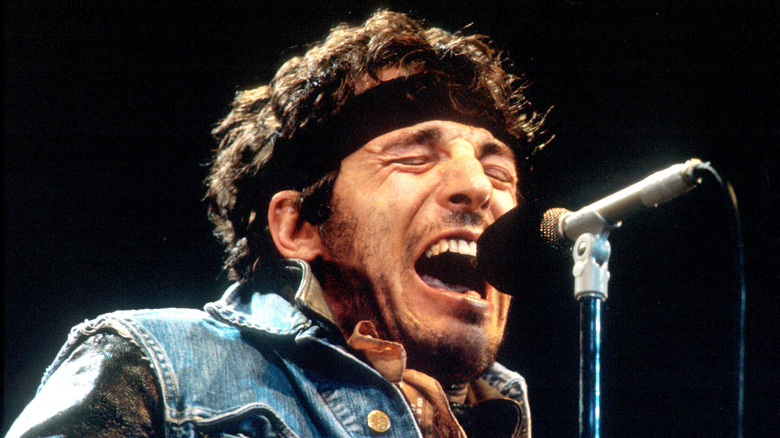
The meaning of "Born in the U.S.A.," the hit title track off Bruce Springsteen's 1984 album of the same name, is commonly misunderstood. Thought to be a patriotic anthem because of the title and the proud and defiant way Springsteen sings it, "Born in the U.S.A." is actually a critical examination of the mistreatment of returning Vietnam War soldiers. To use such a song in a commercial would amount to a woeful and ironic misread and misappropriation, and Springsteen wouldn't allow that to happen anyway.
In the wake of Springsteen's elevation to rock and pop mega-star due to the blockbuster sales of the "Born in the U.S.A." LP, the corporations came calling. Lee Lacocca, the celebrity head of the Chrysler automobile company, personally tried to get Springsteen to allow the song "Born in the U.S.A." to be employed in a car ad. The man nicknamed the Boss said no to the Chrysler boss, rejecting what was reportedly a licensing fee in the neighborhood of $12 million.