

5 Guitarists Who Helped Invent The Defining Sound Of Folk Rock
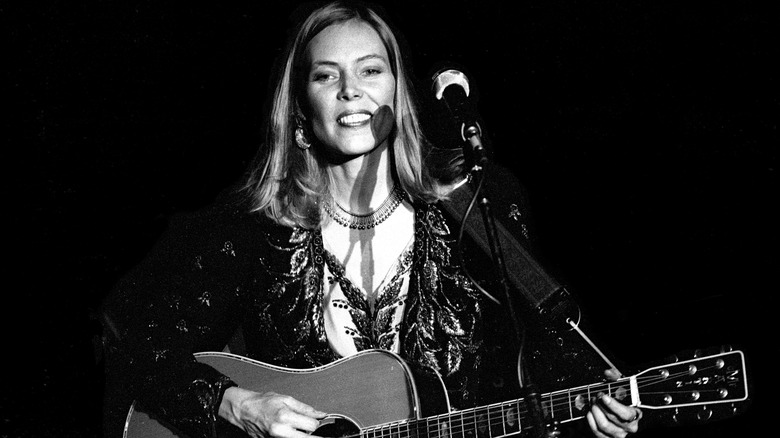
Whether they leaned more into the gritty, feedback-heavy end of the spectrum or stuck to the more jangling, acoustic-friendly side of the genre, a distinctive set of guitarists contributed their considerable talents to craft what became the overarching folk-rock sound. This new invention occupied the gap between the protest and traditional folk music of the first half of the 20th century and the exciting new flavors of rock music that were quickly becoming the preferred sound of young musicians — and young audiences who responded emphatically.
If you're a folk or folk rock connoisseur, you'll recognize every name in our five-pack of premium players, each of whom we chose for their contributions to forging a whole new lane for musicians to explore. Some, such as Roger McGuinn, springboarded off of contemporary sounds and took them further into the folk rock mode, while others like Joni Mitchell experimented with whole new avenues of sound to arrive at a more upscale version of what folk rock could be. But no matter what they added, we think these inventive guitarists helped make folk rock into a viable sonic playground that never left the musical landscape.
Roger McGuinn
As lead guitarist for the generational folk-rock band the Byrds, Roger McGuinn found the balancing point between strong and soft, expertly adding his tones to the genre's pantheon of top players. He's widely considered one of the fathers of folk rock and even had early connections with the Beatles when they first arrived in America, adopting the band's use of folk chords in a rock format and creating a successful blend of his own. The magic wand he used to help usher in this new sound was a 12-string Rickenbacker, which sparked his imagination thanks to its use in the Beatles' "A Hard Day's Night." The instrument helped create the expansive chime and thick texture the Byrds' music became known for.
The catalog of influential folk-rock guitar sounds that McGuinn created is like a treasure trove of the 20th century's sweetest sounds. The joyous jingle of "Mr. Tambourine Man," the cheerful chime of the biblical "Turn! Turn! Turn!," the jangle of "I'll Feel a Whole Lot Better" — every tune reinforced McGuinn's knack for infusing sonic elation into his guitar work.
This McGuinn-fluence furthered a folk rock motif that would be picked up by future artists from commercial biggies of the '80s, from the Heartbreakers' Tom Petty and Mike Campbell and R.E.M.'s Peter Buck to alternative darlings of the '90s like the Lemonheads and the Replacements. His guitar playing gave early folk-rock its sonic foundation, and forwarded a movement that celebrated the fusion.
Bob Dylan
The king of modern folk rock, self-taught guitarist Bob Dylan gave the otherwise gentle folk guitar motif a heady feedback buzz that told other players it was okay to make a little noise. What he didn't deliver in vocal prowess — even if his style did become a lasting trademark — was more than made up for by instrumental skill.
After starting with acoustic folk in Greenwich Village in the early '60s and taking the torch from folk heroes like Woody Guthrie, Dylan began putting his signature guitar sounds on original songs, informing the scene with an edgier, more electric take on what folk music could be. That take came with a distinct sharpness that matched the growing American rock scene.
What Jack Kerouac became for beat poetry, Dylan became for folk-rock music: a legendary figure whose heady poetry and open-hearted guitar playing informed modern music makers in the late 20th century, and well into the 21st. Americana rockers from John Prine to Bruce Springsteen and Jason Isbell have cited Dylan as foundational to their musical creativity. The more folk-oriented side of Dylan's scrappy spirit echoes through the playing of modern musicians like protest singer Jesse Welles and folk-rock troubadour Noah Kahan. Dylan may not have played with technical polish, but that was the point; his playing from the soul instilled confidence in other singer-songwriters, assuring them that the folk-rock sound was about authenticity more than training.
Joni Mitchell
There were no greater experimentalists in the sphere of folk rock guitar playing than the legendary Joni Mitchell. The alternate tunings Mitchell discovered by accident came as a result of childhood polio leaving her with a weaker left hand. Forced to be inventive with her playing, Mitchell created a soundscape all her own, one that expanded the genre's possibilities and inspired countless musicians to twist the tuning pegs into configurations that were more expressive than academic.
Thanks to Mitchell's revolutionary guitar tuning technique, open chord structures that doubled up notes or combined unexpected tones created imaginative harmonies that became the hallmark of her playing. The configurations created perfect partnerships for her crystalline vocals, complementing her voice rather than competing with it. Mitchell has since shared her alternate tunings to give players a chance to try them out.
Mitchell's willingness to tinker with tropes and upend established sound structures until they fit her interior emotions was a pioneering move; it opened up possibilities of working jazz and prog-rock layers while maintaining folk-like song structures. This was most noteworthy on her biggest commercial hit, "Help Me," a 1974 folk-rock classic from her landmark album "Court and Spark," which introduced cosmopolitan orchestration to her breezy guitar work and elevated the folk rock genre as Mitchell, one of its key sonic inventors, matured.
Richard Thompson
English folk rock musician and iconic guitarist Richard Thompson was one of the founding members of seminal folk group Fairport Convention. At the tender age of 21, he forged his own path as a solo artist, sharing the journey with fellow singer-songwriter and wife Linda. Thompson emerged as one of the greatest folk rock storytellers thanks to his unique voice, which shaded his lyrics with a world-weary, lived-in feel. But it was his guitar playing that was folk rock lightning, stunning enough for the LA Times to refer to him as "... the finest rock songwriter after Dylan and the best electric guitarist since Hendrix."
Thompson's classic "1952 Vincent Black Lightning" shows off his love of traditional finger work, sending out arpeggiated notes reminiscent of an Irish reel brought to the 20th century, woven into a set of guitar strings instead of fiddles and pipes. His beloved ballad "Dimming of the Day" features chord-plucking akin to beloved pop-folk hits of the '70s, such as Gordon Lightfoot's "If You Could Read My Mind." And the bluesy electro-folk of "Night Comes In" demonstrates his flexibility and deftness with more than just an acoustic guitar.
Some 60 years after starting his journey, Thompson is still releasing new music that displays his folk rock inventiveness, and is a founding father of a sound that altered the music industry. He's been awarded an OBE by Queen Elizabeth II for his contributions to music — not a bad honor for a pioneering folk rock guitarist to snag.
Neil Young
Neil Young became a guitar hero to a generation (or two) of aspiring folk rockers who liked playing in the grit more than they liked keeping their sound clean and pristine. As a member of Buffalo Springfield and later as a solo artist in the '60s and early '70s, Young developed an earthy style that could dim down to a heartbreaking acoustic chime or rise up to a hearty blast. Young's playing demonstrated that the range of sounds available from a guitar — acoustic in particular — could evolve within a song to suit whatever spirit needed to come through. A tune like "Heart of Gold" demonstrates the soft yet strong balance Young applied, helping dispel the notion that "acoustic" meant "gentle" by default.
Becoming a member of Crosby, Stills & Nash – temporarily renamed Crosby, Stills, Nash & Young — in the late '60s gave Young a serene yet steady outlet for his more folkish guitar stylings. The group expanded into more experimental rock creations before settling into a definite adult contemporary groove that served their sterling harmonies, but didn't do much to keep the "rock" in the folk rock equation.
As he moved into the late '70s and early '80s, Young's grubby chords and feedback-heavy settings grew murky and raw with his longtime backing band Crazy Horse. This edgier, electrified folk rock flavor made him the official "godfather of grunge," with modern heroes like Eddie Vedder and Kurt Cobain citing his influence as a driving force for them.