

The Greatest Storytellers Of Folk Rock, Ranked
Folk rock was a huge commercial force back in the 1960s and 1970s, and the genre is held in high esteem thanks to the incredible musical talents of many of the artists who practiced it, as well as the vivid lyricism encountered in its most defining songs. In this article, we're ranking the five best storytellers in the history of folk rock: those who, like the balladeers before them, could spin tales of love, loss, murder, and revenge and instill them with striking emotion, historic resonance, and intriguing questions of morality.
From the rich descriptiveness of Gordon Lightfoot to the symbolist masterpieces of rock music's only Nobel Prize winner to date, the songs given to us by these songwriters over the years draw on the oldest folk traditions of oral poetry, and in doing so often rival works of literature in their narrative power. In fact, most experts would tell you that's exactly what they are.
5. Gordon Lightfoot
Ontario-born singer-songwriter Gordon Lightfoot emerged from the 1960s folk scene with his debut album, "Lightfoot!," and in the decades that followed, he established himself as one of Canada's greatest musical talents. As well as a keen ear for melody and tasteful musical arrangements — his greatest works, such as the 1970 classic "If You Could Read My Mind," perfectly showcase both of these talents — he was also a fantastic narrative writer.
Among his most revered songs is "The Wreck of the Edmund Fitzgerald," a ballad that tells the tale of the tragic loss of the ship on Lake Superior in November 1975, in which all 29 members of the crew lost their lives. The track hit No. 2 on the Billboard Hot 100 in November 1976, and is remembered for its vivid lyricism that perfectly illustrates the terror and horror of the storm that caused the accident.
Other songs, such as his No. 1 hit "Sundown," focus on relationships, but contain a great amount of dynamism in the lyrics that make the songs play out like stories rather than simply love songs. Lightfoot was highly acclaimed in his lifetime, receiving countless awards and having among his fans figures such as Bob Dylan, who called Lightfoot his favorite songwriter. Sadly, Lightfoot died May 1, 2023 after facing ill health for many years. He was 84.
4. Paul Simon
As one half of Simon & Garfunkel with his erstwhile musical partner Art Garfunkel, Paul Simon became known as one of the defining folk songwriters of the 1960s. Songs like "Bridge Over Troubled Water" and "The Sound of Silence" were both musically lush and emotionally rich, a combination that fired both singles high up the charts.
However, the New Jersey-born songwriter is also capable of telling memorable stories. His '60s masterpiece is arguably "The Boxer," a first-person narrative told from the point of view of a young man trying to survive through poverty and strife in New York City. The widely covered track is perhaps one of folk rock's finest character sketches, with a rousing wordless chorus that contrasts with the dense, Biblically-inspired lyricism of the verses.
In the 1970s Simon went solo and kept the narrative songs coming in the form of other classics such as "Duncan," a track from his self-titled debut album that tells the story of a young man losing his religious faith and heading out on the road in search of a spiritual awakening. Whereas that track is deeply introspective, "Me and Julio Down by the Schoolyard" shows Simon's talent for bustling street scenes, with the song's story of hanging with friends and getting into trouble with the law bedded in a vividly summoned urban setting. Simon continues to perform and record, with his 2023 album "Seven Psalms" receiving praise from critics. Simon has been inducted into the Rock & Roll Hall of Fame twice, once as part of the duo and once as a solo artist, and those are only two of the many plaudits he has received for his incredible contribution to the art of songwriting.
3. Richard Thompson
Not every storytelling songwriter receives the immense fame they might deserve. English musician Richard Thompson has been ever present in the world of folk rock since forming the group Fairport Convention back in the 1960s while still a teenager. The band was successful in interpreting traditional balladic songs, such as the murder ballad "Matty Groves," and compositions by songwriters such as Bob Dylan. But Thompson was already blossoming as a narrative songwriter, with the 1969 album "Unhalfbricking" opening with "Genesis Hall," a protest song against police brutality used to evict squatters from London's Drury Lane. The second album they released that year, "Liege & Lief," featured the early masterpiece "Crazy Man Michael," which tells the eerie tale of a man who receives a supernatural message from a crow that he is destined to murder his own true love.
Thompson's writing became more idiosyncratic as he embarked on a solo career, as shown on his debut album "Henry the Human Fly." In his later years, Thompson has become eclectic in the styles of music he performs, but remains a gifted storyteller: his stomping rocker "Cooksferry Queen" sees Thompson put in a swaggering performance comparable to the vocal style of Nick Cave, while he spins the tale of a character named Mulvaney who is utterly captivated by the titular woman. Hugely prolific, Thompson's work is a feast for narrative lovers.
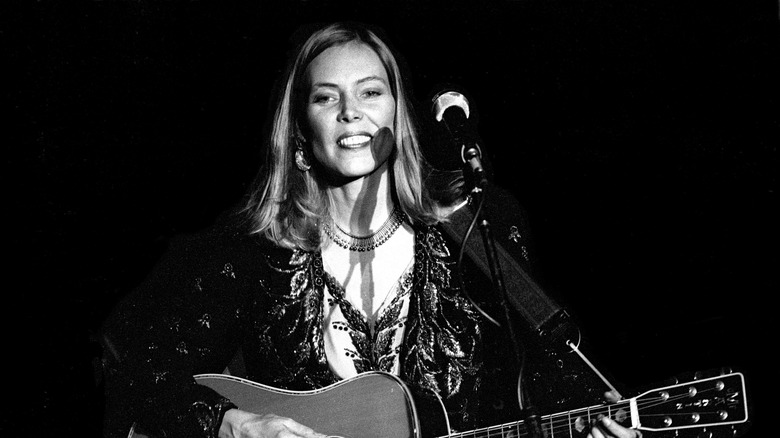
2. Joni Mitchell
Joni Mitchell is one of folk rock's best-loved figures, whose crystal-clear vocals and intricate guitar work underpin an incredible talent for impactful songwriting. Emerging from the North American folk circuit in the late 1960s, Mitchell's early repertoire included adaptations of narratives such as O. Henry's 1905 story "The Gift of the Magi," and though she arguably grew more abstract and impressionistic in her songwriting as she matured, songs that contain an identifiable story exist throughout her discography.
The 1975 album "The Hissing of Summer Lawns" sees Mitchell branching out in numerous new sonic directions, but her storytelling continues. In the song "Edith and the Kingpin," she spins the tense tale of a woman who finds herself attracting the dangerous romantic attention of a local gang leader. The following year, on the acclaimed "Hejira," Mitchell sings "Coyote," a metaphorical encounter with a nomadic trickster and womanizer who it is said represents the playwright Sam Shepard, who she was in a relationship with at the time. Meanwhile, "Song for Sharon" is a deeply personal piece written in the form of a letter to Mitchell's childhood friend, telling the story of Mitchell's activities after arriving in New York City after a break-up.
Later in her career, she continues to draw on sources from her own life for inspiration. On 1988's "Chalk Mark in a Rain Storm," which embraces the pop aesthetics of the era, "The Tea Leaf Prophecy (Lay Down Your Arms)" offers a fictionalized account of her parents' experiences meeting each other during World War II, which the song tells us was foretold by a fortune teller. Like Mitchell's best songs, it's infused with a sense of magic.
1. Bob Dylan
Is there any surprise that Bob Dylan tops our list of the greatest folk rock storytellers ever? Arguably the most widely acclaimed popular musician alongside the Beatles, Dylan's long career began in the early 1960s as a folk performer, accompanied only by his acoustic guitar and harmonica. Inspired by folk veteran Woody Guthrie, Dylan's songs could offer sprawling social commentary, such as on "The Times They Are A-Changin'," or specific critiques of topical injustices, such as on "John Brown," which tells the story of a disfigured war veteran, and "The Ballad of Hollis Brown," a horrifying portrayal of a family's poverty. When Dylan famously "went electric," he jumped with both feet into the work of folk rock.
Many of Dylan's songs are cinematic in scope. On 1975's "Blood on the Tracks," Dylan delivers "Lily, Rosemary and the Jack of Hearts," a sprawling Western that tells the tale of a love triangle, a bank heist, murder, and hanging. On the following year's "Desire," "Isis" sees Dylan enter a symbolist mode to tell the story of a newly married man who leaves his wife to seek his fortune, passing through the Old West before entering a strange icy landscape to raid a mysterious pyramid. However, the most famous narrative song from the album is undoubtedly "Hurricane," which drew attention to the real-life story of the wrongfully incarcerated boxer Rubin Carter.
Dylan has remained ambitious in his songwriting well into the 21st century, even after winning the Nobel Prize in Literature in 2016. The haunting "Murder Most Foul," from his 2020 album "Rough and Rowdy Ways," uses the assassination of President John F. Kennedy to frame a history of the United States for the rest of the century. After more than six decades as a storyteller, Dylan is still capable of delivering surprises.