

The 5 Best Vocal Harmonies In Bubblegum Pop History
Oftentimes, it seems like there are two types of music fans: those who gravitate toward a song's instrumentation, and those who hone in on the lyrics. Vocal harmonies, however, can be enjoyed by both groups, since the words can satisfy the lyric lover and the melody the music enthusiast. It can also be said that vocal harmonies are what caused a lot of '60s bubblegum pop songs to be massive hits, and so, we've picked some of the best harmonies in the subgenre's history.
Some made our list simply because they're the best part of the song, and they're the reason those cuts are still classics today. Others were selected for the sheer execution of the harmonies — although there are just a handful of singers, it sounds like a room full of them, with each individual part adding color to one big, beautiful picture. From the Archies to Ohio Express, these songs perfectly show just how much a well-sung vocal harmony can lift a song and take it from good to extraordinary.
Jingle Jangle — The Archies
Some bubblegum pop songs have a slow buildup before the rich, gorgeous vocal harmonies are introduced, but not the Archies' "Jingle Jangle," which pulls the listener into warm, multi-layered vocals from the start. Released as a single off the fictional band's album of the same name, the song begins with a single vocal melody by Toni Wine, with Ron Dante coming in later to handle the verse melody in falsetto, which he sings softly over a rhythm guitar.
Some might believe that Wine took care of all the song's high parts, but Dante just used a higher register. No portion of the cut was wasted either, as the singers filled every section with harmonies, so listeners are able to immerse themselves in one wave of catchiness before being washed over by another. Then, toward the end of the 1969 single, Dante and Wine give a vocal-harmony finale of sorts, bouncing notes and lyrics off each other until the final chorus hits.
We Can Fly — The Cowsills
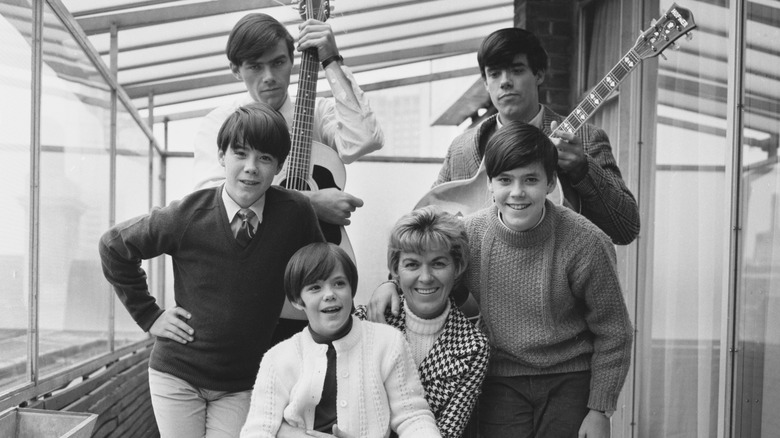
The original members of the Cowsills, brothers Bill, John, Barry, and Bob Cowsill, wanted to be the next Beatles when they started, and although they don't have a song like "Because" under their belt, in which the Fab Four harmonize beautifully, they achieved their own exquisite harmonies in their 1968 song "We Can Fly." Their mother Barbara, sister Susan, and brother Paul joined the band by the time it was recorded, and they filled out those harmonies wonderfully, adding even more sweetener to an already sugary sound.
The song begins with a punchy horn riff before the band takes listeners to the sky with vivid lyrical imagery, all enhanced by their combined voices. "See how the fluffy clouds move by us / See how the morning mist can hide us away / And how the day is so much fun / Isn't it groovy in a daydream / Doesn't the day seem like it could never end / And so, my friend, we're one," sings the band, as they stretch out the last word and turn it into a soothing, multi-layered harmony.
Tracy — The Cuff Links
Whenever a thick, comforting vocal harmony comes piercing through the speakers, it's easy to picture several people standing in a vocal booth and singing in unison. However, some of the best harmonies are made by just one person, and that's the case with "Tracy" by The Cuff Links, which is sung entirely by Ron Dante. The stacked vocals are heard at the very beginning, but they're layered in a way that pulls the melody in different directions, so listeners have a choice of which one they'll follow and enjoy.
That same method is also used in the verses, where Dante sings about a woman named Tracy and the intense feelings she evokes. "Tracy, when I'm with you / Something you do / Bounces me off the ceiling / Tracy, day after day / When you're this way / I get a loving feeling," sings Dante with the same delicate delivery that he used to make the Archies' "Sugar, Sugar" the No. 1 bubblegum pop hit in 1969.
Dante talked about the recording process in an interview with Goldmine, describing how much layering was done, yet how it barely took any time at all. "With overdubs, I recorded a dozen voices on it to make it sound like The Association and The Turtles," Dante explained. "I did all the voices in about two hours, with different parts, drawing on the doo-wop music I grew up with."
Up, Up and Away — The 5th Dimension
Whenever the day has been difficult and feels like it's gotten the best of you, the 5th Dimension's "Up, Up and Away" from 1967 may be all you need to lighten your mood, thanks to richly textured harmonies made of one part bubblegum pop, one part sunshine pop, and a little bit of choral music thrown in for good measure. Then once you mix all of that together, out comes a song with a picture-perfect vocal arrangement that sounds like it's being sung by 20 people instead of five.
"Would you like to ride in my beautiful balloon? / We could float among the stars together, you and I / For we can fly, we can fly / Up, up and away / My beautiful, my beautiful balloon," sings the group while raising their octave to mimic someone in flight. At the song's midpoint, the harmonies really shine bright, as most of the instruments fade and the women in the group take center stage. The men sing a line by themselves after that, before everyone's voices blend again and slowly dissipate — as if the group and their beautiful harmonies have floated away.
Yummy Yummy Yummy — Ohio Express
Some of the most beautiful-sounding harmonies grab hold of you at the start of a song and don't let you go until the end. However, the harmonies in 1968's "Yummy Yummy Yummy" by Ohio Express are used sporadically, giving the listener a quick taste of gorgeous melody, before pulling back and offering more sweet-sounding notes later on.
The first batch of layered vocals is heard in the song's opening verse and is repeated in short, occasional bursts thereafter. They're also sung solely by Joey Levine, making "Yummy Yummy Yummy" one of the bubblegum pop hits that weren't recorded by the actual band. It's our belief that the quick in-and-out harmonies make it easier to appreciate the various tones being used, since they're given in small doses that make you want more as soon as they disappear.
But despite how impeccable the harmonies are, Levine didn't give them much praise when talking to Record Collector in 2013, explaining that he merely laid down a scratch vocal for a demo so Ohio Express could learn the lyrics. "The background's flat and everything," said Levine. "[Buddah Records executive] Neil Bogart heard it and said, 'You can't take that guy off of it. He makes the record.'" The song peaked at No. 4 on Billboard's Hot 100, remaining in that spot for three weeks, and there's no doubt that the quick, isolated harmonies helped to lift it to that position.