

Bubblegum Pop Hits That Weren't Recorded By The Bands You Thought
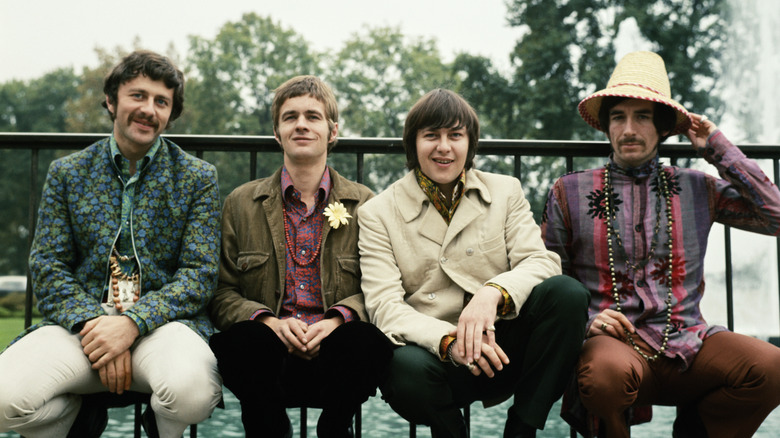
In the late 1960s and early 1970s, the music industry concocted a way to take the edge off of rock 'n' roll and market it to a younger audience. Taking on the nickname bubblegum pop — because it was so sweet, airy, disposable, and attractive to young people — such music lacked the musical and lyrical darkness of mainstream rock of the era, preferring fast rhythms, bouncy melodies, and songs about crushes and having fun. Bubblegum pop was irresistible, sold a lot of records for a little under a decade, and was often completely manufactured. Many classic bubblegum standards weren't recorded by the so-called bands listed or pictured on the sleeve of the 45, but rather seasoned session musicians.
This has long been something of an open secret, a taste of the dark side of the 1960s music industry and the messed-up music industry of the 1970s. The sound of bubblegum is a direct outgrowth of the smash hit music generated by the likes of the made-for-TV Monkees. Here's a long chew on some of bubblegum's greatest hits, and popping the bubble by revealing who really performed them.
Love Grows (Where My Rosemary Goes) – Edison Lighthouse
The British bubblegum pop industry revolved around a handful of regular characters, chief among them singer Tony Burrows. In 1970, four studio creations presented as if they were organic rock bands, all hit singles where the lead vocals were performed by Burrows, who sounded a bit different on each one. That's him on White Plains' "My Baby Loves Lovin'," the Brotherhood of Man's "United We Stand," the Pipkins' "Gimme Dat Ding," and the bounciest and most quintessential bubblegum confection of them all, Edison Lighthouse's No. 5 smash "Love Grows (Where My Rosemary Goes)."
The piece was co-written and produced by bubblegum stalwart Tony Macaulay. He liked to work with Burrows, and during a marathon recording session one day, he realized he didn't have anyone to provide vocals for the session musician-powered "Love Grows (Where My Rosemary Goes)," an exuberant love song notable for its frenetic string section and delicious bass groove. In addition to providing background vocals, the job for which he'd been hired, Burrows sang the main part, too. To boost the song, Bell Records sent a band out on the road as "Edison Lighthouse" and made a promotional music video where an actor mimed singing to Burrows' vocals so that when he was on stage, the image and music would match.
Yummy, Yummy, Yummy – Ohio Express
After bubblegum producing team Jerry Kasenetz and Jeff Katz scored a hit in 1967 with "Little Bit O' Soul" with their act the Music Explosion, they looked around the actual rock band's home of Ohio for more acts to sign and market. They settled on high school garage rockers Sir Timothy and the Royals. By the time they had contracted with Super K Productions, there was a single ready to go: "Beg, Borrow and Steal," already recorded by the Rare Breed but attributed to the Ohio Express, the new name bestowed upon the teenagers. That track made the Top 40, and Kasenetz and Katz devoted much energy to furthering the Ohio Express as an entity rather than as a band.
The next Ohio Express single was "Try It," recorded entirely by session musicians with the exception of the group's Dale Powers singing the main vocal part. The Ohio Express's next major release didn't include the band whatsoever. Super K songwriter Joey Levine brought in the catchy and jaunty "Yummy, Yummy, Yummy" after it was rejected for the group Jay & the Techniques. The favored team of studio musicians laid down a demo with Levine singing lead. And that's the version that got massive, peaking at No. 4 on the Hot 100 in 1968.
I Think I Love You – The Partridge Family
One of the best and biggest No. 1 hits of 1970 was a delirious tune that runs through the several stages of grief as applied to the process of falling in love. That's "I Think I Love You," in which teen idol singer David Cassidy tries to make sense of the wild gamut of emotions associated with a crush becoming something more, made all the more buoyant and emotionally resonant with the use of lots of percussion and lovely instrumental breaks. "I Think I Love You" was the first and biggest single ever for the Partridge Family. It hit the charts right after the sitcom "The Partridge Family" hit network television in the fall of 1970. The show depicted the mild adventures of a pop-rock group that just happened to be a family. Cassidy starred as singer and guitarist Keith Partridge.
"I Think I Love You" bore the name of the Partridge Family, but apart from the passionate vocal contributions of Cassidy and backing vocals from Shirley Jones, none of the other cast members from "The Partridge Family" — including Susan Dey and Danny Bonaduce — participated in the recording session. The bubblegum classic was knocked out quickly by professionals, many of whom were members of the prolific and often-relied-upon members of the "Wrecking Crew" of Los Angeles session musicians. Hal Blaine played drums, Larry Knechtel played keyboard, Joe Osborn took the bass, and Louis Shelton provided guitar.
Tracy – The Cuff Links
Ron Dante sang a No. 1 single so huge that Billboard named it the biggest song of 1969. That ought to have made him famous, but the nature of the work required relative anonymity. At least portraying the singing voice of cartoon character Archie Andrews, lead of the Archies, on "Sugar, Sugar" led to more work in bubblegum pop. Even before "Sugar, Sugar" became one of the biggest hits in the country, Dante had headed into a recording studio to be the centerpiece of another project.
Songwriters Paul Vance and Lee Pockriss, who had previously employed Dante on the 1965 novelty hit "Leader of the Laundromat," used studio trickery to make Dante sound like a band full of singers. "With overdubs, I recorded a dozen voices on it to make it sound like the Association and the Turtles," he told Goldmine. "I did all the voices in about two hours." With the rest of the track provided by day-player instrumentalists, "Tracy" was finished. A bright and shiny love song about one young guy's electric affection for his girlfriend, Decca Records released it under the name of a non-existent band called the Cuff Links.
Beach Baby – The First Class
In 1973, prolific U.K. songwriter John Carter, who in the 1960s wrote songs recorded by hitmakers like Brenda Lee and Herman's Hermits, teamed up with Gill Shakespeare to write a song that sounded like it came from Southern California, circa a decade earlier. "Beach Baby," with its harmonies, chugging guitar and drums, and nostalgic lyrics about innocent and idealized teenage love, perfectly recreated the formula used by the Beach Boys in the early '60s.
Rather than shop it around to any pre-existing band, Carter and Shakespeare independently recorded it, hiring musicians including British singer Tony Burrows — the same vocalist behind Edison Lighthouse's "Love Grows (Where My Rosemary Goes)." Burrows handled the lead vocal — in his best, affected American accent.
After those tracks were applied to the instrumental, UK Records agreed to release it. In 1974, "Beach Baby" was issued as a single, attributed to The First Class, a band that existed in name only. In the U.K., "Beach Baby" was a Top 20 hit. In the place whose music inspired the song, the U.S., it was a smash, peaking at No. 4 on the Hot 100. When the First Class toured to support the single and an album put together by Carter, a whole different group of musicians took the stage, including Del John in for Tony Burrows, who lip-synced to the original track.